Pomegra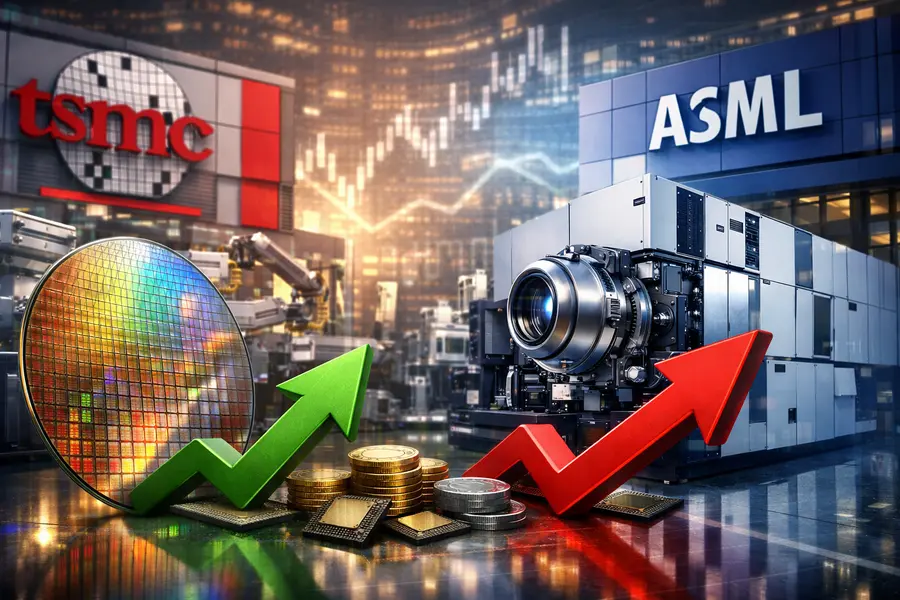
TSMC stock and ASML cement their status as the AI era's two indispensable semiconductor suppliers, reporting synchronized record earnings in Q2 2026.
- TSMC Q2 2026 revenue rose 36% to $40.2B, net income surged 77.4%, as AI accelerators climbed to 66% of wafer revenue.
- ASML raised full-year 2026 guidance to €43–45B for the second time this year, driven by record EUV lithography demand.
- Both companies hold structural monopolies with no near-term rival — TSMC in advanced-node fabrication, ASML in EUV tooling.
Lead
The two companies that make modern artificial intelligence hardware physically possible reported record earnings within 24 hours of each other in mid-July 2026, confirming that the AI infrastructure buildout remains the most powerful demand cycle in the semiconductor industry's history. Taiwan Semiconductor Manufacturing Company (NYSE: TSM) posted Q2 revenue of $40.2 billion — up 36% year-over-year — while ASML Holding (NASDAQ: ASML) reported €9.3 billion in Q2 net sales and raised its full-year guidance to €43–45 billion, the second upward revision this year. Both results reflect one structural reality: every advanced AI chip that ships runs through these two companies.
The Picks-and-Shovels Logic
The "picks and shovels" framework holds that the most durable returns in a technology boom accrue not to end-product makers but to the indispensable suppliers who equip them. In the AI era, that logic points squarely at the semiconductor infrastructure layer. Chipmakers such as Nvidia, AMD, and Apple design the accelerators, but the physical act of manufacturing them depends on two chokepoints: TSMC's advanced fabrication nodes and ASML's extreme ultraviolet (EUV) lithography machines. Neither has a commercially viable substitute.
TSMC: Foundry at the Center of Everything
TSMC's Q2 2026 results demonstrated the pace at which AI has reshaped its business. Net income for the quarter reached NT$706.56 billion, a 77.4% increase from the prior year and a record high. Gross margin expanded to 67.6%. High-Performance Computing — the revenue segment driven by AI accelerators for cloud data centers — grew 20% sequentially in a single quarter and now accounts for 66% of total wafer revenue, a dramatic shift from 2022, when smartphones held the largest share. June 2026 monthly revenues surged 68% year-over-year, the fastest monthly pace since the AI buildout began accelerating.
Management raised full-year 2026 TSMC stock revenue growth guidance to slightly above 40%, up from an earlier projection of more than 30%, and lifted capital expenditure guidance to between $60 billion and $64 billion. An additional $100 billion commitment to chip factories in Arizona signals that TSMC regards the AI demand cycle as durable, not cyclical.
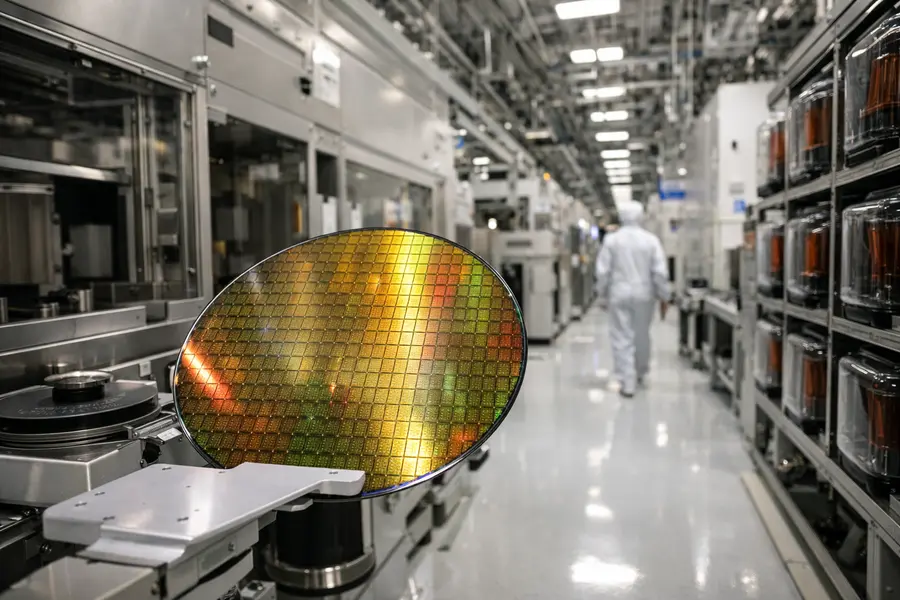
In advanced-process nodes at 7 nanometers and below, TSMC commands more than 90% of worldwide capacity. That concentration gives the company unmatched pricing power and a first-call relationship with every hyperscaler and AI chip designer on the planet.
ASML: The Toolmaker with No Substitute
ASML occupies an even narrower monopoly position. It is the world's only producer of EUV lithography systems — the machines that etch circuit patterns onto silicon at the atomic scale required for leading-edge chips. Every Nvidia Blackwell GPU, every AMD Instinct accelerator, and every Apple M-series chip requires EUV for its most critical manufacturing layers.Q2 2026 revenue of €9.3 billion included €3.8 billion from EUV system sales alone. Net income reached €2.9 billion. To meet surging demand, ASML is planning to expand low-NA EUV capacity by 30% in 2027 and is evaluating a further 30% increase for 2028. Intel's shipment of the first High-NA EUV logic chip in mid-2026 opened a new product cycle that extends ASML's technology lead further into the decade.
Full-year 2026 net sales guidance of €43–45 billion, with gross margins of 54–56%, reflects the strength of a multi-year order book that chipmakers — TSMC foremost among them — are filling well into 2027. In Q1 2026, ASML had already reported €8.8 billion in revenue with a 53.0% gross margin.
Market Reaction
TSMC stock (TSM) has risen approximately 52% in 2026 year-to-date, trading near $434 in mid-July after pulling back from a 52-week high of $474.71. Analyst price targets range from $494 to $600, with Susquehanna maintaining a Positive rating and a $600 target. ASML's Nasdaq-listed ADR surged as much as 87% in the first half of 2026, reaching an all-time closing high of €1,989.44 on June 30 before retracing to €1,555.80 by July 17. Following Q2 results, JPMorgan raised its price target to $2,400, Wells Fargo to €2,500, and Deutsche Bank to €2,150.TSMC currently trades at a lower valuation multiple relative to its growth rate, while ASML commands a premium consistent with its uncontested monopoly position. Both attract institutional capital as core positions in any AI infrastructure thesis.
Geopolitical Dimension
The same concentration that defines each company's competitive strength creates structural geopolitical risk. TSMC's dominance in advanced fabrication is geographically anchored to Taiwan, where the overwhelming majority of its capacity remains. Bloomberg Economics estimates that a Taiwan conflict would cost the global economy approximately $10 trillion — roughly 10% of world GDP, exceeding the economic damage of the COVID-19 pandemic.
ASML operates under Dutch and U.S. export-control regimes that restrict sales of its most advanced EUV systems to China; the company still expects China to represent approximately 20% of 2026 revenue, primarily from legacy tools. Taiwan is separately weighing tighter export controls on leading-edge AI chips destined for Chinese customers. Neither company can fully decouple from these geopolitical constraints in the near term, and both have incorporated them into long-range supply-chain planning.Outlook
TSMC and ASML enter the second half of 2026 with upgraded guidance, record margins, and order books visible into 2027. The AI infrastructure spending cycle shows no deceleration, and the semiconductor chokepoints both companies occupy position them to capture a disproportionate share of the capital flowing into that cycle. Geopolitical risk remains material and unresolved, but both companies have initiated operational resilience programs — TSMC through its Arizona expansion, ASML through multi-year capacity increases — that may reduce, without eliminating, the structural tail risk over a multi-year horizon.