Pomegra
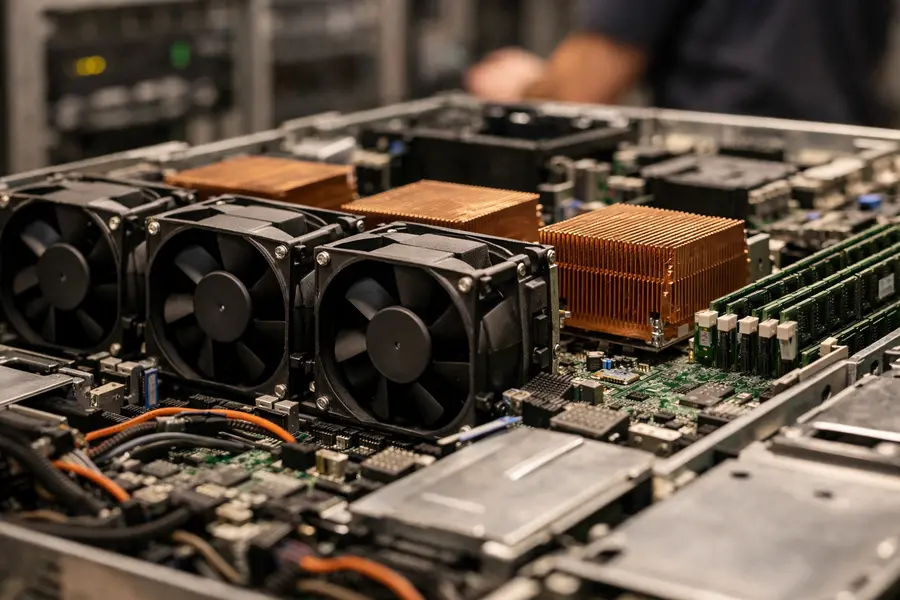
Dell (DELL) fell 11% after a Barclays downgrade argued server growth reflects memory costs, not enterprise AI demand, dragging HPE and Super Micro lower.
- Dell shares fell 11% on Wednesday, October 14, after Barclays cut the stock to Equal Weight from Overweight.
- Barclays says higher memory prices, not an enterprise AI surge, explain much of the recent server revenue growth.
- HPE, NetApp, Super Micro and Oracle also fell, and the selling continued into October 16.
Lead
Dell Technologies (DELL) shares dropped 11% on Wednesday, October 14, after Barclays (BCS) downgraded the stock. The move led a broad sell-off in server and data-center hardware names. The bank argued that recent growth in server revenue reflects higher memory costs passed on to customers rather than a surge in enterprise adoption of artificial intelligence. The downgrade ended a rally of roughly 187% over six months and nearly 300% since the start of the year, and it pulled the stock back from a 52-week high near $596.Among ai stocks, hardware makers had been the clearest beneficiaries of the data-center build-out. The downgrade tested the idea that their revenue growth is purely demand-driven.
What Did Barclays Say About Dell?
Barclays said the strong enterprise revenue at Dell is more a function of memory costs than of a real move into enterprise AI. The bank cut Dell to Equal Weight and moved Hewlett Packard Enterprise (HPE) and NetApp (NTAP) to hold-equivalent ratings.
The reasoning rests on spending data. Businesses put only about 5% of their IT budgets into AI, and only about a quarter of enterprise AI spending goes to hardware. Barclays has not seen a meaningful AI inflection in enterprise spending. It still expects about $75 billion in AI server revenue at Dell this fiscal year, but forecasts slower growth over the next two years as memory prices normalize.
Why Do Memory Prices Matter for Server Revenue?
Memory prices matter because DRAM and other components make up a large share of a server's bill of materials. A global memory shortage has pushed those prices sharply higher. Server makers have passed the increases on to customers, which lifts revenue per system without any rise in units shipped.
If the shortage eases and prices fall, that revenue support fades. Memory producers reacted accordingly. Micron (MU) fell about 11% over the week, and SK Hynix lost roughly 13%.
How Did the Rest of the Sector React?
Server and data-center stocks fell together. Oracle (ORCL) dropped about 9%, and Super Micro and HPE also declined. On Friday, October 16, the pressure continued as investors questioned who pays for the data-center build-out:
- HPE fell 5% to $55.87.
- Super Micro Computer (SMCI) fell 7% to $32.78.
- Dell fell a further 3% to $458.78.
Broader technology held up better. The iShares U.S. Technology ETF (IYW) lost 2% that day, and the Invesco QQQ Trust (QQQ) lost 1.3%. The pattern points to losses concentrated in AI hardware rather than a wider technology retreat.
Is the Dell Order Book Still Strong?
Dell's reported figures remain strong, which is why the debate centers on quality of growth rather than a collapse in demand. In its latest quarter the company reported revenue of $47 billion, up 58%. It raised full-year revenue guidance to $192 billion. Record AI orders reached $60.9 billion, and the AI backlog stands at $95 billion.
The Barclays view does not dispute those totals. It questions how much of the increase is price and how much is volume, and whether enterprise customers, as distinct from hyperscalers and large AI labs, are buying AI infrastructure at scale. Enterprise buyers often rent capacity from cloud providers instead of purchasing on-premises systems, which limits the addressable market for server vendors.
Strategic Context
The sell-off reflects valuation as much as fundamentals. Dell had gained nearly 300% this year, HPE about 160%, and NetApp had doubled. After gains of that size, the bank's argument about timing was enough to trigger heavy selling. The downgrade also coincided with wider concern about financing for trillion-dollar data-center projects, which compounded pressure on suppliers dependent on that spending.
Outlook
Near-term direction for AI hardware depends on two variables: the trajectory of memory prices and evidence of enterprise AI purchasing. Falling memory costs would lower server revenue per unit, while confirmed enterprise orders would support volume. Upcoming quarterly results from Dell, HPE and NetApp will show how much of their growth comes from price and how much from shipments. Until then, the sector is likely to trade on that distinction rather than on headline backlog figures.
Mentioned tickers: DELL, BCS, HPE, NTAP, SMCI, ORCL, MU, QQQ, IYW