Pomegra
Nvidia shares rose about 1.4% after Jensen Huang said AI chip orders still exceed supply, even as the stock trades at its cheapest valuation in seven years.
- Nvidia (NVDA) gained about 1.4% after CEO Jensen Huang said customer AI chip orders still exceed supply.
- Huang said new orders arrive almost daily while the backlog of undelivered orders keeps growing.
- The stock trades near 18 times forward earnings, its lowest multiple in about seven years.
Lead
Nvidia shares rose about 1.4% after chief executive Jensen Huang said demand for the company's AI accelerators continues to outstrip what it can ship. The move extended a recovery for one of the most closely watched ai stocks on the market. It came as commentators pointed out that the chipmaker's valuation has compressed to its lowest level in roughly seven years. The company is valued at about $5.5 trillion.What Did Jensen Huang Say About Chip Orders?
Huang said Nvidia is receiving new AI chip orders almost every day, and the volume of undelivered orders keeps rising even as the company expands output. He made the remarks in a recent podcast interview. They repeat a message from the company's last earnings call, where he said demand was running well above the roughly 70% revenue growth embedded in management's forward outlook.
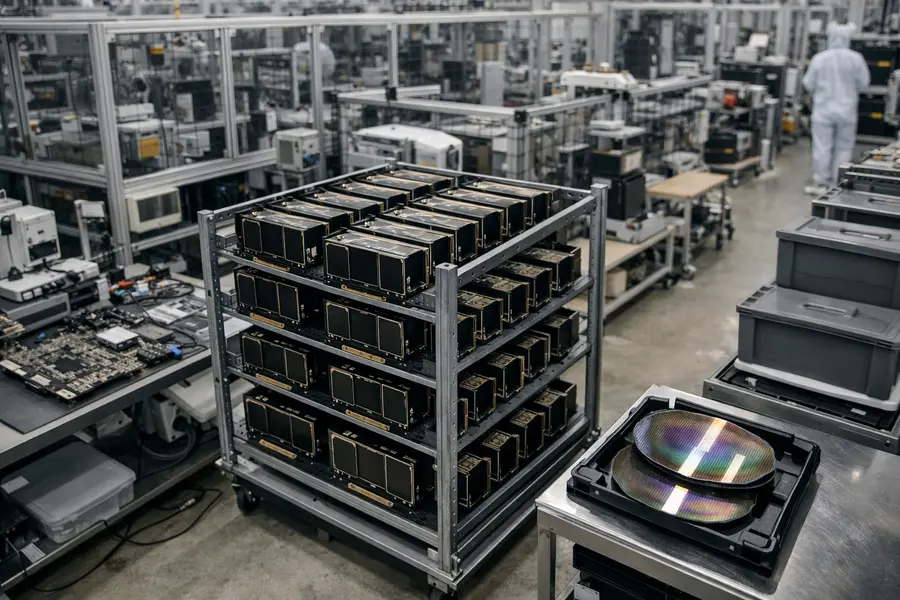
The constraint, in his account, is supply rather than appetite. Large cloud providers and AI developers are asking for more systems than Nvidia can deliver. Power availability, data-center buildout and advanced packaging capacity limit how quickly new hardware reaches customers.
Why Is Nvidia Trading at Its Cheapest Valuation in Seven Years?
Nvidia trades at its cheapest valuation in about seven years because earnings estimates have risen faster than the share price. The stock is priced at roughly 18 times forward earnings. That is a low multiple for a company guiding to growth near 70%, and well below the levels reached during earlier phases of the AI rally.
The compression reflects a divide in sentiment. Forecasts for revenue and profit keep moving up, supported by hyperscaler capital spending plans. Investors have also taken a more cautious view of how long that spending can last, how much of it depends on credit markets, and whether grid capacity can support new data centers. The share price has traded in a range of roughly $216 to $226 in recent sessions.
Management has acted on the gap. Nvidia announced a record share repurchase program in late September, a step widely read as a statement that the board sees the stock as undervalued.
Market Reaction
The 1.4% gain came in a session where sentiment toward large technology names was uneven. Nvidia outperformed as Huang's comments reinforced the case that near-term revenue is limited by production rather than demand. A backlog that grows faster than shipments gives the company visibility into coming quarters and some pricing power on its newest platforms.
Strategic Context
For corporate buyers, the supply shortfall shapes capital planning. Cloud providers and AI developers are reserving capacity far in advance, and delays in delivery push back model training and inference rollouts. That dynamic also favors suppliers across the chain, from memory makers to foundry and packaging firms, whose capacity determines how quickly Nvidia can raise output.
The risks are structural. Power constraints, financing conditions for data-center projects and customer concentration could slow conversion of orders into revenue. Competing custom chips from large customers are another long-term factor, though Huang has said the order flow shows no sign of easing.
Outlook
The next test is Nvidia's quarterly report, when investors will see whether shipments are catching up with the backlog and whether guidance supports the 70% growth path. If supply expands as planned, the gap between rising estimates and a seven-year-low valuation could narrow. If power or financing bottlenecks persist, the order book may keep growing faster than revenue.