Pomegra
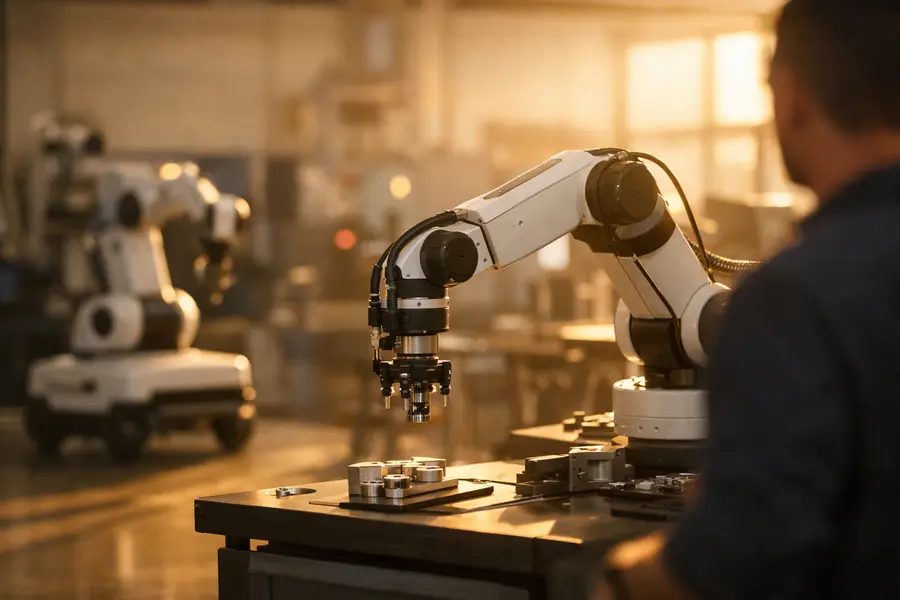
Dream Labs, founded by ex-NVIDIA researchers, raised a $90M seed led by B Capital to build Dream-1, a model that transfers skills across different robots.
Key Takeaways
- Dream Labs announced a $90M seed round on October 19, 2026, led by B Capital; valuation was not disclosed.
- Its Dream-1 model runs on grippers from different makers and is sold through an API from $3 per hour.
- The company says the money will mostly buy compute to widen the tasks and robots Dream-1 supports.
Lead
Dream Labs, a San Francisco robotics AI startup founded by former NVIDIA researchers, emerged from stealth on October 19, 2026 with a $90 million seed round. B Capital led the financing. Kindred Ventures, a.capital, Unusual Ventures, SV Angel, Wing VC, Scribble VC and investor Adrian Aoun also took part. The company did not disclose a valuation.
CEO and co-founder Joel Jang previously worked as a senior research scientist at NVIDIA's GEAR Lab, where he led the world-model team for the company's Project GR00T humanoid effort. Dream Labs launched alongside its first product, Dream-1, and a public Dream API.
What Does Dream-1 Actually Do?
Dream-1 is a robot foundation model that turns camera feeds and plain-English instructions into motor commands. It is described as a 14-billion-parameter "world action model," meaning it predicts video and robot actions jointly. It takes three camera views, one of the scene and one from each wrist, and outputs end-effector poses: position, orientation and gripper state.
The model learns from video of people doing everyday tasks rather than from large fleets of teleoperated robots. Dream Labs says it works zero-shot on robots with grippers, so a machine can run it without task-specific training. Each call returns 1.6 seconds of actions.
Current capability is narrow. Dream-1 handles tabletop work such as picking, placing and folding laundry on bimanual robots with parallel grippers. Wheeled platforms and dexterous hands are on the roadmap.
How Is Dream Labs Selling It?
The company sells access by usage. Dream-1 costs $3 per hour of inference through the API, and a browser-based Robot Playground lets developers test it on physical robots in the San Francisco office. A fine-tuning service lets customers adapt the model with their own demonstrations.
Jang said the model can get a new robot doing useful work in minutes, versus months with conventional methods. That figure comes from the company, and the product description itself notes that some cases need substantially more data. The target hardware is cheap: robots in the $2,000 to $10,000 range, with more than 20 hardware partners cited.
B Capital general partner Daisy Cai framed the opening this way: "A capable robot arm has gone from the price of a luxury car to the price of a high-end laptop." The bet is that if hardware costs keep falling, software that works across machines captures the value.
Why Is a $90M Seed Round Possible Here?
The round reflects how robotics foundation models are being funded in 2026: large checks go to teams with pedigree before there is meaningful revenue. A $90 million seed is far above the typical early-stage cheque, though not unprecedented in the category. Genesis AI raised a $105 million seed, and Physical Intelligence has raised a $600 million Series B.
Further up the curve, Skild AI has raised about $1.4 billion at a valuation above $14 billion, and Figure AI has raised more than $1 billion in a Series C at a $39 billion valuation. Against those numbers, Dream Labs sits at the start of the capital ladder, and its undisclosed valuation leaves investors' entry price unclear.
The skeptical reading is straightforward. Cross-embodiment transfer is the hardest unsolved piece of the robotics software stack, and a model that performs well on tabletop grippers has not yet shown it can handle mobile bases or dexterous hands. Spending the proceeds primarily on compute also means the round buys training capacity, not a proven business.
What Separates Dream Labs From Rivals?
Dream Labs competes on openness and price rather than on a single flagship robot. Figure builds its own humanoids, while Physical Intelligence and Skild AI pursue broad robot brains for enterprise and hardware partners. Dream Labs instead offers an hourly-priced API aimed at developers using low-cost arms, with video of human activity as its main training signal.
That positioning has a commercial logic. Developers building on $2,000 to $10,000 machines cannot absorb six-figure integration contracts, and hourly pricing lowers the barrier to trying the model. It also exposes the company to a familiar risk: if larger labs release comparable models at similar prices, a seed-stage firm with 20-plus partners but no named flagship deployment will have a thin moat.
What Comes Next?
The near-term milestones are listed in the company's own roadmap. Dream Labs plans to extend Dream-1 to wheeled mobile robots and dexterous hands, the latter expected to land in the $5,000 to $10,000 price band by 2027. Those expansions will test whether a single model can carry skills across morphologies that look nothing alike.
Adoption will be the measure investors watch. Hourly API revenue, retention among the 20-plus hardware partners and the amount of fine-tuning data customers need per new robot will show whether the "minutes, not months" claim holds outside the demo environment.
Outlook
Dream Labs enters a crowded field with $90 million, a credible founding team out of NVIDIA's GR00T work and a pricing model built for cheap hardware. The product is narrow today, the valuation is undisclosed, and the main use of funds is compute. Whether Dream-1 generalizes beyond tabletop grippers will decide if the round looks prescient or early.