Pomegra
Alphabet shares fell 12.6% on Oct. 29, their worst day on record, after a search revenue miss, negative free cash flow and $51.4B in quarterly capex.
- GOOGL fell 12.6% on Oct. 29, erasing about $482B in market value, the steepest one-day drop since its 2004 debut.
- Search revenue rose 12% to $63.4B, below the $64.96B expected and down from 17% growth in the prior quarter.
- Free cash flow was negative $9.1B for a second straight quarter as capex reached a record $51.4B.
Lead
Alphabet (NASDAQ: GOOGL, GOOG) suffered the worst trading day since its 2004 public debut on Thursday, Oct. 29, as shares fell 12.6% and about $482B in market value disappeared. The sell-off followed third-quarter results released after the close on Oct. 28, which missed on revenue, operating income and cash generation. The session turned one of the market's largest ai stocks into a test case for how far investors will fund artificial intelligence infrastructure before demanding returns.What Happened in Alphabet's Third Quarter?
Alphabet missed consensus on its headline measures despite 25% revenue growth to $127.6B. Analysts had expected $128.2B. Adjusted earnings per share came in at $2.67 against $3.02 expected, and diluted EPS of $2.12 was down 26% from a year earlier. Net income fell 25% to $26.2B from $35.0B, and operating income of $40.6B missed the $43.2B forecast.
Google Cloud was the exception. Revenue rose 103% to $30.7B, well above the $28.7B expected, driven by enterprise AI infrastructure and AI solutions. That strength was not enough to offset weakness in the core advertising franchise and the cost of building capacity.
Why Did Search Revenue Alarm Investors?
Search revenue disappointed because it slowed while the cost of defending it rose. Google Search and other revenue grew 12% to $63.4B, below the $64.96B forecast and a clear deceleration from 17% growth in the second quarter. Management said query growth was the highest in five years, but that volume has not translated into the revenue growth the market priced in.
The concern is structural. AI chatbots and agents may change how users find information and how advertisers reach them, and Google is both the incumbent exposed to that shift and a leading builder of the competing technology. A search slowdown in a quarter of heavy AI spending reinforced the view that the cash engine funding the buildout is losing momentum.
How Large Is the Cash Flow Problem?
Free cash flow was negative $9.1B in the third quarter, against consensus for positive $2.7B. It was the second consecutive negative quarter. Alphabet had not reported a single quarter of negative free cash flow since going public in 2004 until this year. Trailing 12-month free cash flow stands at $19.7B.
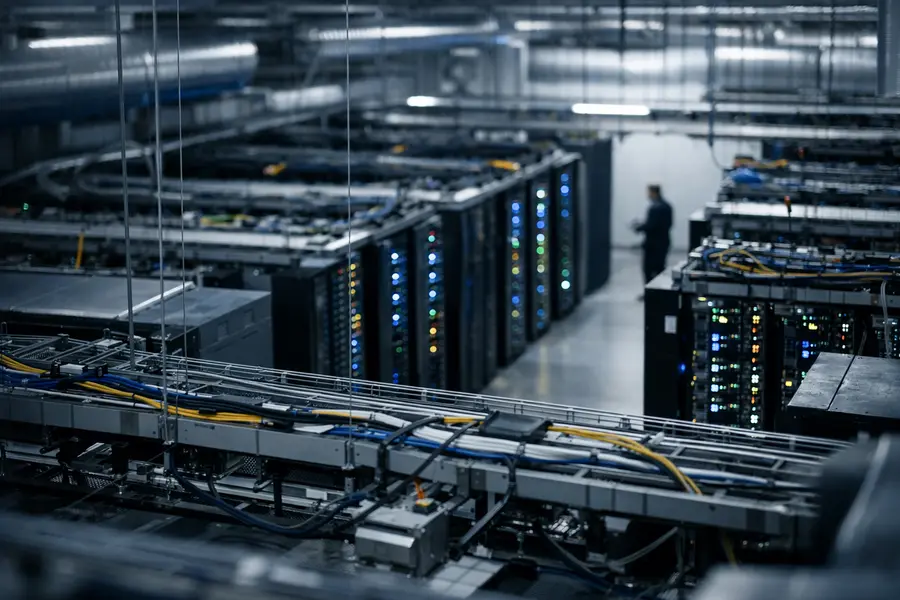
The cause is capital expenditure. Capex reached a record $51.4B, more than double the $24B spent in the year-earlier quarter, with most of it directed to technical infrastructure for AI: data centers, servers and networking. Full-year 2026 capex guidance was maintained at $195B to $205B. The chief financial officer said spending is expected to increase significantly in 2027, with details due on the fourth-quarter call.
Market Reaction
Shares fell more than 10% in after-hours trading on Oct. 28 and extended the decline through the regular session on Oct. 29. The drop was the largest single-day loss in Alphabet's history as a public company, and the market value lost exceeded the total capitalization of most S&P 500 constituents.
The weakness spread to the broader market by the end of the week. On Friday, Oct. 30, the S&P 500 fell 1.82% and the Nasdaq Composite fell 2.86%, as investors reassessed the return on hyperscaler spending across large-cap technology.
What Does This Mean for AI Spending Across Big Tech?
The reaction signals a shift in how investors treat AI capex. Through earlier quarters, rising spending was rewarded when paired with cloud growth. Alphabet delivered cloud growth above 100% and was still penalized, because the spending is now consuming free cash flow while the legacy profit pool slows.
That raises the bar for other large technology companies with comparable buildout plans, including Microsoft (MSFT), Amazon (AMZN) and Meta. Investors are likely to focus on three measures: capex relative to operating cash flow, cloud backlog conversion into revenue, and whether AI products add to advertising revenue or merely displace it. A comparison of Meta's advertising gains with Google's search slowdown has already become a central theme in coverage of the sector.
What Comes Next for Alphabet?
The next catalyst is the fourth-quarter report, when management is due to provide 2027 capex details. Capex above the current $195B to $205B range would extend the free cash flow squeeze into next year, while evidence that search growth is stabilizing would address the core concern. Cloud revenue remains the offsetting strength, and its pace will determine how quickly the AI investment begins to earn a visible return.
Outlook
Alphabet's record decline reflects a convergence of slowing search growth, a profit miss and a cash flow reversal at the same time as spending reached $51.4B in a single quarter. Cloud revenue above $30B shows the AI investment is generating demand, but the market has moved from rewarding spending to scrutinizing its payback. The 2027 capex outlook and search trends in the fourth quarter will set the next phase of that debate for the sector.