Pomegra
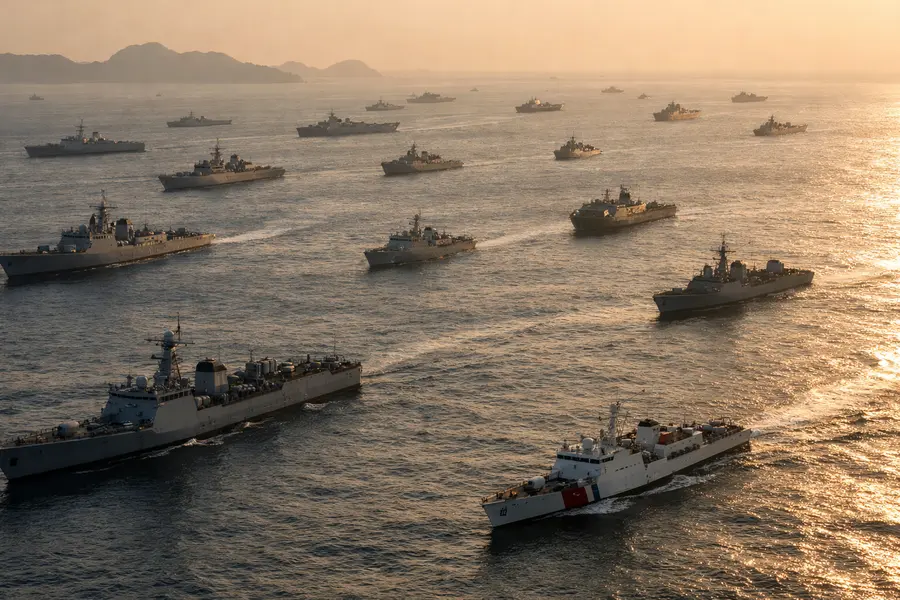
Taiwan says 53 Chinese navy and official vessels, including the Liaoning carrier group, are operating from southern Japan to the Philippines, a threat it calls "obvious."
- Taiwan tracked 53 Chinese vessels, 34 of them navy warships, in waters from southern Japan to the Philippines.
- The Liaoning carrier group is east of the Philippines, while three formations operate off southern Japan.
- Beijing calls the Liaoning's western Pacific training an annual routine not aimed at any country.
Lead
Taiwan said on October 29, 2026, that more than 50 Chinese naval and other official vessels are operating across a wide arc of sea from southern Japan to the waters off the Philippines. The secretary-general of Taiwan's National Security Council, Joseph Wu, published a map showing 53 ships, 34 of them People's Liberation Army Navy warships, including the aircraft carrier Liaoning. "The simultaneous threat to Taiwan, Japan and the Philippines is obvious," Wu said. China's defense ministry described the carrier's activity as routine training.
What Is China's Navy Doing Around Taiwan, Japan and the Philippines?
China's fleet is deployed across three theaters at once. The Liaoning and its accompanying battle group sit east of the Philippines. Other formations operate off Taiwan's east and southeast coasts. Three more are positioned off the southern coast of Japan, where Chinese warships and coast guard vessels passed through the Osumi Strait off Kyushu island on October 28, according to Japanese tracking.
The remaining 19 vessels on Taiwan's map are coast guard and other official craft. Their presence alongside warships matters because it blends naval and law-enforcement tools, a pattern that complicates how neighboring governments respond.
Taiwan posted a similar map in May 2026. The latest version shows a broader geographic spread and a larger share of warships.
Why Does Taiwan Call the Threat "Obvious"?
Taiwan calls the threat obvious because the deployment touches three U.S.-aligned governments simultaneously. Taipei is watching whether the Liaoning group continues north toward Japan, a move that could be read as pressure on Tokyo's defense posture.
Taiwan Defense Minister Wellington Koo said Beijing has never abandoned the use of force to annex Taiwan. He said he was unhappy to see any attempt to project deterrence that could undermine peace and stability in the Indo-Pacific.
The assessment follows comments by the U.S. Army Pacific commander, Ronald Clark, at a forum in Hawaii on Tuesday. Clark said the U.S. military assesses that China could act against Taiwan within a year.
How Has China Responded?
China has rejected the framing. Defense ministry spokesperson Zhang Xiaogang said the Liaoning's training in the western Pacific is an annual routine to test long-range, open-ocean combat capabilities. He said it is not directed at any particular country.
Japan's and the Philippines' defense ministries did not immediately comment on the Taiwanese assessment.
Geopolitical Dimension
The deployment lands on top of strained ties between Beijing and Tokyo over Japanese support for Taiwan, and years of friction between China and the Philippines over South China Sea claims. The three flashpoints share one geography. Taiwan sits between Japan's southwestern islands and the northern Philippines, and the waters between them form the First Island Chain, the line of archipelagos that constrains Chinese naval access to the open Pacific.
The economic channels are direct. The Bashi Channel, the Taiwan Strait and the East China Sea carry a large share of East Asia's container traffic and energy imports. Semiconductors made in Taiwan underpin global electronics supply chains. Any extended exclusion zone, inspection regime or insurance repricing for shipping in these waters would raise freight costs and add volatility to energy and technology markets.
What Comes Next for Regional Security?
The near-term variable is the Liaoning's track. A turn north toward Japan would widen the pressure from Taiwan's east coast to the Ryukyu chain. A move to remain east of the Philippines would keep the focus on the Luzon Strait and the Philippine Sea.
Over the next three to twelve months, governments in Tokyo, Manila and Taipei are likely to push for tighter intelligence sharing and more frequent joint surveillance. China typically calls its large-scale exercises routine, and its presence at sea tends to persist well beyond the headline period. Defense contractors, shipping insurers and Taiwan-linked chip supply chains are the sectors most exposed to a shift in posture.
Outlook
Taiwan's count of 53 Chinese vessels, 34 of them warships, marks one of the broadest simultaneous Chinese naval deployments it has publicly mapped. Beijing says the activity is routine, while Taipei says the threat to three neighbors is clear. The next signals are the Liaoning's heading, the response from Tokyo and Manila, and any change in commercial shipping advisories across the Taiwan Strait and Philippine Sea.