Pomegra
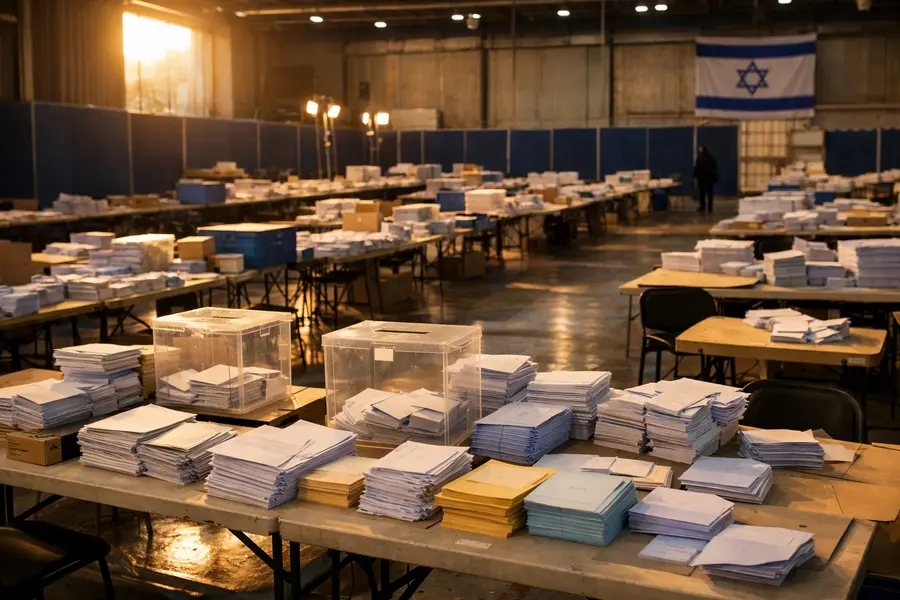
Israel's final count gives Netanyahu's bloc 53 seats and the opposition 48, leaving both short of 61 as President Herzog urges leaders to avoid a repeat vote.
- Netanyahu's bloc won 53 of 120 Knesset seats, the opposition 48. Neither reaches the 61 needed to govern.
- Arab parties won a record 19 seats and hold the balance of power.
- President Isaac Herzog said leaders must do everything to avoid another election.
Lead
Israel's final vote count from the October 27 election left Prime Minister Benjamin Netanyahu's bloc with 53 seats in the 120-seat Knesset and the opposition bloc led by Gadi Eisenkot with 48. Neither side holds the 61-seat majority required to form a government. President Isaac Herzog responded by calling on party leaders to approach consultations with an open mind and to avoid a fifth-round-style repeat election, a pattern that has repeatedly stalled Israeli policymaking in recent years.
What Do the Final Results Show?
The final tally shows a divided parliament with Netanyahu's Likud as the largest single party at 27 seats. The Netanyahu bloc combines Likud with far-right and ultra-Orthodox allies. The opposition bloc brings together Eisenkot's Yashar party, Naftali Bennett's Together party and Yair Golan's Democrats.
The remaining 19 seats went to Arab-led parties, the highest combined total on record. That block includes the United Arab List (Ra'am) led by Mansour Abbas. The result is that the 101 seats held by the two main blocs leave a pivotal group that neither has been willing to court openly.
Why Is a 61-Seat Majority So Hard to Reach?
Neither bloc can reach 61 without Arab party support or defections from the other side. Netanyahu's path is the narrower of the two. He has described Arab party participation in government as a danger to Israel, and his settler-aligned partners would likely leave a coalition that relied on those votes. His party has also amplified claims of improper Arab party influence on the vote. Election officials have said there is no basis for allegations of election theft.
The opposition has a theoretical arithmetic route, since 48 seats plus the Arab parties would clear the threshold. In practice Eisenkot has pledged not to enter a partnership with Arab parties, and most of his allies share that position. Golan is the exception and supports the option. Arab party leaders have signaled differing postures, with the Joint List expressing readiness for cooperation to remove Netanyahu and Abbas saying he is in contact with both camps.
What Is Herzog's Role Now?
Herzog's role is to consult every elected party on its preferred candidate for prime minister, then assign the task of forming a government to the person he judges most likely to assemble 61 votes. His appeal for an open mind points to the main off-ramp, a unity arrangement between Likud and the Eisenkot-led bloc. Both leaders have so far framed the result as a mandate for their own camp, and no formal talks on a joint government have been announced.
If the nominee fails within the statutory period, the mandate can pass to another member of the Knesset. If that also fails, the law triggers new elections.
Economic and Market Dimension
A prolonged stalemate carries budget consequences. Israel has no way to pass a full-year spending plan without a functioning majority, which limits defense, reconstruction and social spending decisions at a time of high security costs. Prolonged uncertainty also complicates the outlook for sovereign credit ratings, the shekel and Tel Aviv-listed equities, which have historically reacted to coalition risk through currency volatility and wider risk premiums rather than sharp one-day moves.
What Comes Next?
The Knesset results are due to be certified within days, after which Herzog opens consultations. The sequence over the next three to twelve months runs along three paths: a unity government that splits the two blocs' priorities, a narrow coalition that depends on Arab party backing or abstentions, or a sixth election in under five years. The first requires a political concession on who leads. The second requires the opposition to reverse a campaign pledge. The third requires nothing, which is why the president's warning carries weight.
Outlook
The final count confirms a hung parliament: 53 seats for Netanyahu's bloc, 48 for the opposition, 19 for Arab parties and no path to 61 without a break from campaign positions. Herzog's consultations will determine whether the system produces a government or another vote.
Mentioned tickers: None