Pomegra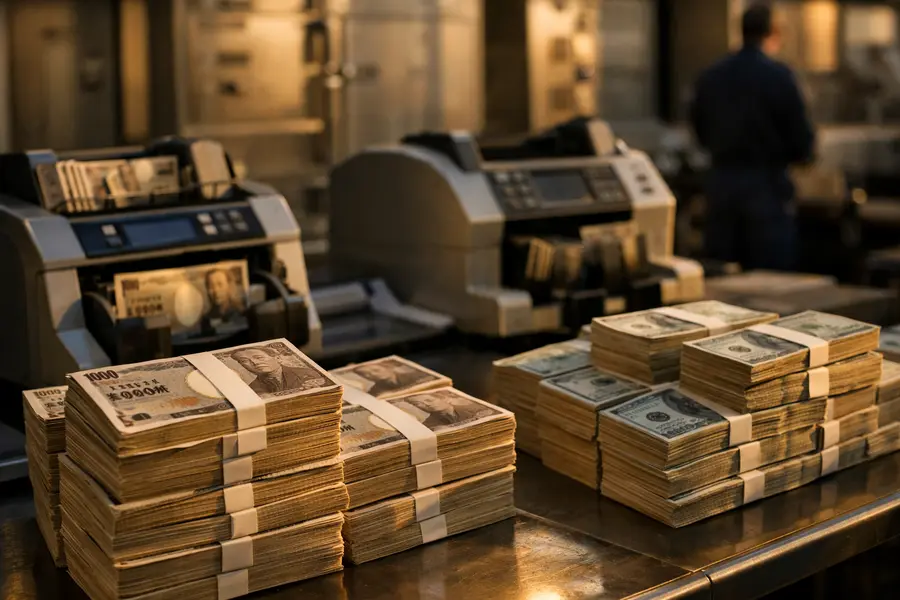
The first U.S.-Japan joint yen intervention since 1998 deployed an estimated $65 billion to halt the yen's collapse to a four-decade low near 163 per dollar, sending the currency 5% higher in two sessions.
- Japan's Ministry of Finance sold approximately $58.97 billion in dollar reserves on July 30-31; the U.S. Treasury bought an estimated $5-10 billion in yen using euro holdings.
- The coordinated operation lifted the yen from 163.73 to a three-month high of 155.20 per dollar before the currency retraced toward 159 by mid-August.
- U.S. Treasury Secretary Scott Bessent and Japan's Finance Minister Satsuki Katayama both signaled readiness for additional intervention if yen weakness persists.
Lead
TOKYO / WASHINGTON - Japan and the United States confirmed on Aug. 3, 2026 that they had conducted a coordinated foreign-exchange operation, selling dollars and euros to buy yen after the currency hit its weakest level against the dollar since 1986. The dollar-yen rate touched 163.73 on July 29 before the intervention, its lowest in roughly four decades, accelerating fears of financial instability across both countries. Japan's finance ministry deployed an estimated $58.97 billion over July 30 and July 31, while the U.S. Treasury purchased between $5 billion and $10 billion in yen funded with euro reserves - a structural choice designed to avoid a direct dollar sale that could complicate U.S. monetary messaging. The operation was the first coordinated U.S.-Japan yen-buying effort since 1998 and the most significant bilateral forex action since G7 nations jointly weakened the yen following Japan's 2011 earthquake.
Market Reaction
The yen surged roughly 5% in the two sessions following confirmation of the intervention, touching 155.20 per dollar - a level not seen since early May 2026. Yen-hedged Japanese equity benchmarks rallied sharply, and the dollar index retreated modestly as currency traders reassessed the credibility of the joint operation. The move in SPY and QQQ was limited on intervention day itself, though the implied volatility on yen options spiked to multi-month highs. By Aug. 18, the yen had drifted back to approximately 159 per dollar, surrendering roughly half of its intervention-driven gains as the structural interest rates gap between the U.S. and Japan reasserted its gravitational pull. Bessent and Katayama reiterated their warnings publicly, extending the psychological deterrent even as the exchange rate backslid.
Why Did the Yen Collapse to a 40-Year Low?
The yen's collapse reflects an entrenched divergence in monetary policy between Tokyo and Washington. The Bank of Japan has raised its benchmark rate incrementally in 2025-2026, but Japanese borrowing costs remain far below the Federal Reserve's policy rate, sustaining one of the world's most profitable carry trades: borrowing cheaply in yen to invest in higher-yielding U.S. assets. That trade intensified in 2026 as geopolitical turbulence in the Middle East boosted safe-haven demand for the dollar while simultaneously clouding Federal Reserve rate-cut expectations. The yen fell roughly 15% in the first half of 2026, breaching a series of technical thresholds before the July plunge through 160 and then 163 per dollar - territory last visited when Japan's bubble economy was unwinding in the late 1980s.
Why Did the U.S. Agree to Intervene?
Washington's direct participation reflected a set of systemic risks that extend well beyond Japanese domestic currency policy. Japan holds approximately $1.14 trillion in U.S. Treasury securities, making it the largest single foreign holder of U.S. government debt. A disorderly yen decline risked triggering Japanese institutional repatriation of overseas assets, which would push Treasury yields higher and tighten financial conditions across the global economy at a moment of existing macro fragility. Beyond the bond market, an abrupt yen carry trade unwind threatened U.S. equity markets: when short-yen positions are closed, investors historically liquidate their most appreciated assets first - large-cap momentum stocks and broad index positions. The August 2024 episode, when a surprise Bank of Japan rate hike produced one of the steepest single-session global equity selloffs in years, provided a concrete recent reference point. The Sept. 2025 joint statement between Bessent and Katayama had already established a diplomatic framework for coordinated action, formally committing both governments to consult on currency markets when excessive volatility emerged.
The Carry Trade Dimension
The yen carry trade - estimated in the tens of trillions of dollars in total notional exposure globally - remains the most direct transmission channel between Japanese currency policy and U.S. capital markets. Investors borrowing in yen at near-zero rates to fund positions in U.S. equities, Treasuries, and real estate face sudden margin pressure whenever the yen strengthens sharply. The July 30-31 intervention tested those positions: options data in the days following showed elevated hedging demand, and anecdotal reports pointed to covering activity in equity futures. With the yen at 159 per dollar as of mid-August - still near historically weak levels - carry positions remain largely intact and the risk of a disorderly unwind persists. That vulnerability gives both Tokyo and Washington an ongoing incentive to defend levels that prevent a cascading exit.
Outlook
The joint intervention demonstrates political will but does not resolve the fundamental dynamics weighing on the yen. A sustained yen recovery requires either a material rise in Japanese interest rates, a Federal Reserve pivot toward easier policy, or both. Neither appeared imminent as of mid-August 2026. The diplomatic architecture for repeat action is in place, and Bessent and Katayama retain the credibility of having acted once. Markets are likely to treat 160-165 per dollar as the range where further coordinated buying becomes probable, creating an informal intervention band. The Bank of Japan's next rate decision and any shift in U.S. inflation data will determine whether that band holds or requires another deployment of reserves.