Pomegra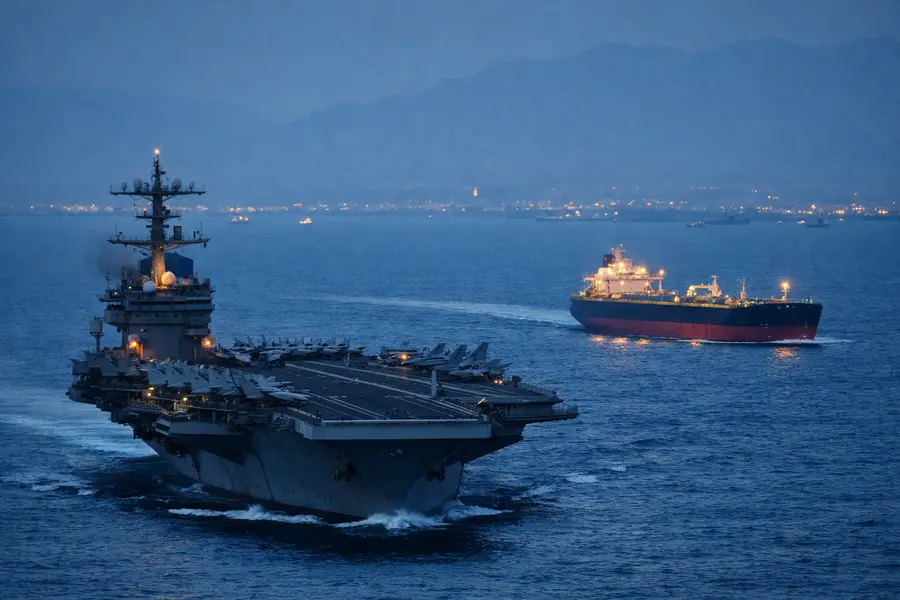
The USS Theodore Roosevelt is the third U.S. carrier sent toward Iran, adding about 10,000 personnel and pushing Brent crude above $100 a barrel as talks stall.
- The USS Theodore Roosevelt left San Diego on September 27 and is due in the Middle East by the end of November.
- Brent crude rose 4.4% to $102.31 a barrel on October 1 after the deployment became public.
- The strike group and the 13th Marine Expeditionary Unit add roughly 10,000 sailors and Marines to the region.
Lead
The U.S. Navy is sending the USS Theodore Roosevelt carrier strike group to the Middle East, putting a third aircraft carrier in the Iran theater as diplomacy with Tehran stalls. The nuclear-powered Nimitz-class carrier departed its San Diego home port on September 27 and is expected to reach U.S. Central Command's area of responsibility by the end of November. It will join the USS George H.W. Bush and the USS George Washington, and is expected to relieve the Washington. A separate amphibious group carrying more than 2,000 Marines is also deploying, bringing the added force to about 10,000 personnel.
What Is the USS Theodore Roosevelt Being Sent to Do?
The Roosevelt is being sent to sustain and expand U.S. air power against Iran during a conflict now in its eighth month. The carrier's air wing provides strike, air-defense and surveillance capacity that land bases in the Gulf cannot fully replace. Relieving the George Washington keeps a continuous carrier presence in place. The overlap period, when all three carriers are on station, gives Washington its largest concentration of naval aviation near Iran in the current campaign.
The deployment follows months of strain on the fleet. Carrier strike groups that have spent long periods at sea face maintenance backlogs and crew fatigue, and the Navy has acknowledged serious welfare problems aboard the USS Abraham Lincoln after an extended deployment. Rotating the Roosevelt in is meant to prevent gaps rather than simply add hulls.
Why Is the U.S. Escalating Now?
Washington is escalating because diplomacy has produced no deal and the political calendar has opened a window for renewed military action. President Donald Trump has said Iran must either sign "a very fair deal" or "won't exist any longer." Indirect contacts took place on the margins of the UN General Assembly, and Iranian President Masoud Pezeshkian said Tehran "has never shied away from talks."
U.S. officials have indicated that Trump expects to resume bombing Iran after the November 3 midterm elections. The Roosevelt's arrival at the end of November lines up with that timeline. The carrier is a signal to Tehran, a hedge against stalled negotiations, and a way to ensure that any renewed campaign begins with maximum force in place.
How Did Oil Markets React to the Third Carrier?
Oil prices rose sharply, with Brent crude gaining 4.4% to settle at $102.31 a barrel on October 1, the day the deployment became public. U.S. West Texas Intermediate climbed 2.7% to $92.87. The move reflected a repricing of risk to Gulf supply rather than any new physical disruption.
The reaction comes against an already tight market. The conflict has restricted nearly all traffic through the Strait of Hormuz, which the International Energy Agency has described as the largest supply disruption in the history of the global oil market. Attacks on Saudi Arabia's East-West pipeline, a key bypass for Hormuz, temporarily halted flows. The U.S. Energy Information Administration puts the September Brent average at $114 a barrel, $23 above August, and forecasts $105 for the fourth quarter. Brent was near $100.84 on October 6, so the crude oil price remains elevated despite some retracement from the early-October spike.
Production shut-ins averaged 4.8 million barrels a day in September, down from 5.8 million in August and a peak of 10.9 million in May. The decline shows partial recovery, but supply remains well below pre-war levels.
Strategic and Economic Context
The carrier buildup carries economic consequences beyond energy. Higher fuel costs feed through to transport, petrochemicals and airlines, and sustained prices above $100 complicate central bank efforts to bring inflation lower. Importers in Asia and Europe that depend on Gulf crude face the sharpest exposure, while U.S. producers benefit from the price level but face political pressure over pump prices ahead of the midterms.
For shipping, a third carrier raises the capacity to escort tankers and to suppress missile and drone threats to vessels. It also raises the odds of confrontation in the narrow waters around Hormuz, where insurers have already repriced war-risk cover.
What Comes Next for Iran Talks and Oil Prices?
The next decisive moments are the November 3 midterms and the Roosevelt's arrival at the end of the month. If negotiations produce a framework before then, the carrier becomes leverage for a settlement and the risk premium in crude is likely to compress. If talks fail and strikes resume, the Strait of Hormuz and Gulf infrastructure are again exposed, and the EIA's $105 fourth-quarter forecast becomes a floor rather than a midpoint.
The three-carrier overlap is also temporary. Once the Roosevelt relieves the George Washington, the force returns to two carriers unless the Pentagon extends the Washington's stay. That sequencing gives Washington a defined period of maximum strength in which to act or bargain.
Outlook
The Roosevelt's deployment marks a clear step up in U.S. military posture toward Iran, timed to the end of the U.S. election cycle and to a stalemate in negotiations. Brent has held near $100 a barrel, supported by the Hormuz disruption and the prospect of renewed strikes. Between now and late November, headlines on talks, tanker security and Gulf infrastructure will drive the oil market, with the carrier's arrival serving as the next fixed date on the calendar.