Pomegra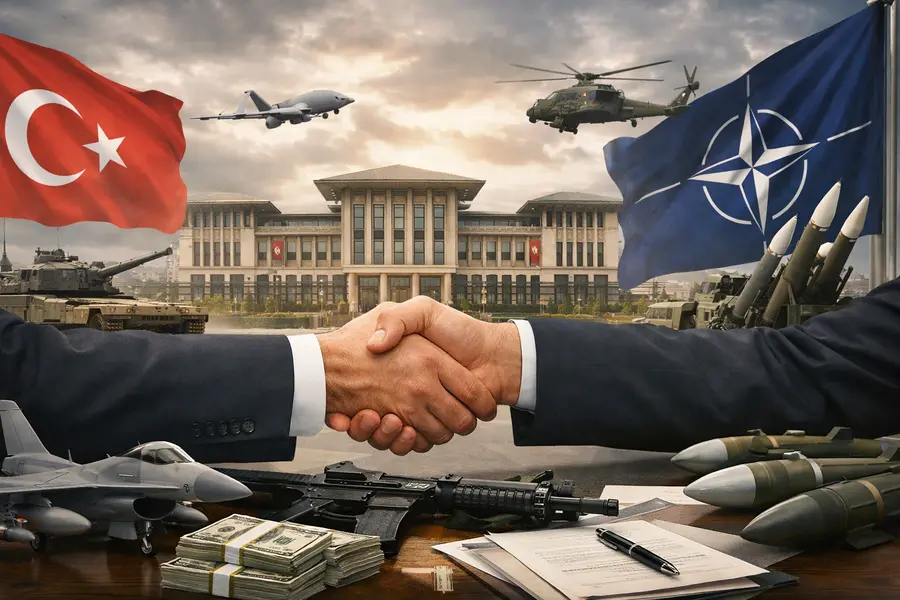
NATO's Ankara summit delivers a sweeping defense investment push as Trump arrives in Turkey, unlocks sanctions relief, and presses allies toward a 5%-of-GDP spending commitment.
- NATO Secretary General Mark Rutte unveiled tens of billions in new arms contracts as the Ankara summit opened July 7.
- Trump announced the U.S. will lift sanctions on Turkey tied to its 2019 purchase of Russia's S-400 missile system.
- Allied leaders agreed to a framework committing members to 5% of GDP on defense by 2035, with 3.5% for core military spending.
Lead
Ankara, Turkey — July 7–8, 2026. U.S. President Donald Trump arrived at the Beştepe Presidential Compound in Ankara on Tuesday for the 36th NATO summit, the alliance's second convened on Turkish soil since Istanbul in 2004. Within hours of his landing, NATO Secretary General Mark Rutte announced tens of billions of dollars in new defense contracts — a choreographed show of firepower designed to validate Trump's years-long pressure campaign on allied spending — as 32 heads of state closed a two-day session with a reaffirmation of the alliance's core Article 5 guarantee.What Happened
The Trump NATO summit Ankara gathering centered on three interlocking priorities: accelerating allied defense investment, expanding transatlantic defense industrial capacity, and sustaining military support for Ukraine. Rutte framed the arms announcements as evidence that European capitals are translating political pledges into procurement contracts.
Among the headline deals: Denmark unveiled agreements worth more than €3 billion ($3.43 billion), including a partnership with Belgium on air defense and a shipbuilding arrangement with Britain. Copenhagen also confirmed the purchase of two Boeing (BA) P-8A Poseidon maritime patrol aircraft. Separately, representatives from 15 member nations announced a joint acquisition of air-to-air refueling and transport aircraft from Airbus (AIR.PA), and NATO moved to replace its aging fleet of U.S.-built AWACS surveillance planes with Saab's (SAAB.ST) GlobalEye system — a contract that marks a significant shift in alliance airborne early-warning infrastructure away from American suppliers.
US-Turkey Relations Reset
The bilateral dimension of the summit proved equally consequential for US Turkey relations. Trump and Turkish President Recep Tayyip Erdoğan projected visible warmth in their bilateral session, with Trump announcing that Washington will lift the sanctions imposed on Ankara in 2019 after Turkey acquired Russia's S-400 air defense system — a move that resulted in Turkey's expulsion from the F-35 fighter jet program. The sanctions removal, if formalized, would mark the most significant reset in US Turkey relations in nearly a decade and potentially reopen discussions about Ankara's eventual reintegration into fifth-generation fighter procurement.
Turkey's role as host carried its own geopolitical weight. Ankara has cultivated a distinct foreign policy lane within the alliance — maintaining ties with Moscow while hosting NATO's southern flank infrastructure — and Erdoğan used the summit's spotlight to press for a broader rehabilitation of Turkey's standing within Western defense networks.
Defense Spending: The 5% Framework
The summit's defining policy output on global defense spending is a formalized commitment framework that asks all 32 members to reach 5% of GDP on defense and security-related expenditure by 2035. The structure breaks down as 3.5% for core military requirements and an additional 1.5% for adjacent defense infrastructure, industrial capacity, and contributions to Ukraine's defense sector.
Trump declared at the summit's close that members are making "great progress" toward the 5% target and cited "tremendous unity" — notably more upbeat than his pre-summit posture, in which he publicly attacked Spain as "terrible" for lagging on commitments and posted that the U.S. receives no benefit from NATO despite bearing the highest share of alliance costs. Rutte, seeking to pre-empt Trump's frustrations before his arrival, had highlighted $1.2 trillion in spending by European allies and Canada since 2017.
Current data shows European allies and Canada collectively investing around 4% of GDP in defense and security — a significant jump from years past, though still below the new 5% ceiling. The Baltic states — Estonia, Latvia, Lithuania — together with Poland already exceed the 3.5% core-defense threshold, having prioritized military buildup in response to Russia's posture in Eastern Europe.
Strategic Context
The NATO arms deals announced in Ankara arrive against a backdrop of dual crises. Russia's continued military operations in Ukraine have compressed allied procurement timelines and exposed stockpile shortfalls across multiple categories, from artillery ammunition to air defense interceptors. Simultaneously, an unstable U.S.-Iran ceasefire — reached in the days before the summit — introduced additional pressure on energy markets and shipping lanes, reinforcing allied arguments for sustained defense investment.
The GlobalEye selection to replace AWACS reflects a broader structural shift in NATO's industrial dependencies. Sourcing a flagship surveillance platform from Sweden — itself a recent NATO entrant — over U.S. defense contractors signals that European procurement autonomy is becoming a genuine alliance priority, not merely a political aspiration. The 15-nation Airbus refueling consortium makes the same point through a different line item.
Outlook
The NATO summit Ankara concludes with the alliance in measurably stronger financial shape than it entered — but with execution risk attached to every spending headline. National parliamentary cycles, coalition governments, and fiscal constraints across southern and central Europe mean the gap between pledged percentages and signed contracts will remain a central tension through 2035. Trump's decision to lift Turkey sanctions introduces a new variable in southeastern flank dynamics, with implications for F-35 supply chains and the alignment of Turkish defense procurement. Allied defense stocks with European exposure — including Saab and Airbus — are positioned as structural beneficiaries of the multi-year spending ramp. The summit's core message, "an attack on one is an attack on all," was reaffirmed in the final declaration, but the speed at which industrial commitments convert into battlefield-ready capacity will define whether that pledge carries strategic weight.
Mentioned tickers: BA, AIR.PA, SAAB.ST