Pomegra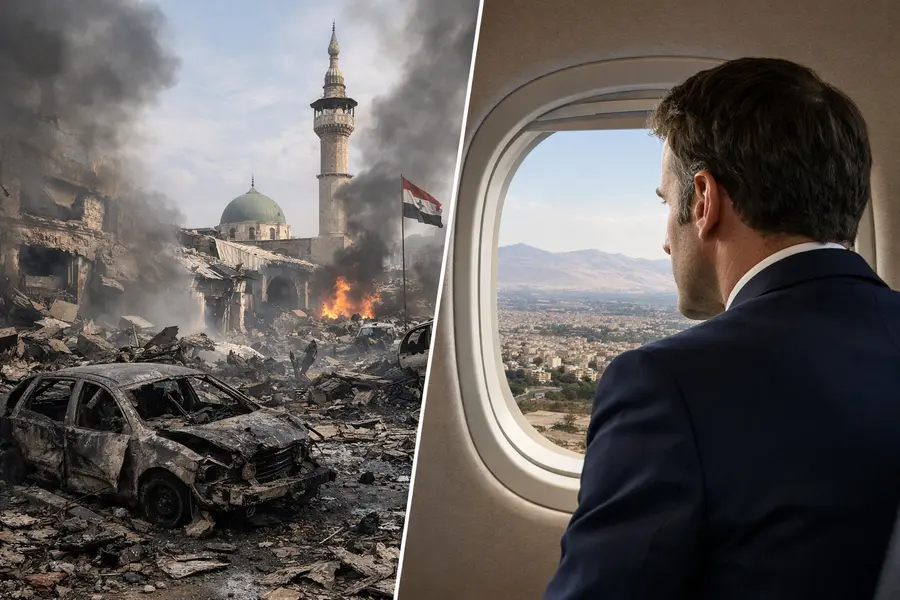
Twin explosive devices wounded 18 people near the French president's Damascus hotel on July 7, 2026, as Macron signed landmark reconstruction deals with Syria's new government.
- Two bombs — one in a trash bin, one in a parked car — detonated near the Four Seasons Hotel and Ministry of Tourism in central Damascus, wounding 18 including four police officers.
- Macron was inside the presidential palace meeting President Ahmad al-Sharaa when the blasts occurred and was not in danger; the visit continued without interruption.
- France and Syria restored full diplomatic ties and signed a Framework Declaration for Comprehensive Cooperation, with deals covering shipping, energy, water infrastructure, and banking reform.
Lead
Twin explosive devices rocked central Damascus on July 7, 2026, wounding at least 18 people — including four police officers — as French President Emmanuel Macron conducted the first visit by a Western head of state to Syria since the December 2024 fall of Bashar al-Assad. The Damascus bomb attack occurred within blocks of the Four Seasons Hotel where Macron had spent the previous night, yet the French president was already inside the presidential palace meeting his Syrian counterpart, Ahmad al-Sharaa, when the devices detonated. The visit proceeded without interruption, and no group has claimed responsibility for the attack.
What Happened
Syria's Interior Ministry confirmed that one bomb had been concealed in a garbage bin and a second in a parked car, both positioned near the Ministry of Tourism and the Four Seasons Hotel in the heart of the capital. The blasts occurred during the morning hours of July 7, sending shockwaves through a commercial district already placed under heightened Syria security protocols for the state visit.
Macron's office said the president was en route to the presidential palace and did not hear the explosions. Syrian authorities stated that the detonations fell outside Macron's designated security perimeter and posed no direct threat to his itinerary. The wounded included civilians and law enforcement personnel who had been deployed as part of the expanded security cordon.
The Macron Syria visit comes less than a week after a separate bombing killed nine people at a cafe on al-Nasser Street in Damascus on July 2, underscoring the fragility of Syria security in the post-Assad transition period.
The Diplomatic Agenda
Macron arrived in Damascus on the night of July 6 alongside a substantial economic delegation that included the chief executives of TotalEnergies and French container shipping group CMA CGM, signaling Paris's intent to anchor itself as Syria's principal Western reconstruction partner.
The bilateral talks yielded a Framework Declaration for Comprehensive Cooperation, representing a formal restoration of full diplomatic ties severed during years of Assad-era conflict. Specific agreements signed during the visit included:
- A major maritime, air transport, and logistics partnership with CMA CGM Group
- Modular water treatment and energy infrastructure protocols for Homs province
- Civil aviation coordination memoranda
- A development assistance agreement with the French Development Agency targeting institutional capacity building
Macron also pledged technical assistance to the Central Bank of Syria to support restructuring of the country's banking sector, with joint expanded economic committees established to coordinate reconstruction financing alongside Gulf sovereign partners.
Strategic Context
The Macron Syria visit carries weight beyond its economic deliverables. France becomes the first European Union member state to engage Syria at head-of-state level since al-Sharaa's rebel coalition ended Assad's five-decade family rule in December 2024. The visit signals a broader Western recalibration toward Damascus, with the European Union having moved to lift most sanctions against Syria in the preceding months to enable reconstruction capital flows.
Middle East geopolitics add further complexity. Syria sits at the intersection of Iranian, Turkish, Israeli, and Gulf Arab spheres of influence, each with divergent stakes in the country's reconstruction trajectory. France's early positioning — through CMA CGM's logistics footprint and TotalEnergies' energy sector interest — reflects a strategic calculation that first movers in post-conflict reconstruction markets secure lasting commercial and diplomatic influence.The Damascus bomb attack complicates that calculus. Al-Sharaa's transitional government has struggled to extend security control across Syrian territory, where remnants of the former Assad military structure, Islamic State cells, and competing armed factions remain active. The IS resurgence in particular has exploited security gaps to target civilian infrastructure and religious minorities since the transition, with the July 2 cafe bombing and July 7 hotel-district explosions representing two of the most visible recent incidents.
Geopolitical Dimension
No group has claimed the July 7 attack, though regional analysts assess the French delegation as the likely symbolic target given its timing and proximity. The UAE Foreign Ministry issued a formal condemnation, stating that it "rejects all forms of terrorism and violence aimed at threatening security and stability," underscoring the Gulf states' alignment with the new Damascus government.
For Middle East geopolitics, the episode illustrates the tension at the core of Syria's reconstruction moment: international capital and diplomatic recognition are flowing toward Damascus precisely as security remains contested. European governments must calibrate between the strategic imperative to stabilize Syria — reducing migration pressure, countering Iranian and IS influence — and the reputational and physical risks of engagement with a government that cannot yet guarantee baseline security in its own capital.
France's decision to continue the visit without alteration sends a deliberate signal that Paris will not be deterred by spoiler attacks, but the incident is likely to inform security-risk assessments by other Western governments considering similar high-profile engagement.
Outlook
The Damascus bomb attack will not derail the Franco-Syrian economic partnership sealed on July 7 — the agreements are signed and diplomatic ties restored. However, the attack reinforces that Syria security remains the central variable determining the pace of foreign capital deployment. Reconstruction financing commitments from France and Gulf partners will likely proceed through structured development vehicles rather than direct commercial exposure until the transitional government demonstrates greater territorial control.
Macron's Damascus visit has reset France's position in the Levant, but converting diplomatic first-mover advantage into durable economic and strategic influence depends on al-Sharaa's ability to suppress destabilizing factions — a task that July 7 made plain is far from complete.