Pomegra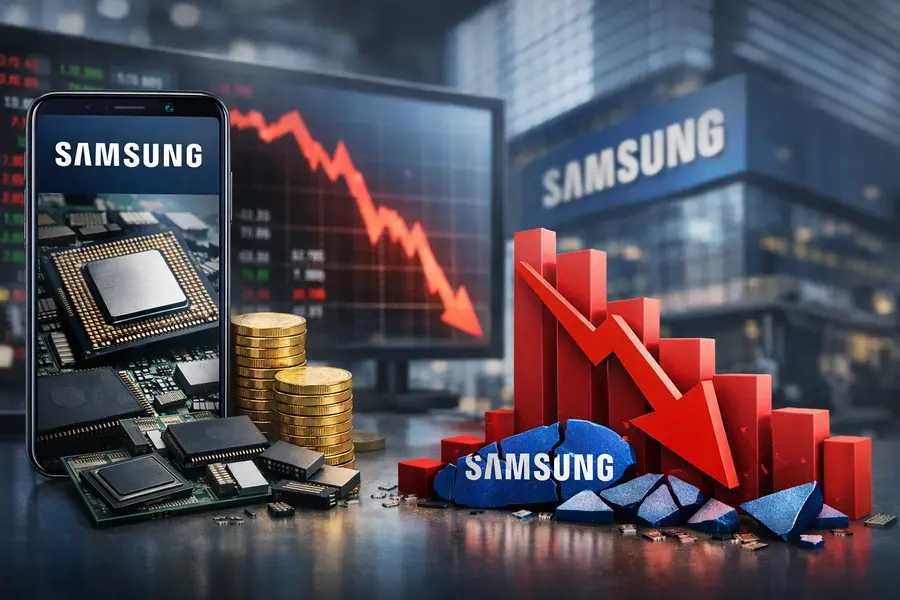
Samsung Electronics delivered an unprecedented quarterly earnings result in Q2 2026, yet a 10% stock drop erased more than $100 billion in market value as investors questioned whether the AI memory chip supercycle can be sustained.
- Samsung Q2 2026 operating profit surged 19-fold to $58.4 billion, the highest single-quarter result in the company's history.
- Despite the record profit, Samsung stock fell nearly 10% in Seoul, triggering a broad semiconductor stock selloff across Asia and Wall Street.
- Investor concern centers on the durability of AI chip spending, with AI memory now consuming 52% of cloud providers' capital budgets.
Lead
Seoul, July 7, 2026 — Samsung Electronics posted a 19-fold jump in Q2 2026 operating profit to 86 trillion Korean won (approximately $58.4 billion), surpassing every single-quarter profit record in the technology industry. The announcement failed to satisfy markets primed for a blowout: Samsung stock fell as much as 9.5% in Seoul trading, closing near 286,000 won and erasing more than $100 billion in market capitalization in a single session.What Happened
Samsung's Device Solutions division — encompassing its AI memory chip and logic semiconductor operations — drove the quarter's outsized result. Revenue for the period reached 171 trillion won, more than double the 74.57 trillion won reported in Q2 2025. Average DRAM selling prices rose 44% quarter-on-quarter, while NAND prices advanced 53% over the same stretch, reflecting a supply market in which all three major memory producers — Samsung, SK Hynix, and Micron — had completely sold out their 2026 high-bandwidth memory (HBM) capacity by the start of the year.
The preliminary results beat consensus analyst estimates by roughly 6%. Yet revenue came in slightly below Street forecasts, and the margin of the earnings beat fell short of what the market had implicitly priced after a near-150% year-to-date rally in Samsung shares ahead of the print.
Market Reaction
The semiconductor stock rout spread rapidly beyond the Korean peninsula. SK Hynix fell 14.57% in Seoul, while Samsung and SK Hynix together — now comprising roughly half the KOSPI's total weighting, up from approximately a quarter at year-end 2025 — pulled the broad South Korean index sharply lower. On Wall Street, Intel and Applied Materials each shed more than 10%, AMD fell approximately 8%, and Micron Technology lost more than 10% despite a stunning 260% gain year-to-date. Nvidia and Broadcom declined 1% to 2%.
The selloff represented the classic "buy the rumor, sell the news" dynamic amplified by the sector's extraordinary 2026 run. Deutsche Bank analysts characterized the quarter as a result that was "'only' 6% ahead of estimates," producing a profit-taking wave as institutional holders rotated out of positions accumulated during the AI infrastructure frenzy.
AI Memory Chip Demand and the Sustainability Question
At the core of the Samsung stock drop is a structural question that no earnings figure can definitively resolve: whether hyperscalers and cloud providers can sustain capital expenditure at the rates the AI memory build-out requires. AI memory's share of cloud capital budgets has reached 52% in 2026, up sharply from prior years. Projections circulating in the analyst community place that share at 70% or more by 2027 — a trajectory that implies either a significant acceleration in cloud revenue or a compression of investment elsewhere.
Samsung itself has committed capital expenditure exceeding $700 billion in 2026 for capacity expansion and research and development, an investment that represents a substantial bet on continued AI infrastructure demand. SK Hynix secured early orders from major AI customers by achieving higher yield rates on HBM3E stacks — the advanced packaging format underpinning Nvidia's H100 and H200 accelerators — before Samsung reached equivalent production consistency. That competitive dynamic has left Samsung fighting for share in the most lucrative segment of the memory market even as overall volumes surge.Strategic Context
The AI hardware cycle has reshaped the semiconductor stock landscape with unusual speed. Three years ago, Samsung's memory division was registering losses during a severe demand downturn. Today, the same division accounts for the vast majority of group operating profit, and the company's market capitalization, alongside SK Hynix, now effectively steers the performance of South Korea's benchmark equity index.
That concentration introduces systemic risk. A sustained correction in AI chip stocks would ripple through the KOSPI in ways that were structurally impossible before the AI build-out concentrated capital in a handful of memory and logic manufacturers. Investors weighing that risk against lofty valuations created the conditions for Tuesday's sell-off even in the face of historic earnings.
Outlook
Samsung's Q2 2026 result confirms that the AI memory chip cycle remains in full force — demand is outrunning supply for a third consecutive quarter, and pricing power across DRAM and NAND has not materially weakened. The tension now is between those fundamentals and market positioning. After a near-150% run in Samsung stock, a 6% earnings beat was insufficient to extend gains. Whether the next leg of the AI capex cycle justifies current semiconductor valuations or triggers a deeper correction in semiconductor stock prices will depend heavily on hyperscaler spending commitments in the second half of 2026 and the trajectory of AI memory's share of enterprise technology budgets. Samsung is well positioned to supply whatever demand emerges; the question the market is now pricing is how durable that demand will prove.