Pomegra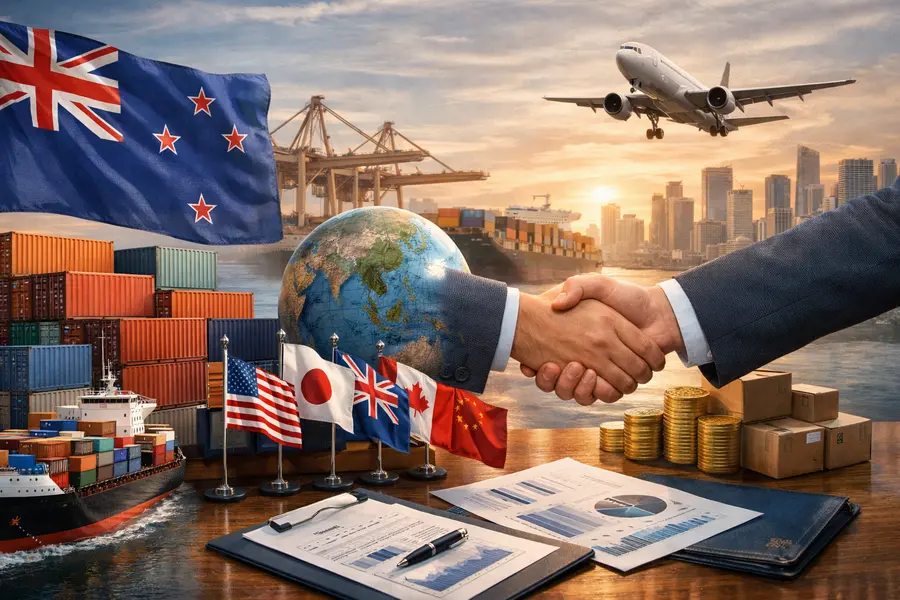
New Zealand's governing National Party pledges trade talks with seven new economies representing US$5 trillion in combined GDP, targeting hundreds of millions of new customers for the country's exporters.
- National commits to trade negotiations with Brazil, Switzerland, Argentina, Bangladesh, Nigeria, Uruguay, and EFTA within five years if re-elected.
- The seven target markets collectively represent 700 million people and US$5 trillion in combined GDP, yet currently account for only NZ$1.8 billion in New Zealand exports.
- National's broader export-doubling target has lifted total exports from NZ$94.4 billion to NZ$114.1 billion since the party entered government.
Lead
Wellington, July 6, 2026 — New Zealand's National Party unveiled an expansive NZ trade policy platform on July 5, committing to formal trade negotiations with seven economies within five years should it win the November 2026 general election. Trade Minister Todd McClay framed the pledge as a bid for the "next billion customers," targeting markets that span 700 million people and carry a combined gross domestic product exceeding US$5 trillion — yet currently receive only NZ$1.8 billion of New Zealand's annual exports.What Happened
The announcement, made ahead of the 2026 election campaign, names Brazil, Switzerland, Argentina, Bangladesh, Nigeria, Uruguay, and the European Free Trade Association — comprising Iceland, Liechtenstein, and Norway — as first-tranche priority markets to be pursued within the next parliamentary term.
A second tranche, covering South Africa, Turkey, Colombia, Morocco, Sri Lanka, and Mauritius, would be advanced over the following decade. Prime Minister Christopher Luxon confirmed the commitment, positioning the global trade deals agenda as central to National's economic prospectus.
McClay described the gap between the US$5 trillion combined GDP of first-tranche targets and the NZ$1.8 billion in current bilateral exports as representing "huge, untapped opportunities" for the country's exporters.
Strategic Context
The NZ economy has operated under a National-led coalition since late 2023, and the government set an ambitious target of doubling total exports by 2034 upon taking office. Progress has been steady: national export revenues have climbed from NZ$94.4 billion to NZ$114.1 billion — roughly a 21% increase — though analysts note average annual export growth of around 2% remains well below the 5–6% annual rate required to hit the doubling goal.
The new trade policy is explicitly designed to close that gap. Beyond formal free-trade agreement negotiations, the platform includes:
- Essential supplies agreements modelled on the existing New Zealand–Singapore AOTES food-for-fuel arrangement, which secured stable fuel supplies following disruptions to the Strait of Hormuz.
- Elimination of NZ$1 billion in non-tariff barriers through expanded paperless trade and digital customs infrastructure.
- At least 23 government-led trade missions over the parliamentary term.
- Three AI-powered digital tools to help exporters navigate tariffs, rules of origin, and market access requirements.
- A "Next 200" programme targeting 200 high-potential New Zealand businesses that do not yet export.
- New Zealand Trade and Enterprise (NZTE) directed to develop forward-looking sector opportunity maps, matching the country's export strengths to global demand ahead of competitors.
Geopolitical Dimension
The New Zealand export push arrives at a moment of pronounced global trade reconfiguration. Protectionist pressures in major economies — including elevated U.S. tariffs and sustained friction over agricultural market access — have made diversification a priority for small, trade-dependent economies.
New Zealand already holds free-trade agreements with China, the United States, the United Kingdom, the Gulf Cooperation Council, and the broader CPTPP bloc. The new markets targeted in National's first tranche are, notably, outside that existing network. Brazil and Argentina, as Mercosur members, represent a long-standing but elusive prize for Southern Hemisphere agricultural exporters; EFTA markets offer high-income, rule-of-law entry points in Europe that bypass the structural complexity of an EU-wide agreement.
The pivot toward Bangladesh, Nigeria, and other emerging-market economies signals recognition that future global trade deals growth will increasingly be driven by middle-class expansion in Asia, Africa, and Latin America — markets where New Zealand's agri-food, technology, and education sectors have underexploited positioning.
What Comes Next
National faces a competitive election in November 2026. The opposition Labour Party has not yet released a countervailing trade platform, though it has previously emphasised the difficulty of negotiating meaningful agreements with complex or geographically distant economies. Economists and trade law analysts have pointed to the multi-year timelines typically required even to initiate formal FTA negotiations, particularly with large, protectionist economies such as Brazil.
The essential supplies agreement concept, while narrower in scope than a full FTA, offers a faster-track instrument for securing supply-chain resilience across sectors including energy, food, and critical minerals — and may prove more deliverable within a single term.
Outlook
National's trade agenda represents one of the most expansive NZ National Party trade policy commitments in recent electoral cycles. Pursuit of thirteen new bilateral or regional frameworks across two tranches — combined with non-tariff barrier reduction, digital trade tools, and export-development programmes — is calibrated to accelerate the NZ economy toward its 2034 export-doubling target. The degree to which these commitments translate into signed agreements will depend heavily on global negotiating conditions, domestic political stability post-election, and trading-partner appetite in an environment of heightened economic nationalism. For New Zealand's exporters, the scale of the ambition signals a sustained, government-backed push into markets that have, to date, remained largely beyond reach.
---