Pomegra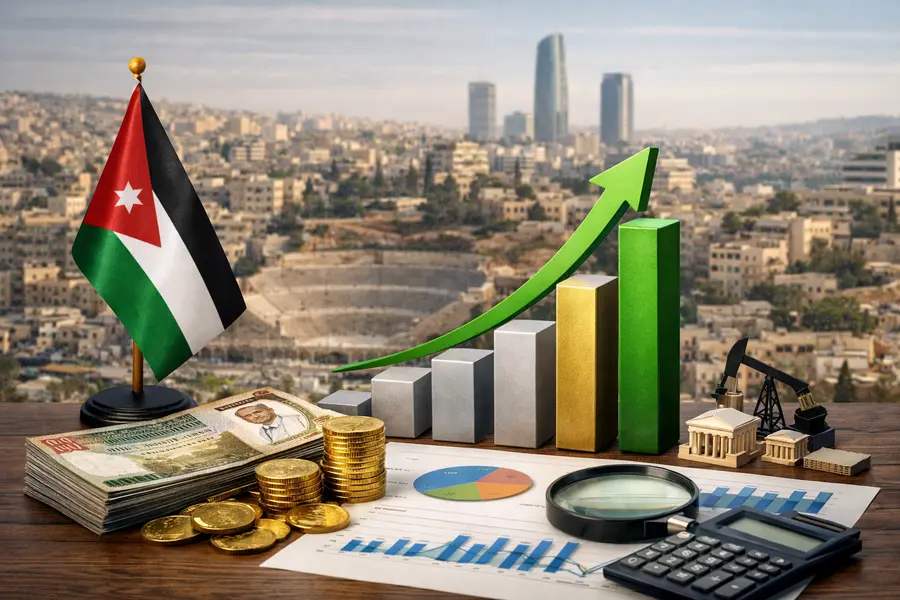
Jordan's economy expanded 2.9% in the first quarter of 2026, outpacing year-earlier growth as services, tourism, and industrial output drove the kingdom's fastest quarterly advance in recent years.
- Jordan GDP growth reached 2.9% year-on-year in Q1 2026, above the comparable Q1 2025 rate.
- Services, tourism receipts, and manufacturing were the primary growth contributors.
- The result reinforces the IMF's above-consensus 2026 expansion forecast for the Jordanian economy.
Lead
Jordan's Department of Statistics confirmed that Jordan economic output rose 2.9 percent year-on-year in the first quarter of 2026, outpacing the equivalent period of 2025 and beating consensus expectations for the Middle East GDP region's smaller open economies. The reading marks the kingdom's strongest opening-quarter performance in several years, offering policymakers in Amman a measure of confidence as the government continues structural fiscal consolidation under its extended International Monetary Fund program.
What Happened
The Jordan Q1 economic report showed broad-based acceleration, with the services sector — which accounts for roughly three-quarters of national output — leading the advance. Financial services, information technology and business-process outsourcing, and transport and logistics all registered positive contributions. The industrial segment, anchored by phosphate and potash extraction and downstream chemicals, added incremental support as global commodity demand stabilized.
Tourism receipts, which remain a critical hard-currency earner for the kingdom, continued their post-conflict recovery trajectory. Visitor arrivals through Aqaba, Petra, and Amman's conference circuit held above the prior-year trend, partly buffered by Jordan's positioning as one of the region's more stable destination markets. Remittance inflows from Jordanian workers in Gulf Cooperation Council economies provided additional household-sector support, sustaining private consumption.
Regional Context
The Jordan GDP growth figure lands against a complex Middle East GDP backdrop. Much of the broader region has faced headwinds from elevated oil-price uncertainty, unresolved conflict dynamics in Gaza and Sudan, and tighter global financial conditions. Jordan, as a net energy importer with a Jordanian dinar pegged to the U.S. dollar, benefits from lower imported-inflation pressure when energy costs ease but remains exposed to regional confidence shocks.
The kingdom's geographic proximity to multiple conflict zones continues to weigh on foreign direct investment sentiment and logistics costs. Yet the Q1 data confirm that Jordan's institutional anchors — the IMF program, consistent monetary policy from the Central Bank of Jordan, and a diversified services base — are providing a degree of insulation that several regional peers have not managed to replicate.
Labor Market and Social Dimension
Unemployment, historically one of Jordan's most persistent structural weaknesses, held above 20 percent in recent quarters, and the Q1 GDP expansion has not yet translated into a material improvement in formal job creation. The government's reliance on the public sector as an employer of last resort constrains the fiscal space available for growth-enhancing capital investment. Youth unemployment, in particular, remains a policy priority highlighted in Jordan's Vision 2033 development framework.
The approximately 1.3 million registered Syrian refugees hosted by Jordan — one of the highest per-capita refugee burdens globally — continue to exert pressure on public services, water infrastructure, and the informal labor market, even as multilateral and Gulf bilateral support partially offsets the fiscal cost.
What Comes Next
If the Jordan economic momentum evident in Q1 is sustained, the full-year 2026 growth rate could approach or slightly exceed 3 percent — a threshold that would represent the strongest annual expansion in nearly a decade. That outcome depends on several variables: the trajectory of Gulf state investment flows, the pace of global goods trade (critical for phosphate and potash export revenues), and whether regional de-escalation advances far enough to lift broader investor sentiment.
The IMF's current program review, expected in the second half of 2026, will assess whether Jordan's fiscal consolidation targets are on track. A positive review would maintain access to the credit line that underpins the dinar peg and sovereign bond market confidence.
Outlook
Jordan's 2.9 percent Jordan GDP growth in Q1 2026 marks a constructive acceleration that places the kingdom ahead of several regional peers on the Middle East GDP leaderboard for the opening quarter. The result reflects the durability of Jordan's services-led model and the stabilizing effect of multilateral support, even as structural constraints on employment, debt, and regional security persist. Maintaining this trajectory through the remainder of 2026 will require continued execution on fiscal reform and sustained foreign exchange inflows from tourism, remittances, and investment.
Mentioned tickers: APOT