Pomegra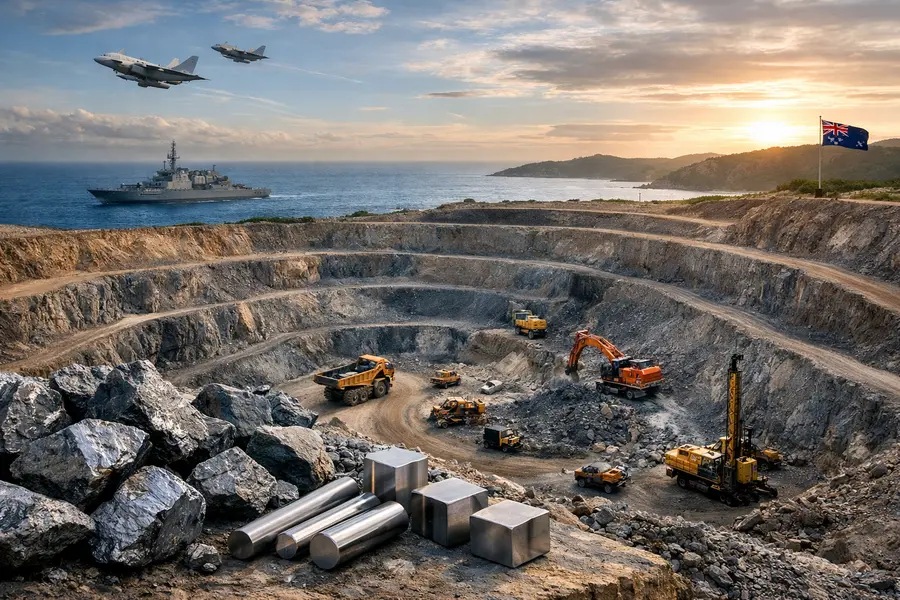
Australia's King Island Dolphin Mine, the highest-grade large tungsten deposit outside China, has re-emerged as the West's most strategically vital non-Chinese source of the metal essential for armor-piercing munitions, missile systems, and advanced defense hardware.
- China controls approximately 85% of global tungsten supply; a U.S. NDAA mandate bars Chinese-sourced tungsten from defense contracts effective January 1, 2027.
- Group 6 Metals' Dolphin Mine now ships roughly six containers of concentrate monthly, each valued at approximately $2 million at current prices.
- A $110 million underground mining contract positions the site to produce 2,000 metric tons annually into the 2030s — roughly 2.4% of current global output.
Lead
The Dolphin Mine, operated by Group 6 Metals (ASX: G6M) on King Island — a remote landmass of 1,600 residents midway between Tasmania and the Australian mainland — has become one of the most consequential pieces of real estate in Western defense supply chains. Spread across 80 hectares between a platypus stream and a penguin colony, the mine shipped its first commercial tungsten concentrates in 2023 and has since scaled to a rhythm that Western defense planners are watching with unusual attention. With a U.S. statutory deadline arriving in just six months, the Australia Dolphin Mine tungsten operation has moved from an obscure minerals story to a front-line matter of military mineral sourcing.
A Mine That Tracks the Arc of War
The Dolphin Mine has a peculiar history: it opened in 1917 to supply munitions for World War I, shut when peace crashed prices three years later, restarted in 1938 on the eve of World War II, revived again for Korea, and again for Vietnam. It closed definitively in 1990 — precisely 12 months after the fall of the Berlin Wall — when the peace dividend collapsed tungsten demand. That pattern has made the mine a striking proxy for global conflict cycles. Its current reopening coincides with the most acute rearmament wave in the Western world since the Cold War.
Group 6 Metals recommenced operations and achieved commercial production in 2023. The mine now dispatches approximately six shipping containers of gray tungsten concentrate per month, each worth around $2 million at prevailing market prices. Management has set a production target of 2,000 metric tons annually, a level it aims to sustain well into the 2030s.The Strategic Logic of Critical Minerals Supply
Tungsten is not easily replaced. Its combination of extreme density, hardness, tensile strength, and the highest melting point of any metal — 3,422 degrees Celsius — makes it indispensable for armor-piercing kinetic energy penetrators, missile nose cones, anti-tank rounds, and high-temperature aerospace components. No synthetic material replicates its performance profile at scale or cost.The structural problem for Western defense planners is concentration. China controls approximately 85% of global tungsten extraction and dominates downstream processing for the metal. That dependency has triggered legislative action in Washington. Under the U.S. National Defense Authorization Act, the Defense Federal Acquisition Regulation Supplement mandates that, from January 1, 2027, no tungsten metal powder, tungsten heavy alloy, or finished and semi-finished components containing tungsten heavy alloy sourced from China, Russia, North Korea, or Iran may be incorporated into U.S. military contracts. The United States has virtually no domestic tungsten production of its own, making allied-nation sourcing the only near-term solution.
Australia's Dolphin Mine represents the most advanced shovel-ready answer to that gap in the non-Chinese world.
Infrastructure Investment and Alliance Backing
Group 6 Metals has moved to scale the operation. The company signed a binding three-year underground mining contract with HMR Drilling Services valued between $110 million and $120 million, with options to extend. The deal covers both development and production phases of the underground expansion at King Island, transforming what was a modest concentrate operation into a longer-horizon industrial mine.
The bilateral strategic context amplifies the mine's importance. Australia and the United States have jointly committed more than A$5 billion — approximately $3.5 billion — to critical minerals and rare earth projects designed to reduce dependence on Chinese supply chains. The two governments convened their inaugural Mining, Minerals, and Metals Investment Ministerial in Tokyo in March 2026, formalizing cooperation under a broader framework for securing critical minerals supply across allied economies. Australian Prime Minister Anthony Albanese has positioned his country explicitly as an offshore extraction base for U.S. strategic needs.
Key commercial partnerships reinforce the mine's integration into Western supply chains. Commodities trader Traxys Sarl, which is both a customer and an investor in Group 6 Metals, provides a direct channel into defense-adjacent industrial consumers. The scheelite processing operation returned a profit in the first half of fiscal year 2026, and management is pursuing a relisting process alongside a new long-term offtake agreement.
Geopolitical Dimension
China's grip on tungsten supply has intensified in strategic significance as relations between Beijing and Western capitals deteriorate. Export restrictions on critical minerals have emerged as a central tool of Chinese economic statecraft, with tungsten sitting alongside gallium, germanium, and rare earths as levers in an escalating critical minerals contest. The U.S. and European governments have classified tungsten as a critical material, and procurement planners in Brussels and London face the same January 2027 deadline pressure as Washington.
For Australia, the Dolphin Mine's revival illustrates both the opportunity and the complexity of the allied minerals push. King Island's geographic isolation creates logistics challenges; small-scale output relative to Chinese producers constrains immediate impact. Yet at current trajectory, the mine's concentrate shipments represent one of the few near-term, operating, non-Chinese sources of high-grade tungsten available to allied defense manufacturers.
Outlook
The Dolphin Mine's expansion timeline, anchored by the $110 million underground mining contract and a target of 2,000 metric tons annually, aligns closely with the January 2027 U.S. procurement deadline for China-free military mineral sourcing. The mine will not, on its own, fill the Western world's tungsten gap — China's dominance at 85% of global output is not displaced by a single island mine. But in a supply landscape where qualified non-Chinese sources are sparse, King Island carries a weight well beyond its size. The Australia-U.S. critical minerals supply partnership provides the institutional scaffolding; Group 6 Metals provides the ore. Whether that combination proves sufficient will depend on how quickly the underground expansion ramps and whether offtake arrangements with defense-supply-chain customers mature before the statutory clock expires.
Mentioned tickers: G6M