Pomegra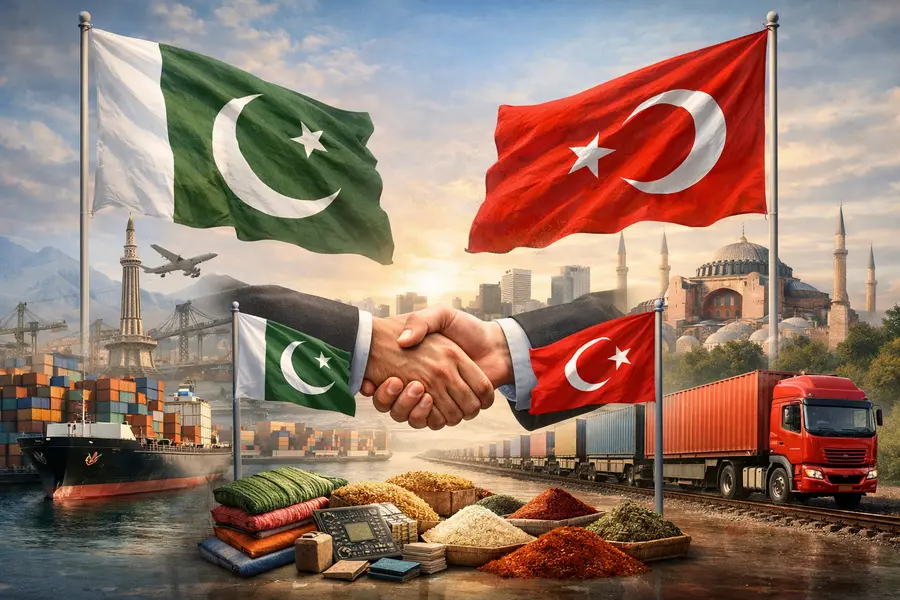
Pakistan and Türkiye deepen a decades-long strategic partnership in Istanbul, pledging a $5 billion trade target and expanded defense cooperation including MILGEM warships and drone technology.
- Bilateral trade stood at roughly $1.3 billion in 2024; the new $5 billion target requires nearly a fourfold increase.
- Pakistan has earmarked a 1,000-acre site at Port Qasim, Karachi for a dedicated Turkish investor zone named after President Erdoğan.
- Defense cooperation centers on four MILGEM-class corvettes, with two under construction at Karachi Shipyard under full technology transfer.
Lead
Prime Minister Shehbaz Sharif met Turkish President Recep Tayyip Erdoğan in Istanbul on July 4, 2026, reaffirming a bilateral trade target of $5 billion and outlining an expanded security architecture that spans naval platforms, unmanned aerial systems, and joint defense production. The summit — held at Vahdettin Palace in Istanbul's Üsküdar district — signals a deliberate effort by Islamabad's foreign-policy establishment to turn a historically warm but commercially thin relationship into a structurally consequential one.What Happened
Sharif arrived at Erdoğan's invitation for a one-hour closed-door session before both leaders convened with senior officials over a working lunch. The talks produced no single binding treaty but covered a broad agenda: trade, investment, energy, transportation, critical minerals, information technology, digital connectivity, and defense co-production.
At a Pakistan–Türkiye Business Conference held on the sidelines, Sharif invited Turkish companies to enter Pakistan's Special Economic Zones and highlighted privatization opportunities in infrastructure, energy, and technology. The flagship announcement was the designation of a 1,000-acre parcel at Port Qasim in Karachi as the "President Tayyip Erdoğan Special Economic Zone," ring-fenced exclusively for Turkish investors — a symbolic and practical gesture designed to lower entry barriers for Turkish capital.
Trade and Economic Dimension
The Pakistan Turkey trade deal framework targets $5 billion in annual bilateral commerce, up from approximately $1.3 billion recorded in 2024 — a gap that demands structural interventions rather than incremental goodwill. Türkiye's Ministry of Foreign Affairs confirmed the figure, noting that cooperation priorities span energy, mining and minerals, manufacturing, agriculture, maritime logistics, and IT.
Both sides acknowledged that realizing the target will require preferential trade arrangements, streamlined customs protocols, and direct private-sector linkages. The dedicated SEZ at Port Qasim is intended as a tangible anchor: by clustering Turkish manufacturing within a bonded zone, Islamabad hopes to replicate elements of the China-Pakistan Economic Corridor model — infrastructure-linked industrial presence rather than loose trade pledges.
Pakistan's broader economic context amplifies the urgency. After years of IMF-monitored fiscal adjustment, Islamabad is actively courting foreign direct investment across a widening geography of partners; Türkiye, with deep construction, textile, and defense industrial capacity, fits that template.
Defense and Security Cooperation
Regional security considerations run through the bilateral agenda as a load-bearing thread. The defense dimension has evolved most visibly through the MILGEM corvette program: Pakistan has ordered four Turkish-designed warships in total. The first, PNS Babur, entered service in 2024; a second was handed over by Erdoğan personally in a ceremony that underscored the political weight attached to the program. The remaining two vessels are being built at Karachi Shipyard under full technology transfer, with delivery scheduled for 2026 and 2027 respectively.Beyond naval platforms, the two sides discussed Turkish armed drones — specifically Bayraktar-series unmanned aerial systems — alongside collaboration in avionics, propulsion, and surveillance. These capabilities carry particular salience given the India–Pakistan tensions earlier in 2026 and the sustained drone-warfare lessons both nations have drawn from conflicts in Ukraine and the Middle East.
In February 2025, the High-Level Strategic Cooperation Council signed 24 cooperation agreements spanning defense, security, and related sectors. The July summit builds on that foundation, with both governments indicating that joint military training and intelligence-sharing will expand through the remainder of the year.
Geopolitical Dimension
The political symmetry animating the relationship was on full display in Istanbul. Sharif expressed Pakistan's support for the Turkish Republic of Northern Cyprus, aligning with Ankara's position on one of its most sensitive sovereignty disputes. Erdoğan, reciprocally, reaffirmed Türkiye's "consistent support for the people of Jammu and Kashmir and their right to self-determination" — language that carries weight in Islamabad and irritates New Delhi in equal measure.
Erdoğan also publicly congratulated Sharif for Pakistan's mediating role in the negotiations that produced the Islamabad Memorandum of Understanding tied to the U.S.-Iran ceasefire process, calling Pakistan's efforts "invaluable." The acknowledgment positions Islamabad as a constructive regional interlocutor at a moment when it is seeking to expand diplomatic influence beyond its immediate South Asian theater.
Both countries are members of the Organisation of Islamic Cooperation and the D-8 Group of Developing Countries, providing institutional scaffolding that formalizes the bilateral consultation cadence. The convergence on regional diplomacy — including shared skepticism of certain Western security frameworks in the broader Muslim world — provides political cover for deepening military-industrial ties that might otherwise attract external scrutiny.
Pakistan Foreign Policy Context
The Istanbul summit reflects a Pakistan foreign policy recalibration toward "balanced engagement," a term Pakistani officials have applied to simultaneous deepening of ties with Türkiye, Saudi Arabia, China, and the Gulf states. Sharif's government, having stabilized the macroeconomic picture under IMF oversight, is now focused on investment attraction and strategic diversification — reducing dependence on any single external partner while building redundancy in defense supply chains.
Türkiye's defense industry, operating under ASELSAN, ROKETSAN, and Turkish Aerospace Industries, offers an alternative to Western platforms for a country that has faced episodic arms restrictions from the United States and Europe. The technology-transfer provisions embedded in the corvette program are a template Islamabad aims to replicate in land and air systems.
Outlook
The July 4 Istanbul summit recasts Pakistan–Türkiye relations as a strategically purposive partnership with measurable targets. The $5 billion trade threshold, the Port Qasim SEZ, and the MILGEM delivery schedule provide concrete milestones against which momentum can be assessed. Whether the trade target is achievable within a five-year horizon depends on private-sector uptake, logistical connectivity — particularly the lack of direct overland routes — and the pace at which each economy manages its own structural reform agenda. On the defense side, the trajectory is clearer: technology transfer in naval construction is already underway, and drone and avionics cooperation has institutional backing. Islamabad diplomatic talks scheduled through the remainder of 2026, including follow-up meetings at the HLSCC level, will determine the sequencing of new agreements and the operational depth of the joint production programs.
Mentioned tickers: None