Pomegra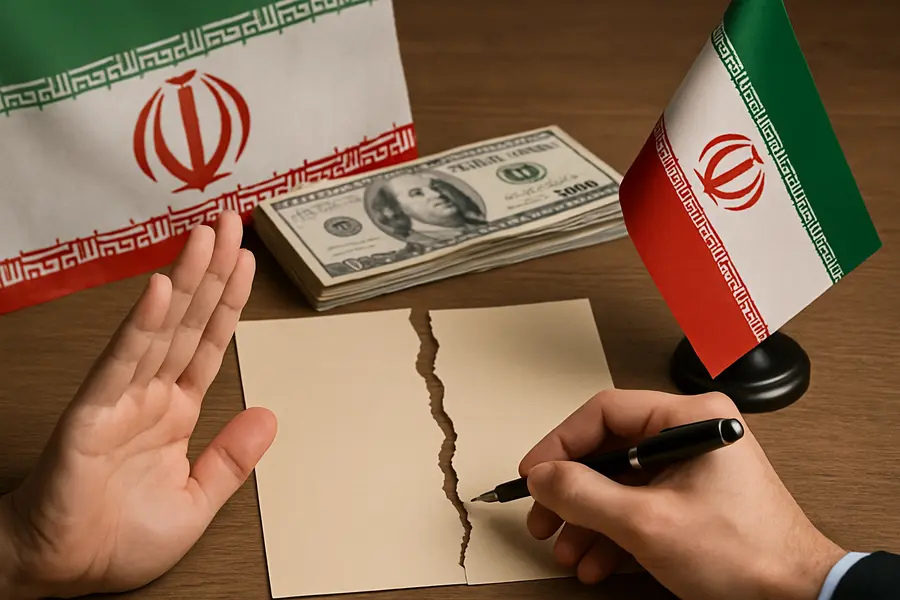
The U.S.-Iran peace accord faces its first crisis as disputed $300 billion reconstruction terms and canceled Swiss talks stir bipartisan backlash in Washington.
- VP Vance canceled his Switzerland trip on June 19 as follow-up technical talks stalled over logistics and Israeli strikes in Lebanon.
- A 14-point MOU references a $300 billion reconstruction fund — a figure Trump dismissed as "Fake News" while prompting wide Republican pushback.
- Oil has retreated from wartime highs above $117 to roughly $80–$83 per barrel, with full supply normalization seen as months away.
Lead
Just 48 hours after President Donald Trump and Iranian President Masoud Pezeshkian signed a 14-point memorandum of understanding at the Palace of Versailles on June 17, 2026, the fragile US-Iran accord encountered its first serious obstacle. The White House announced that Vice President JD Vance would not travel to Switzerland for scheduled follow-up technical talks, while disputed financial provisions — most prominently a reported $300 billion Iranian reconstruction package — triggered a rare bipartisan revolt on Capitol Hill, casting an early shadow over what the administration had billed as a historic step toward Middle East peace.
What Happened
Switzerland's foreign ministry confirmed on June 19 that U.S.-Iran talks scheduled to take place at Bürgenstock would not proceed as planned. A White House spokesperson attributed the cancellation to unfinished logistics and stated that "the plans for the upcoming technical talks have not been finalized." Iranian officials separately cited Israel's continued military operations in Lebanon as a reason for delaying their delegation.
The MOU itself launched a 60-day negotiating window aimed at converting the interim ceasefire into a permanent agreement covering Iran's nuclear program, sanctions relief, regional security arrangements, and control of the Strait of Hormuz. Iran's state-affiliated Mehr News published what it described as the full 14-point draft framework, detailing provisions for an immediate and permanent end to military operations across all fronts, including Lebanon.
The Financial Fault Lines
The political flashpoint centers on the economics of the Iran nuclear deal 2026. The MOU's reported financial terms include the release of approximately $24 billion in frozen Iranian assets during the 60-day negotiation period, plus what Iran's state media characterized as a $300 billion reconstruction fund to be financed through a Gulf coalition.
Vice President Vance, asked directly whether Iran could ultimately access $300 billion, replied: "That's the sort of thing they could have access to, funded by the Gulf coast coalition, so long as they honor their end of the obligation." The statement immediately intensified scrutiny. President Trump moved to distance himself from the figure, labeling it "Fake News, put out by the Dumocrats." White House officials also insisted that no frozen Iranian assets had been released as of June 19, contradicting reporting in Iranian state-linked media.
The gap between those competing narratives underscored the central geopolitical risk of the framework: Washington and Tehran appear to be selling different versions of the same document to their respective domestic audiences, a dynamic that has historically destabilized interim agreements before permanent terms can be finalized.
Congressional Backlash
The financial disclosures prompted a swift and unusually broad rebuke in Congress. Senator Ted Cruz of Texas assailed the prospect of releasing frozen assets and channeling reconstruction funding to Tehran. Senate Armed Services Chairman Roger Wicker warned that any economic relief would ultimately flow to Iranian-backed militant networks. The backlash spread beyond traditional Iran hawks, with several moderate Republicans expressing concern over the scope of the concessions embedded in the MOU.
Senator Lindsey Graham offered a cautious defense of the framework's existence, arguing that without the MOU "there is no diplomatic path to solving the Iranian nuclear problem" and expressing a preference for resolving the dispute through diplomacy rather than renewed conflict. Vice President Vance urged critics to trust the administration's dealmaking track record.
Oil Markets React
Crude oil markets — the most sensitive real-time gauge of the conflict's trajectory — reflected the deal's mixed signals. At the height of military tensions earlier in 2026, U.S. crude surged to $117.63 per barrel and Brent crude reached $111.80, driven by Iran's closure of the Strait of Hormuz, a chokepoint through which roughly 20% of global seaborne oil supply flows.Following the Versailles signing, U.S. crude fell 4.8% to $80.75 per barrel while Brent retreated 4.7% to $83.17. Brent futures contracts through February 2027 remained anchored near $80 per barrel, reflecting market skepticism about how quickly maritime traffic and Iranian output can normalize. Shipowners, insurers, and vessel crews still require independent assurance that the strait is safe before resuming full-scale transit, with energy insiders warning that reopening the Strait does not automatically translate into immediate supply recovery.
Strategic Context
The US-Iran accord represents the diplomatic aftermath of Operation Epic Fury, the joint U.S.-Israel military campaign against Iran that ran from February 28 to May 5, 2026. That conflict disrupted global energy supply chains, roiled insurance and shipping markets, and forced Middle Eastern producers to substantially curtail output.
The 14-point MOU's nuclear provisions call on Tehran to dilute its stockpile of highly-enriched uranium, addressing the core proliferation concern that has animated years of U.S. and international pressure. The deal also commits both sides to removing "all types" of U.S. sanctions against Iran — a sweeping formulation that exceeds the scope of the 2015 JCPOA and has amplified concerns among proliferation analysts and foreign policy hawks alike.
Outlook
The US-Iran accord remains legally operative despite the Swiss setback, but its durability depends on whether the two parties can align their domestic political narratives with a shared set of financial and nuclear commitments. Congressional pressure over the $300 billion figure will test the White House's ability to sell the deal at home, while Israeli military operations in Lebanon introduce an external variable neither side fully controls. The 60-day clock toward a permanent agreement is already running; failure to produce one resets the question of whether Washington or Tehran is prepared to absorb the economic and reputational cost of renewed conflict. Oil markets are pricing in slow, partial supply recovery rather than a clean resolution — a judgment that the first 48 hours of this accord's implementation appears to validate. Middle East peace in 2026 remains a declared objective, not yet a stable equilibrium.