Pomegra
Semiconductors tumbled while the broader market rallied Monday, with Micron and Broadcom both retreating as the Philadelphia Semiconductor Index fell 1.9% in a session marked by a stark divergence between chip stocks and the rest of Wall Street.
- The SOX dropped 1.9% on August 3 as Micron fell roughly 4% and Broadcom retreated, even as the S&P 500 gained 1%.
- Micron extended a month-long slide totaling more than 20%, dragging the stock to approximately $788 — down 35% from its 2026 peak of $1,255.
- Broadcom trades 24% below its 52-week high despite securing $230 billion in new customer commitments, as concerns over Google customer concentration weigh on sentiment.
Lead
The Philadelphia Semiconductor Index (SOX) fell 1.9% on Monday, August 3, 2026, standing apart as the sharpest pocket of weakness in an otherwise buoyant session. The S&P 500 advanced roughly 1% and the Nasdaq 100 added 0.6% as Amazon crossed $3 trillion in market capitalization for the first time — yet semiconductor names moved emphatically in the opposite direction. Micron Technology (MU) dropped approximately 4.2% during the session to trade around $788, while Broadcom (AVGO) also retreated, extending what has become one of the most persistent sector-level divergences of the year.
What Happened
Monday's chip-sector decline is not an isolated event but the latest chapter in a protracted semiconductor selloff that began in late June. The SOX has now fallen more than 28% from its all-time closing high of 14,634.72 reached on June 22, 2026 — a drawdown that has erased more than $3.3 trillion in combined market value from the sector's largest constituents.
For Micron, the session decline brings its cumulative loss from the 2026 peak of approximately $1,255 to roughly 35%. Over the past month alone, shares have shed more than 20%, placing MU in bear-market territory alongside peers SK Hynix and Samsung, which have similarly retreated from multi-year highs. The proximate catalysts include profit-taking after an extraordinary 12-month run, soft preliminary earnings data from Samsung, ongoing AI-valuation reassessments, and competitive pressure from Chinese memory producers.
Broadcom's retreat carries a different set of drivers. Despite the company securing $230 billion in new partnership agreements — including a $200 billion memorandum of understanding with Samsung and a $30 billion commitment from Apple for custom silicon — the stock remains 24% below its 52-week peak. Investor attention has focused on a structural shift in Broadcom chip revenue concentration: Google, historically responsible for approximately 95% of Broadcom's custom AI chip revenue, is expected to redirect a portion of that spend toward MediaTek and in-house silicon, reducing Broadcom's share to roughly 80% by 2027 and 65% by 2028.
Market Reaction
The intraday contrast was stark. As the broader tape celebrated Amazon's cloud-driven earnings surge and absorbed falling oil prices, semiconductor names moved lower with conviction. Memory stocks — Micron, SK Hynix, SanDisk — bore the brunt, while even larger-cap names such as Broadcom and ARM Holdings offered no shelter. Trading volume in chip-focused exchange-traded funds ran above their 20-day averages, suggesting institutional repositioning rather than retail-driven volatility.
The disconnect underscores a broader rotation: investors appear willing to reward cloud infrastructure operators who buy semiconductors, while marking down the chip suppliers themselves amid concerns about demand cycles, customer diversification, and valuation multiples attached to AI growth assumptions.
Strategic Context
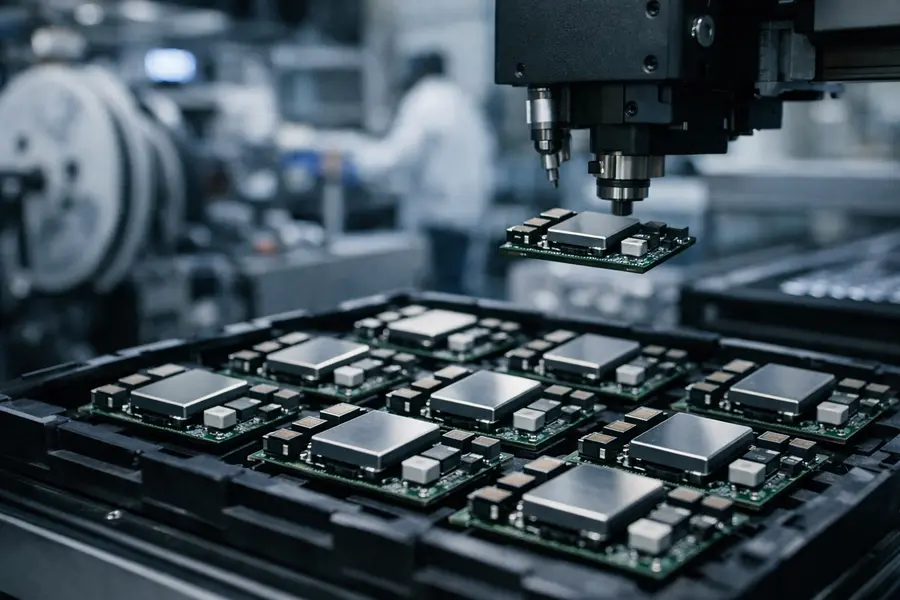
Micron's operational trajectory remains expansionary despite the stock's decline. The company is mid-execution on a $24 billion micron cleanroom expansion in Singapore — adding 700,000 square feet of fabrication space — alongside a $9.3 billion investment in its Hiroshima facility. Fiscal 2026 capital spending has been revised upward to $20 billion from an earlier estimate of $18 billion.
The capacity additions are a direct response to surging demand for high-bandwidth memory (HBM), which AI accelerators require in volumes that stress existing supply chains. A critical constraint is cleanroom lead times: HBM production consumes roughly three times more cleanroom resources per unit than conventional DDR5, and new capacity is not expected to reach meaningful output before late 2027 or 2028. That mismatch between near-term stock pressure and medium-term structural demand has made Micron one of the most debated risk-reward setups in the sector.
For Broadcom, CEO Hock Tan has forecast AI semiconductor revenue approaching $56 billion for fiscal 2026 — nearly triple the prior year — and has set a target of $100 billion in annual AI chip revenue by 2027. The company carries a $73 billion AI backlog. Yet markets are pricing in the erosion of Google concentration, treating the customer-diversification story less as an opportunity and more as evidence of revenue vulnerability at the margin.
AI and Technology Angle
Custom ASIC-based AI server shipments are projected to represent 27.8% of the total market in 2026, growing at 44.6% year-over-year — nearly triple the pace of merchant GPU shipments. Broadcom sits at the center of this structural shift, designing purpose-built chips for Google's Tensor Processing Units and expanding engagements with Anthropic, Meta, and others. The commercial logic is sound; the market's hesitation reflects concern about whether the pace of customer diversification can offset any reduction in Google volumes before fiscal 2027.
Micron's position in HBM places it at an analogous inflection point: every major AI accelerator requires HBM stacks, and Micron is one of three global producers with the process technology to compete. The near-term pressure on memory pricing — driven partly by inventory build-up and China capacity additions — masks a supply environment that most industry analysts expect to tighten materially by 2028.
Outlook
The SOX's 1.9% drop on a day when the S&P gained 1% crystallizes a sector at odds with the broader bull narrative. Semiconductor stocks have priced in peak AI enthusiasm and are now repricing around execution risk, customer concentration, and the pace of new capacity coming online. For Micron, the path forward runs through cleanroom ramp timelines and HBM pricing stability; for Broadcom, it hinges on how quickly new custom-chip customers can replace or supplement declining Google concentration. Neither catalyst is imminent, leaving the sector vulnerable to further rotation until the supply-demand picture in memory and the custom-silicon pipeline clarifies in late 2026 or early 2027.