Pomegra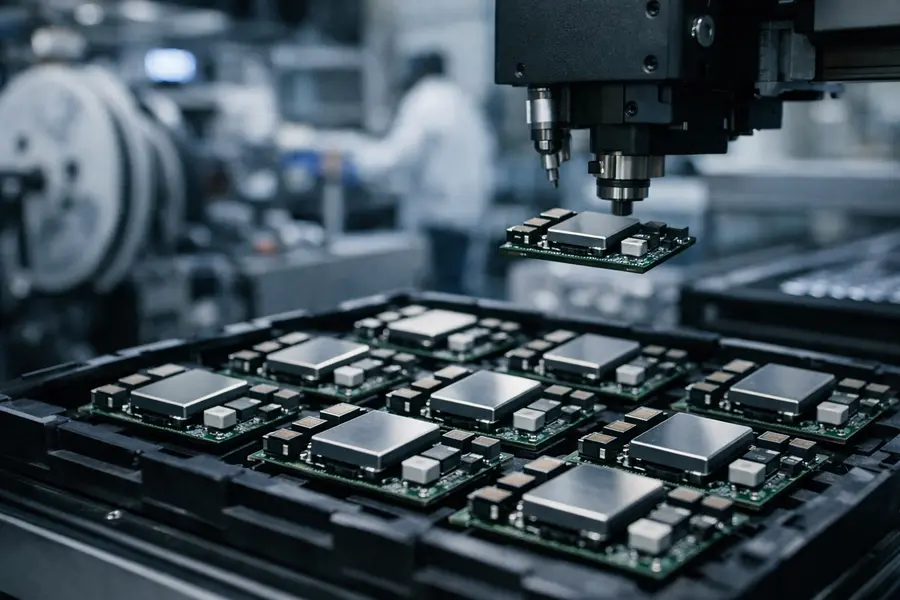
VICR surges 18% as Vicor announces two New Hampshire fab sites and a new VPD license deal, with its order backlog up 145% year over year to $380 million.
- VICR climbed 18.5% on September 17, 2026, as two sequential catalysts - a New Hampshire fab acquisition and a fresh VPD licensing deal - landed within days of each other.
- Vicor is acquiring sites in Merrimack and Hooksett, New Hampshire, for ChiP Fab-2 and Fab-3 with a combined footprint approaching one million square feet.
- Order backlog ended Q2 2026 at approximately $380 million, up 145% year over year and 26% sequentially, underpinning the manufacturing scale-up.
Lead
Vicor Corporation (NASDAQ: VICR) surged 18.5% on September 17, 2026, posting the week's sharpest single-day gain in the semiconductor sector after back-to-back announcements cemented its status as a primary beneficiary of AI infrastructure buildout. On September 11, Vicor disclosed the acquisition of two New Hampshire sites for new ChiP fabs. On September 16, the Andover, Massachusetts-based company granted a non-exclusive Vertical Power Delivery (VPD) license to a major, unnamed AI original equipment manufacturer. Together, the disclosures resolved a central investor question - whether Vicor can match its order intake with manufacturing capacity - with a concrete answer.Why Did VICR Stock Surge 18% in One Session?
The move reflects two catalysts compressing into a single trading event. The fab acquisition, announced six days before the surge, established that Vicor is committing real capital to scale its proprietary Component-in-Package (ChiP) manufacturing. The VPD licensing announcement, released the evening of September 16, confirmed that a leading AI OEM is now a formal licensee of Vicor's power delivery architecture. Markets processed both together on September 17, sending VICR sharply higher and cementing the stock as the week's standout AI infrastructure breakout.
The 145%-year-over-year order backlog provides the financial foundation: with roughly $380 million in orders awaiting fulfillment at the close of Q2 2026, up 26% sequentially, demand is running well ahead of existing capacity. Fab-1 in Andover is approaching full utilization.
Manufacturing Footprint: What Fab-2 and Fab-3 Add
Vicor purchased a 334,000-square-foot building on 66 acres of industrial land in Merrimack, New Hampshire as the designated site for ChiP Fab-2, and separately acquired 54 acres in Hooksett, New Hampshire for Fab-3. The combined footprint of the two facilities will approach nearly one million additional square feet - a multiple of Fab-1's 320,000-square-foot build-out. Vicor estimates a one-year lead time to initial deployment for Fab-2.
The scale signals that the company is not positioning for incremental demand. Hyperscaler and AI OEM procurement cycles require supply chain predictability at datacenter volumes. By securing land and buildings now, Vicor locks in optionality against a backdrop of intensifying competition for industrial real estate near its existing engineering base in the northeastern United States.
What Is Vertical Power Delivery and Why Does the New License Matter?
Vertical Power Delivery is Vicor's architecture for delivering high current at low voltage directly beneath the compute die rather than laterally across a printed circuit board. The lateral approach - dominant in conventional multi-phase voltage regulator and integrated voltage regulator designs - introduces resistance and inductance losses at the point of delivery, a constraint Vicor calls "the last inch problem." VPD resolves it by routing power through the package substrate, enabling the current density that next-generation AI accelerators require.The September 16 license grants a new, unnamed AI OEM the right to procure VPD modules covered by Vicor patents from unlicensed third-party suppliers, preserving multi-source flexibility. OEMs that source VPD modules directly from Vicor receive substantial royalty discounts on commodity VPD volumes procured elsewhere, creating a commercial incentive that ties licensee supply chains to Vicor's manufacturing output. Each new licensing agreement expands the installed base of platforms dependent on VPD compatibility, reinforcing the architecture's position as an emerging datacenter power standard.
Semiconductor sector vehicles including the SMH VanEck Semiconductor ETF and the SOXL leveraged semiconductor ETF captured broader sector tailwinds on September 17, but Vicor's move substantially outpaced both.
Outlook
Vicor exits this week with its manufacturing, licensing, and demand narratives aligned for the first time at scale. A $380 million backlog up 145% year over year justifies the capital commitment to two large New Hampshire sites, while the VPD licensing expansion enlarges the ecosystem of platforms built around Vicor's power delivery IP. With Fab-2 targeting first production in approximately 12 months, the near-term execution focus shifts to construction progress, licensee pipeline, and whether backlog growth sustains its pace into Q3 2026.
Mentioned tickers: VICR, SMH, SOXL