Pomegra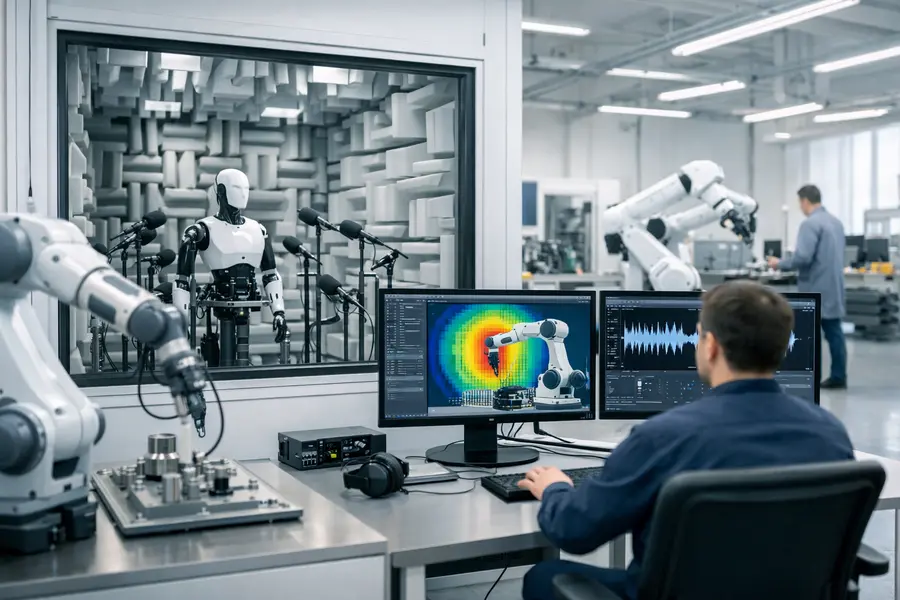
Reykjavík's Treble Technologies closes an $18M Series A-2 led by Paladin Capital to build the acoustic data layer physical AI, robotics, and wearables have been missing.
- Treble Technologies raised $18M in a Series A-2 round led by Paladin Capital Group, with KOMPAS VC, Frumtak Ventures, and the European Innovation Council Fund participating.
- The round brings total funding to €36M and targets expansion of Treble's cloud platform for acoustic simulation, digital twins, and synthetic audio data generation.
- Customers include Amazon and Logitech, signaling traction in voice-enabled hardware at commercial scale.
Lead
Treble Technologies, founded in Reykjavík in 2020 by acoustic engineers Finnur Pind and Jesper Pedersen, announced on September 17, 2026 that it had closed $18 million in a Series A-2 round. Paladin Capital Group led the investment, joined by existing backers KOMPAS VC, Frumtak Ventures, and the European Innovation Council (EIC) Fund. The proceeds will expand Treble's cloud platform for acoustic simulation, acoustic digital twins, and synthetic audio data generation - tools it is now positioning squarely at the physical AI market.
What Does Treble Actually Build?
Treble's core product is a physics-based simulation engine that models how sound propagates through real-world environments. The platform constructs acoustic digital twins - virtual replicas of physical spaces that account for room geometry, materials, reverberation, reflections, competing noise sources, microphone placement, and device orientation. From those twins, the system generates synthetic audio datasets at scale.
The practical need this addresses is specific. A robot, a pair of hearing-enhancing earbuds, or a smart-home speaker must process speech and spatial audio in conditions that a controlled lab recording can never replicate. Training those systems on data captured in a handful of physical rooms produces models that degrade when conditions shift - which they always do in the real world. Treble's argument is that simulated acoustic environments can generate the training variety that physical recordings cannot match in cost or throughput.
The platform handles speech recognition, enhancement, source separation, noise cancellation, localization, and beamforming - the signal-processing stack on which voice-first hardware depends.
Why Does Physical AI Need Sound Now?
The physical AI category - robots, autonomous vehicles, wearables, and ambient computing devices - has invested heavily in vision. Cameras and lidar have mature simulation pipelines; synthetic visual data is a standard ingredient in training robotics models. Acoustic data has no equivalent infrastructure, and the gap is growing more visible as voice interfaces move from smartphones into embodied systems.
Treble's pitch is that acoustic simulation is to physical AI what visual simulation was to autonomous driving five years ago: a precondition for scale that the industry has not yet solved. The €36M total raised since 2020 reflects genuine investor conviction that this gap is real. Whether Treble can own the category before the large cloud providers build their own tooling is a different question.
Paladin Capital Group - a firm with a track record in defense-adjacent and dual-use technology - leading the round adds a dimension worth noting. Acoustic simulation has direct applications in robotics and in environments where voice command is operationally critical. The investor profile fits.
What Did the Earlier Rounds Fund?
Treble raised a €8M seed round and a €11M Series A before this extension. The Series A closed in 2024, meaning the gap to the current Series A-2 is roughly two years. An A-2 rather than a full Series B typically signals that the company hit meaningful milestones but not the growth rate that would command a step-up to the next lettered round. Total capital of €36M for a six-year-old Icelandic deeptech startup is not thin, but it means Treble is still in the build phase rather than the expansion phase its announcement implies.
Amazon and Logitech as named customers give the story credibility. Both companies sell voice-first hardware at volume and both have strong incentives to improve the acoustic performance of their devices without relying solely on field data.
Outlook
Treble enters a market where the demand signal is clear and the competitive set is thin. The acoustic simulation gap in physical AI training pipelines is well-documented inside the robotics and wearables industries. The $18M raised today will likely go toward expanding the cloud platform's data generation throughput, deepening integrations with robotics development environments, and growing a sales team capable of reaching the hardware companies that need what Treble builds. Valuation was not disclosed. The company's next inflection point will be whether it can convert the Amazon and Logitech relationships - and the credibility they carry - into a broader customer base before the window narrows.