Pomegra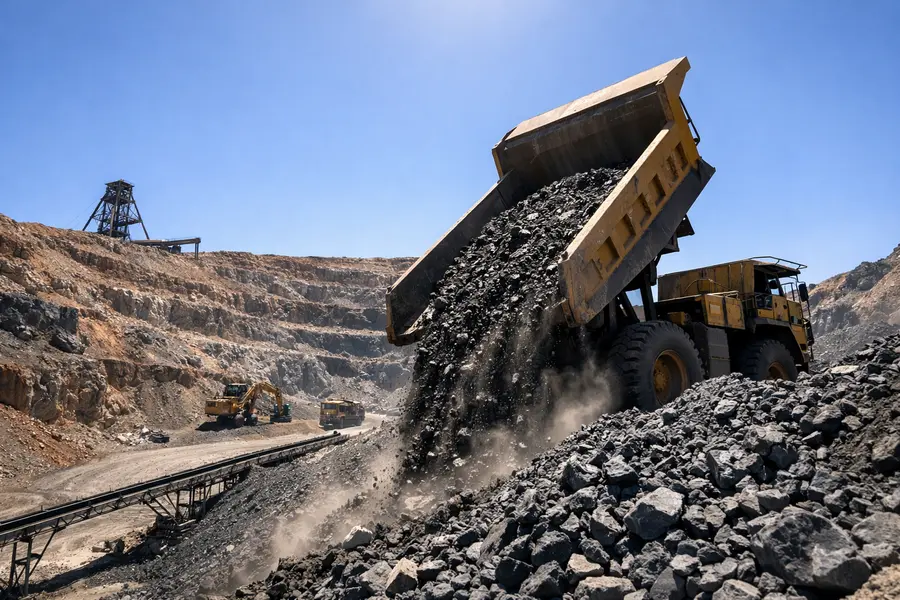
Australia's sydney exchange benchmark slid to 9,115.2 on August 14, 2026, with materials losses overwhelming the asx board's technology gains as Wall Street hit fresh record highs.
- ASX 200 shed 0.80% to close at 9,115.2, marking a third consecutive session of losses and its fifth-session decline of 1.60%
- Materials tumbled 2.58%, the worst sector on the day, as iron ore held near US$98 per tonne with no catalyst for recovery
- Nasdaq 100 surged 9.3% over four sessions and the S&P 500 reached an all-time intraday high above 7,800, underscoring the divergence
Lead
Sydney — Australia's ASX 200 closed down 0.80% at 9,115.2 on Thursday, August 14, 2026, pulled lower by a broad rout in the mining and materials sector even as global technology stocks extended one of their sharpest rallies in more than a year. The index, which sits 1.95% below its 52-week high, has now lost ground in each of its last three sessions, with falling commodity prices and domestic earnings uncertainty offsetting the tailwind from a Wall Street melt-up that added US$3.5 trillion in Nasdaq 100 market capitalisation over four trading days.What Happened
The Materials sector led declines, shedding 2.58%, as weakening base metals and iron ore provided little incentive to hold resource stocks. BHP Group (ASX: BHP) fell 2.5% and Rio Tinto (ASX: RIO) slid more than 3% in the previous session, extending pressure into Thursday's trade. Iron ore held around US$98 per tonne, a level that constrains earnings upgrades for the large-cap mining names that anchor the asx board's weight.
Industrials dropped 1.38% and Real Estate eased 0.74%, while Health Care fell 0.68% and Energy dipped 0.31%. Financials gave back 0.12%, with Commonwealth Bank of Australia (ASX: CBA) retreating for a second straight session despite reporting a cash net profit of A$10.98 billion for fiscal year 2026 — a 7% increase on the prior year — as investors focused on rising loan impairments and a 16% jump in technology expenditure.Against that backdrop, the sydney exchange's Information Technology sector rose 2.83%, extending its five-session advance to 3.59%, mirroring the global tech surge but insufficient to rescue the broader index.
Market Reaction
The divergence between the ASX 200 and its global peers was stark. The S&P 500 reached an all-time intraday high above 7,800, driven by easing inflation expectations and strong momentum in semiconductor and cloud-infrastructure stocks. The Nasdaq Composite gained 5.2% for the week, with Coreweave up 24% and Super Micro Computer up 18% among the leaders. The four-session, US$3.5 trillion Nasdaq 100 rally was the fastest since April 2025.
The Australian dollar traded at US$0.7081, up 0.30% on the session, a modest recovery underpinned partly by copper's 3.5% rise to US$13,791 per tonne. The AUD remains sensitive to commodity prices as a resource-linked currency, and persistent softness in iron ore continues to constrain the currency's upside.
Strategic Context
Australia's sydney exchange has entered its August earnings season with high expectations — consensus forecasts pointed to the ASX 200's first aggregate profit growth in four years. Commonwealth Bank's result illustrated the tension: headline earnings beat estimates, with Business Banking growing lending 13% and contributing 41% of group cash profit, yet the market penalised the stock over cost inflation and credit quality signals.
For Materials, the structural challenge is more acute. Iron ore demand from China remains subdued relative to the levels that underpinned the asx board's resource rally in prior years, and no near-term catalyst is evident to push prices materially higher from current levels.
The Reserve Bank of Australia has tightened the cash rate three times in 2026 — in February, March, and May — lifting it to 4.35%. The Board held in June and met on August 11, with major domestic banks expecting no change. The rate environment adds to cost pressures for domestically oriented sectors including Real Estate and Industrials, compressing valuations even as global risk appetite recovers.
Geopolitical and Macro Dimension
The global technology rally was partly fuelled by receding inflation fears in the United States, which relieved pressure on the Federal Reserve's policy trajectory and encouraged rotation into growth assets. That dynamic benefits AI-adjacent names on major US exchanges more than commodity-heavy bourses such as the sydney exchange, where mining and energy companies represent a proportionally larger share of index weight.
Australia's exposure to Chinese economic activity — both through direct commodity trade and via the AUD — means the ASX 200 remains sensitive to any deterioration in Chinese industrial demand, a risk that has been present but managed in recent months. Copper's outperformance on the day — driven by supply constraints and green-energy demand — offered a partial offset, but iron ore's flatness kept Materials in the red.
What Comes Next
Earnings season on the asx board will continue through late August, with results from major Industrials, Energy, and Health Care names providing the next fundamental tests. Markets will also assess whether the RBA's August policy commentary signals any appetite for further tightening before year-end, a variable that carries particular weight for rate-sensitive Real Estate and lending-dependent Financials.
On the global side, whether the Nasdaq's four-session surge consolidates or corrects will influence risk appetite for technology holdings on the sydney exchange. Should commodity prices stabilise and Chinese demand data improve, the Materials sector has the scale to drive a rapid reversal for the index.
Outlook
The ASX 200's underperformance against a surging global tech backdrop reflects a structural composition mismatch rather than a purely sentiment-driven move. Until iron ore prices recover or Australian earnings surprise convincingly to the upside, the sydney exchange index faces a headwind that technology alone — even in a strong global cycle — is unlikely to overcome. The near-term path hinges on commodity price direction, RBA guidance, and the quality of results still to come in the August reporting season.
Mentioned tickers: ASX: BHP, ASX: RIO, ASX: CBA