Pomegra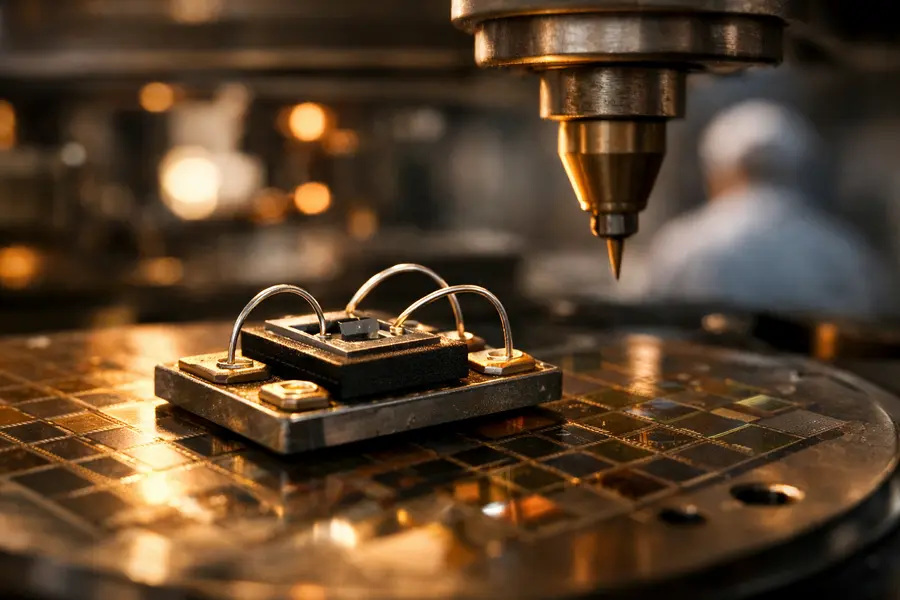
Navitas Semiconductor (NVTS) rose about 8% after the U.S. Army selected it to develop next-generation 10 kV silicon carbide chips under the ALATTIS program.
- NVTS opened at $12.81 on Sept. 29, up from an $11.73 close, after a 20% after-hours surge on Sept. 28.
- The Army picked Navitas for ALATTIS, a prototype program for domestic 10 kV silicon carbide IGBTs.
- The award value was not disclosed, and Navitas is still shifting its revenue toward AI infrastructure.
Lead
Navitas Semiconductor (Nasdaq: NVTS) shares traded roughly 8% to 9% higher on Tuesday, Sept. 29, 2026. The move followed the company's announcement the previous evening that the U.S. Army Research Laboratory had selected it for the ALATTIS program, short for Accelerated, Large-Area, 10 kV SiC IGBT. The stock gapped up to $12.81 at the open from a prior close of $11.73 and reached about $12.77 in early trading. Volume topped 13 million shares. Shares had climbed 20% in after-hours trading Monday and touched $13.15 in premarket trading, so the regular-session gain was smaller than the overnight jump.What Did the U.S. Army Award Navitas?
The Army awarded Navitas a prototype development project to build and validate a domestic manufacturing process for ultra-high-voltage silicon carbide (SiC) power devices. The work centers on 10 kV insulated-gate bipolar transistors (IGBTs) and matching PiN diodes for mission-critical Armed Forces systems. It also has applications in grid and infrastructure equipment.
The Army chose Navitas after a competitive evaluation among U.S. SiC technology companies. It cited the company's ultra-high-voltage know-how and its U.S.-anchored supply chain. Navitas will use its proprietary trench-assisted planar (TAP) architecture.
Neither side disclosed a dollar value or a timeline. That is typical of early-stage defense prototype work, where the first contract funds design and validation rather than volume production.
Siddarth Sundaresan, senior vice president and chief technology officer, said the program lets Navitas extend its leadership beyond SiC MOSFETs into 10 kV IGBTs. The company's GeneSiC portfolio already spans 650 V to 6.5 kV. Its ultra-high-voltage record includes 6.5 kV SiC thyristors in 2010, 10-15 kV PiN diodes in 2012 and commercial 6.5 kV SiC MOSFETs in 2021.
Why Did NVTS Shares React So Sharply?
The reaction reflects a small revenue base and a high-beta stock. Navitas has a market capitalization near $3.1 billion and a beta of about 3.9, so headline news tends to move the shares sharply.
The award also supports a specific narrative. Government selection for a domestic SiC process validates the company's technology and its U.S. manufacturing position at a time when Washington is prioritizing secure supply chains for power electronics.
The financial backdrop is still uneven. Second-quarter 2026 revenue was $10.5 million, up 22% from $8.6 million in the first quarter but down about 27% from a year earlier. The company is deliberately winding down mobile and low-end consumer sales. By year-end it expects nearly all sales to come from high-power markets. The stock traded near its 50-day average of about $12.06 and well below its 200-day average of roughly $15.10 before the news.
How Does the Contract Fit Navitas' AI Strategy?
The contract adds a defense and grid leg to a strategy built mainly around AI infrastructure. Navitas expects AI data centers and grid and energy infrastructure to account for more than one-third of sales by year-end. It has shown a 20 kW, 800 V to 6 V DC-DC power board built on its GaNFast gallium nitride technology, aimed at up to 97.5% peak efficiency. It unveiled the board at the GTC conference of Nvidia (NVDA).
That positioning is why Navitas often trades alongside ai stocks, even though most of its revenue does not yet come from data centers. Company guidance points to third-quarter revenue growth of about 28% at the midpoint. It also points to double-digit sequential growth in the fourth quarter and mid-single-digit growth for the full year.
What Comes Next for Navitas?
The next milestones are disclosure of the award's size and schedule, and evidence that ALATTIS prototypes lead to follow-on production funding. Defense programs of this type often advance in phases, with later stages carrying larger budgets if technical targets are met. Third-quarter results, due in the coming weeks, will show whether AI-related orders are offsetting the consumer wind-down.
Outlook
The Army selection gives Navitas Semiconductor a credential in ultra-high-voltage SiC and a route into defense and grid markets. Its financial profile is unchanged: revenue near $10 million a quarter, losses continuing and an earnings path tied to the AI power build-out. Trading after the announcement showed the market pricing the strategic signal ahead of any confirmed revenue.