Pomegra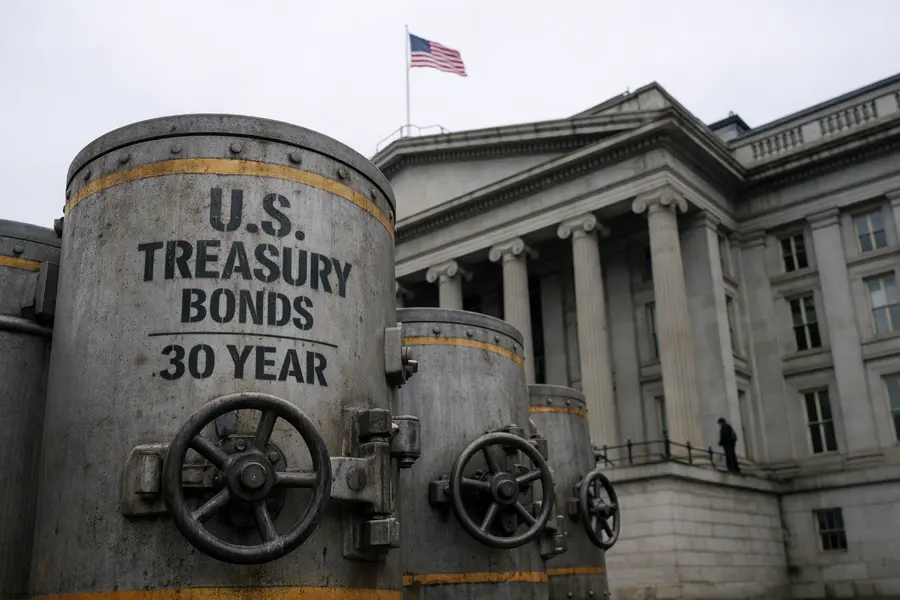
The 30-year Treasury yield topped 5.6% for a sixth straight gain, a 2002 high, pushing the Dow, S&P 500 and Nasdaq to a second losing session on Tuesday.
- The 30-year Treasury yield rose about 5 basis points to roughly 5.60%, touching 5.61% intraday, its highest since June 2002.
- The Dow fell 131.59 points, or 0.26%, to 51,349.92, while the S&P 500 lost 0.16% and the Nasdaq 0.09%.
- Consumer confidence dropped to 81.9, its lowest since 2014, adding growth concerns to the inflation pressure behind the bond selloff.
Lead
The 30-year Treasury yield climbed above 5.6% on Tuesday, September 29, its highest level since June 2002, extending a six-session run and weighing on equities for a second consecutive day. The Dow Jones Industrial Average closed at 51,349.92, down 131.59 points. The S&P 500 slipped 0.16% to 7,670.84 and the Nasdaq Composite fell 0.09% to 26,797.54. All three indexes finished well above their session lows. Bank shares were among the weaker groups, with JPMorgan Chase (JPM), Morgan Stanley (MS) and Bank of America (BAC) all lower. Any read of the stock market today now runs through the long end of the bond market.
What Happened to Treasury Yields and Stocks?
Long-dated Treasury yields rose again on Tuesday while equities gave back ground for a second day. The 30-year yield touched 5.61% during the session and settled near 5.60%. The benchmark 10-year note yield reached 5.29% at its session high, a multiyear peak.
Yields move inversely to prices, so a sixth straight rise means bondholders at the long end have absorbed six sessions of losses. The pace matters as much as the level. Higher long-term yields raise the discount rate applied to future corporate earnings, which pressures the largest growth stocks most. That helps explain why the Nasdaq weakened even in a session of modest index moves.
Losses in the major averages stayed contained. The Dow's 0.26% decline was the largest of the three, and the Nasdaq's 0.09% dip was the smallest. Monday's session had been sharper, with the Dow down more than 300 points at one stage as yields climbed.
Why Are Long-Term Yields Rising?
Long-term yields are rising because inflation concerns, heavy debt issuance and an energy shock are converging. The war involving Iran is in its seventh month and has kept energy prices elevated, with crude trading near $93 a barrel on Monday after topping $100 earlier in September. Higher fuel costs feed directly into consumer prices and into expectations for how long borrowing costs stay restrictive.
Supply is a second driver. Large government borrowing needs and a heavy calendar of corporate-debt issuance have pushed more long-dated paper into the market at a time when buyers are demanding greater compensation. That extra compensation, known as term premium, has widened as investors weigh inflation risk and fiscal deficits over a multidecade horizon.
The 5.6% mark also carries symbolic weight. The 30-year yield last traded at this level in mid-2002, before the housing boom, the global financial crisis and more than a decade of near-zero policy rates. Levels not seen in that span reset the benchmark for mortgages, corporate bonds and pension liabilities.
How Does the Bond Selloff Affect the Fed's Next Move?
The selloff complicates the federal reserve's path because it tightens financial conditions without the central bank acting. The Fed raised its benchmark rate by 25 basis points to a target range of 3.75%-4% on September 16, its first increase since 2023. Updated projections from that meeting showed a strong majority of officials seeing scope for one more hike later this year.
Markets are pricing that risk as energy costs persist. Long-term yields sitting well above the policy rate signal that investors doubt inflation will settle quickly, and they raise the cost of credit across the economy on their own. A steeper curve can do some of the Fed's tightening, which some policymakers may see as a reason to hold off. Others may read it as confirmation that inflation expectations remain unanchored.
Consumer Confidence Adds a Growth Warning
Consumer sentiment weakened sharply on Tuesday. The Conference Board's confidence index fell 6.7 points to 81.9 in September from 88.6 in August, its lowest reading since 2014 and far below the 89 economists had forecast. The Present Situation Index dropped 7.9 points to 109.3. The Expectations Index fell 5.9 points to 63.6, its third consecutive monthly decline.
Respondents cited elevated energy prices, rising costs and job worries. The combination of falling confidence and rising yields is the pairing markets find hardest to price. Higher rates usually accompany strong growth. Here they coincide with weakening household sentiment, which raises the risk of slower consumption just as borrowing costs rise.
How Are Financial Stocks and Growth Shares Responding?
Bank stocks lost ground as the yield rise deepened concerns about unrealized losses on bond portfolios and about credit quality if the consumer softens. Higher long-term rates can lift net interest margins, but a rapid move raises funding costs and pressures the value of securities holdings. Technology and other long-duration equities, whose valuations rest on earnings far in the future, remain sensitive to each step higher in the 30-year yield.
Outlook
The next tests for the market are inflation readings, the Fed's response to rising long-term borrowing costs and the path of crude oil. A pullback in energy prices would ease pressure on both yields and consumer sentiment. Further increases in the 30-year yield beyond 5.6% would extend a repricing of long-dated debt that has already pushed the Dow, S&P 500 and Nasdaq into back-to-back declines.
Mentioned tickers: JPM, MS, BAC