Pomegra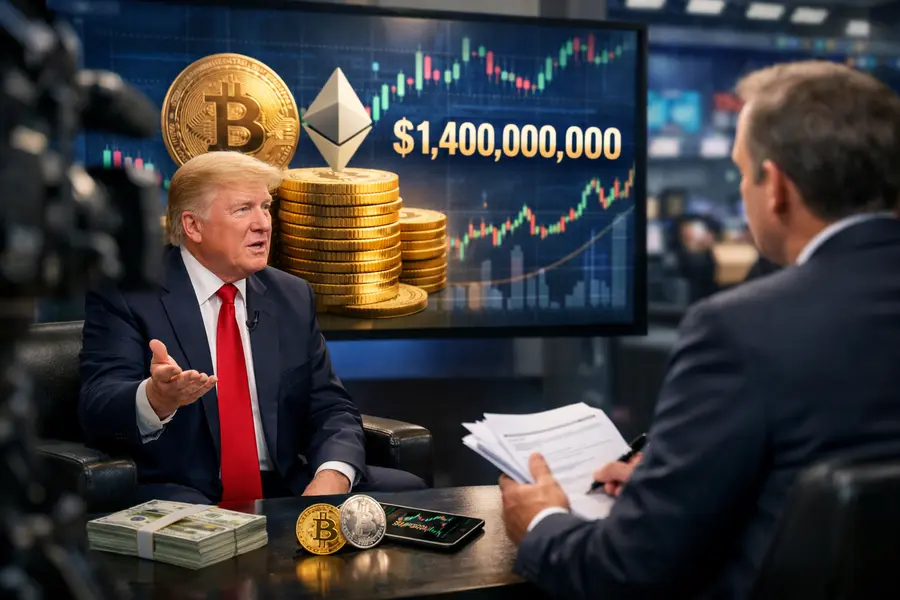
Trump told CNBC's Joe Kernen his crypto earnings are managed legally through family accounts, as his 2025 financial disclosure revealed over $1.4 billion in cryptocurrency-related income.
- Trump's 2025 financial disclosure shows $1.4B+ in crypto income, including $635M in memecoin royalties and $580M tied to World Liberty Financial.
- Trump said son Eric handles his finances while he is in office, describing the arrangement as "semi-blind trusts or blind trusts."
- The president cited federal conflict-of-interest law, which does not require the president to recuse from decisions that may affect personal finances.
Lead
President Donald Trump, in an exclusive interview with CNBC's Joe Kernen conducted at the White House Oval Office on July 2, 2026, defended more than $1.4 billion in cryptocurrency-related income disclosed in his 2025 annual financial filing, calling the gains entirely lawful and attributing oversight of his holdings to his adult son Eric. The interview came within days of Trump's financial disclosure being made public, showing record earnings from two primary crypto ventures — his World Liberty Financial token enterprise and his memecoin business — and reigniting the crypto regulation debate at the highest levels of American politics.
What Happened
Trump's 2025 financial disclosure, released on June 30, documented earnings that dwarf those of any prior sitting U.S. president. The filing listed approximately $515 million from the sale of tokens issued by World Liberty Financial (WLFI), the crypto company co-founded by members of the Trump family and the sons of U.S. envoy Steve Witkoff, with Trump listed as "co-founder emeritus." An additional $65 million came from equity sales in WLF's holding company, and more than $290 million was routed through crypto wallets associated with the venture.
Separate from WLFI, Trump's memecoin business, CIC Digital, generated over $635 million — predominantly through royalties tied to a licensing agreement for what the filing described as "Celebration Coins." The $TRUMP token was launched days before his inauguration in January 2025.
Across all Trump family business crypto ventures, cumulative cash-outs have reached approximately $1.9 billion, underscoring the scale of political wealth generated from digital assets during the administration's first year.
Trump's Defense in the CNBC Interview
In the Trump crypto gains interview, the president was direct. "There's nothing illegal," Trump told Kernen, adding that his son Eric manages the financial operations while he is in office. "My son Eric handles it — I don't talk to him about things such as this." Trump described the financial arrangement as involving "semi-blind trusts or blind trusts," though he declined to name the firms overseeing the holdings.
Trump pointed specifically to federal conflict-of-interest statutes, noting that unlike most executive branch officials, the president and vice president are explicitly exempt from recusal requirements tied to personal financial interests. The White House echoed this position. "Neither the President nor his family has ever engaged — or will ever engage — in conflicts of interest," a spokeswoman said.
On the broader crypto regulation debate, Trump pivoted to strategic competition, stating: "We have to be at the top, otherwise China is going to take it over." The comment reframes the administration's permissive stance on presidential crypto participation as a matter of national economic priority rather than personal enrichment.
Crypto Regulation Debate and Political Fallout
The disclosure has drawn a sharper line in the ongoing crypto regulation debate on Capitol Hill. Congressional Democrats have argued the scale of earnings from assets whose regulatory fate is determined in part by White House policy represents an unprecedented conflict, pointing particularly to World Liberty Financial's push to secure a federal bank charter — a process overseen by regulators that report to the executive branch.
Ethics watchdogs have also flagged the WLFI token's performance as a complicating factor. The token currently trades near $0.057, down approximately 72% from its peak, meaning retail buyers who purchased the coin near its highs have suffered substantial losses even as the Trump family's revenue model — structured around transaction fees and licensing royalties rather than token appreciation — insulated the issuer from price declines.
The Trump family business structure in crypto follows a model common in token launches: revenue is extracted upfront or through recurring fees, detaching issuer economics from the secondary market performance that ordinary investors experience. Critics argue this dynamic, combined with the president's public promotion of the assets, raises questions about disclosure and investor protection that existing securities law does not cleanly address.
Legal Framework and Precedent
Federal ethics law has historically exempted the presidency from the conflict-of-interest provisions that apply to cabinet members and agency officials under 18 U.S.C. § 208. The Trump administration's position is that this exemption is constitutionally appropriate, given the unique nature of executive power. Legal scholars are divided on whether the scope and scale of the financial interests now at stake — particularly in regulated industries like banking and digital assets — fall within the spirit of that exemption or expose a structural gap in the law.
The political wealth being generated has no direct analog in prior administrations. While past presidents have faced scrutiny over blind trust arrangements and post-service income, no sitting president has previously disclosed nine-figure annual earnings from financial products actively traded in markets subject to federal oversight.
Market and Regulatory Backdrop
The CNBC interview occurred against a broader shift in U.S. crypto policy. The administration has moved to establish a regulatory framework that treats most digital tokens as commodities rather than securities, reducing the jurisdiction of the Securities and Exchange Commission over primary token sales. Legislative proposals advancing through Congress in mid-2026 would codify that approach, with some versions containing explicit carve-outs that critics argue benefit structures similar to WLFI.
Bitcoin and major digital assets have held relatively firm in recent sessions, with the broader market largely absorbing the disclosure as confirmation of the administration's pro-crypto posture rather than a destabilizing event.
Outlook
The Trump crypto gains interview crystallizes a debate that is likely to extend through the remainder of the administration and into the 2026 midterm cycle. The combination of record political wealth disclosures, an active Trump family business stake in a federally regulated sector, and an ongoing crypto regulation debate in Congress creates a durable political and legal flashpoint. Whether existing conflict-of-interest frameworks are sufficient to address presidential-scale crypto participation — or whether new legislation is required — will remain an open question as both the White House and congressional committees press forward with their competing regulatory visions.
Mentioned tickers: WLFI, BTC, ETH