Pomegra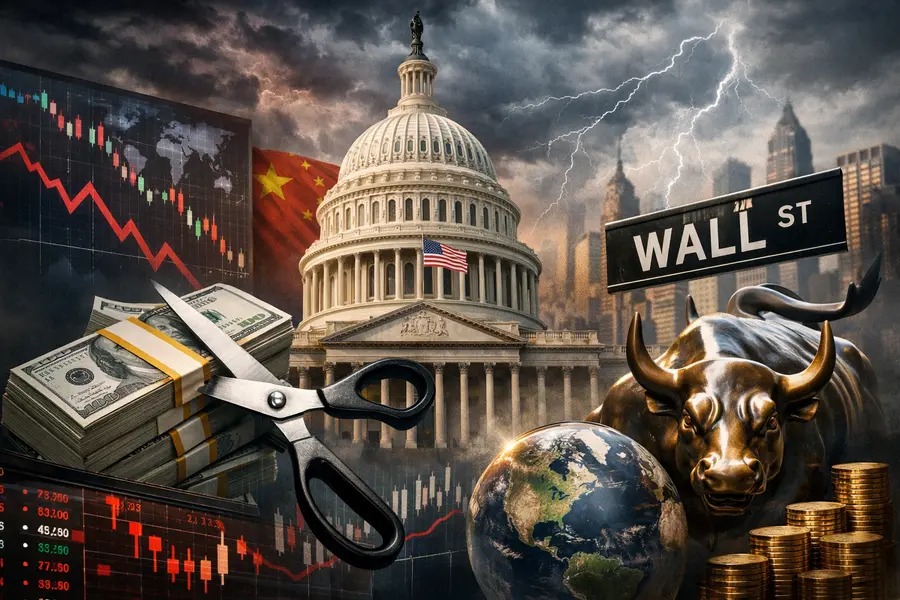
Global hedge funds and institutional investors are systematically reducing hedge fund US exposure in 2026, pivoting capital toward Europe and Asia-Pacific as tariff volatility, dollar weakness, and an unpredictable regulatory environment cloud the US outlook for the year's second half.
- Just 25% of institutional investors plan to increase US allocations in 2026, versus 46% boosting Europe and 44% adding Asia-Pacific exposure.
- Short positions on US equity ETFs surged 17% as global investment risks multiplied from trade policy swings and geopolitical tension.
- Goldman Sachs prime brokerage data show hedge funds recorded their worst monthly drawdown in more than four years in April 2026, coinciding with peak tariff uncertainty.
What Happened
The reallocation gathered pace in the first quarter of 2026 and has accelerated into midyear. Data from leading prime brokerages, including Goldman Sachs (GS) and JPMorgan (JPM) — which together service more than $2.8 trillion in hedge fund assets — confirm that demand for North America-focused strategies has fallen materially over the past year, while appetite for Europe and emerging-market mandates has climbed to levels not seen since 2022.
A February 2026 Reuters report framed the rebalancing around three converging pressures: US-led trade tensions, pain from a weakening dollar, and fragility among mega-cap technology names that had underpinned US benchmark performance for two consecutive years.
Regulatory and Policy Drivers
The single most disruptive variable is tariff policy. The Trump administration's use of the International Emergency Economic Powers Act (IEEPA) as the basis for sweeping import levies now faces a Supreme Court challenge. An adverse ruling could unwind the legal architecture supporting some of the most market-moving trade measures of the cycle.
Simultaneously, the administration has signaled that tariffs on pharmaceuticals could approach 200% by mid-to-late 2026, dramatically expanding the roster of S&P 500 sectors exposed to global investment risks tied to trade retaliation and supply-chain disruption. The regulatory environment for cross-border M&A has grown less predictable, reducing deal flow that historically benefited institutional investor returns in US equities.
This confluence of factors has made the US market — in the language of prime brokerage positioning notes — "crowded, concentrated, and policy-sensitive," prompting fund managers to seek alternatives.
Capital Rotation: Where the Money Is Moving
A Natixis Investment Managers survey of large institutional investor cohorts found that 46% plan to increase European allocations in 2026, 44% are adding Asia-Pacific exposure, and 42% are moving into Emerging Asia — compared with just 25% expanding US positions. The asymmetry reflects both valuation discipline and a structural reassessment of American market dominance.
The MSCI Emerging Markets Index rose nearly 11% in January 2026 alone, drawing allocator attention to a rotation that analysts describe as deconcentration rather than outright liquidation. Hedge fund gross and net allocations in Emerging Markets ex-China reached record highs during 2025, according to Goldman Sachs prime brokerage data, and that trajectory has continued into 2026.
In Europe, portfolio managers at major multi-strategy funds argue that stock dispersion has increased meaningfully across the continent, creating a richer environment for market-neutral long/short approaches — a strategy design that allows funds to reduce directional hedge fund US exposure without exiting equities entirely.
The Dollar Dimension
A weaker US dollar compounds the rotation dynamic. The greenback has been on a declining path through 2026, partly driven by tariff-induced uncertainty and diverging rate expectations between the Federal Reserve and other major central banks. ING and Investing.com analyses characterize the dollar's trajectory as more cyclical than structural, but for international fund managers running unhedged portfolios, the currency drag from US assets has materially eroded returns in local-currency terms.
With overseas USD hedge ratios at historically low levels and the cost of hedging USD exposure set to decline further, the incentive to reduce unhedged US positions has grown. Goldman Sachs Asset Management and Man Group's Q2 2026 strategy outlook both flag dollar softness as a persistent headwind to risk-adjusted returns in North American equities for the remainder of the year.
Nuance in the Flows
The rotation is not a wholesale exit. Foreign investors acquired $878 billion in US financial assets through July 2026, up sharply from $558 billion in the comparable prior-year period. The April 2026 period — corresponding to "Liberation Day" tariff announcements — saw significant outflows, but subsequent months partially reversed that move as markets recalibrated.
The pattern suggests that hedge funds and institutional managers are not abandoning the US but are trimming net long exposure, adding short positions, and blending new international allocations into portfolios to moderate concentration risk. US equity ETF short positions rising 17% year-over-year is consistent with this thesis: managers are hedging, not evacuating.
Geopolitical Dimension
Escalating tensions in the Middle East have added an energy price shock premium to the risk calculus. Rising oil prices linked to Iran-related conflict have renewed inflation concerns in an economy still managing above-target price pressures. For equity-oriented institutional investor portfolios, the prospect of a fresh inflationary impulse — combined with the Federal Reserve's constrained room to maneuver — adds another layer of complexity to US duration and equity forecasts.
The AI and semiconductor sector, long the anchor of US equity outperformance, remains exposed to export-control friction between the United States and China. Hedge fund net exposure to software stocks fell to five-year lows in late 2025, while semiconductor positions moved in the opposite direction — but both remain subject to rapid policy-driven reversals.
Outlook
The second half of 2026 presents a US market that remains capital-attracting on an absolute basis but faces a structural challenge to the exceptionalism narrative that drove decade-long outperformance. The combination of regulatory volatility, a softening dollar, tariff litigation risk, and geopolitical turbulence has given institutional investor allocators credible reasons to diversify hedge fund US exposure at the margin.
A Supreme Court ruling on IEEPA tariff authority, Federal Reserve policy signals in September, and the trajectory of Middle East energy disruption will be the pivotal variables shaping the US outlook for the remainder of the year. Until those uncertainties clear, the geographic diversification underway is more likely to deepen than reverse.
Mentioned tickers: GS, JPM, SPY, EEM, IEMG