Pomegra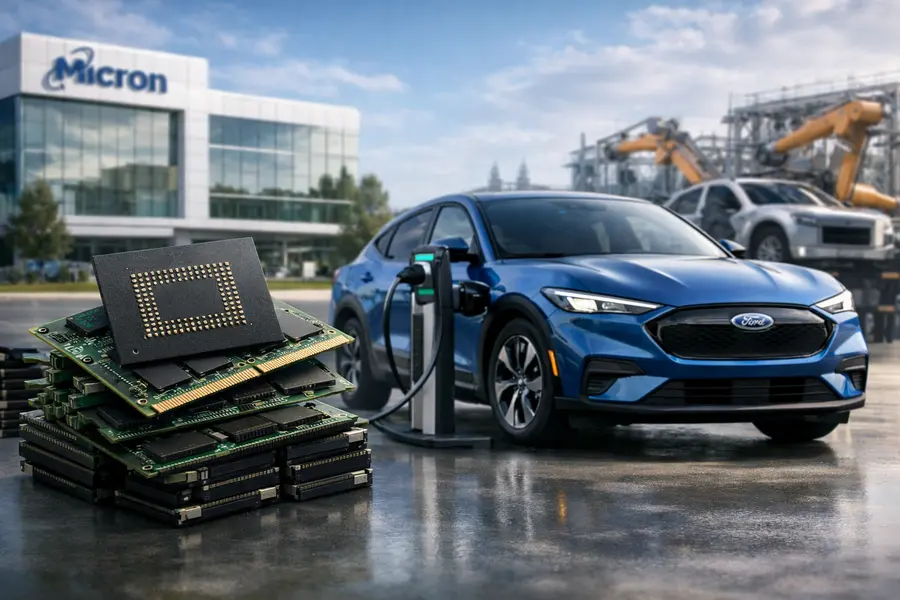
Micron and Ford signed a long-term chip agreement July 6 to secure memory and storage for next-generation EVs as automotive semiconductor demand tightens.
- The Micron Ford chip deal covers DRAM, NAND, and NOR memory for Ford's next-gen vehicle programs, backed by Micron's $2 billion Virginia fab expansion.
- The pact is one of 16 strategic customer agreements Micron outlined on its fiscal Q3 2026 earnings call, carrying a three-year automotive term.
- Ford shares gained roughly 4% on announcement day; Micron briefly surpassed $1,000 intraday before closing below that level.
Lead
Micron Technology and Ford Motor Company announced a long-term Strategic Customer Agreement on July 6, 2026, securing a prioritized supply of automotive-grade DRAM, NAND, and NOR memory for Ford's next-generation vehicle programs. The deal, supported by Micron's $2 billion modernization of its Manassas, Virginia fabrication facility, represents Ford's most direct commitment yet to stabilizing its electric vehicle supply chain against a tightening chip market that has driven DRAM prices up roughly 70% since December 2025.What Happened
Under the agreement, Micron will deliver a portfolio of high-performance memory and storage products engineered for the extended product lifecycles that automotive applications require. Financial terms and volume commitments were not disclosed. The contract carries a three-year term, consistent with Micron's other automotive strategic customer agreements.
The Micron Ford chip deal is one of 16 Strategic Customer Agreements the company disclosed during its fiscal third-quarter 2026 earnings call, spanning multiple industries and customers. For the automotive segment, these agreements are specifically tied to production from the Manassas, Virginia DRAM facility, which entered advanced operations earlier this year and represents Micron's most significant domestic chip-manufacturing investment to date.
Automotive Semiconductor Demand
The agreement reflects a structural increase in automotive semiconductor content as vehicles shift toward software-defined architectures. A modern electric vehicle contains more than 3,000 chips; advanced driver-assistance systems such as Ford's BlueCruise require between 16 and 32 gigabytes of DRAM and up to 256 gigabytes of storage per vehicle. Industry projections place memory content per car on a trajectory to double by 2030.
The 2021–2022 global chip shortage — which idled assembly lines worldwide and cost automakers billions in lost output — accelerated a fundamental change in procurement strategy. Major manufacturers have since abandoned just-in-time component purchasing in favor of long-term supply locks directly with chip producers, reducing dependence on spot markets that amplified the earlier crisis.
Ford Tech Strategy
The supply agreement is a direct enabler of Ford tech strategy around centralized vehicle computing. The automaker is converging functions such as ADAS, infotainment, powertrain management, and vehicle control onto unified system-on-chip platforms that demand higher memory bandwidth and storage capacity than previous distributed architectures. Securing guaranteed access to premium automotive memory from a domestic supplier insulates Ford's production schedule from price spikes and geopolitical supply risk.
Market Reaction
Ford (F) shares rose approximately 4% on July 6. Micron (MU) touched $1,000 intraday — a psychologically significant threshold — before closing below that level, reflecting a positive reception tempered by broader investor caution over semiconductor sector valuations and potential supply-demand cycles ahead. The Micron-Ford announcement followed the company's similar Strategic Customer Agreement with General Motors by five days, underscoring the scale of Micron's automotive push.
Outlook
The Micron-Ford pact signals an accelerating consolidation of the electric vehicle supply chain around long-term bilateral chip commitments. With DRAM prices under sustained upward pressure from AI infrastructure demand, Ford's early positioning in a multi-year supply agreement limits its cost exposure as competitors pursue similar arrangements. Micron's growing roster of 16 strategic automotive and industrial partnerships underpins revenue visibility through at least 2030 and supports the economics of its U.S. manufacturing buildout. Deeper integration between chipmakers and vehicle manufacturers is set to become a defining structural feature of the automotive supply landscape this decade.
Mentioned tickers: MU, F, GM