Pomegra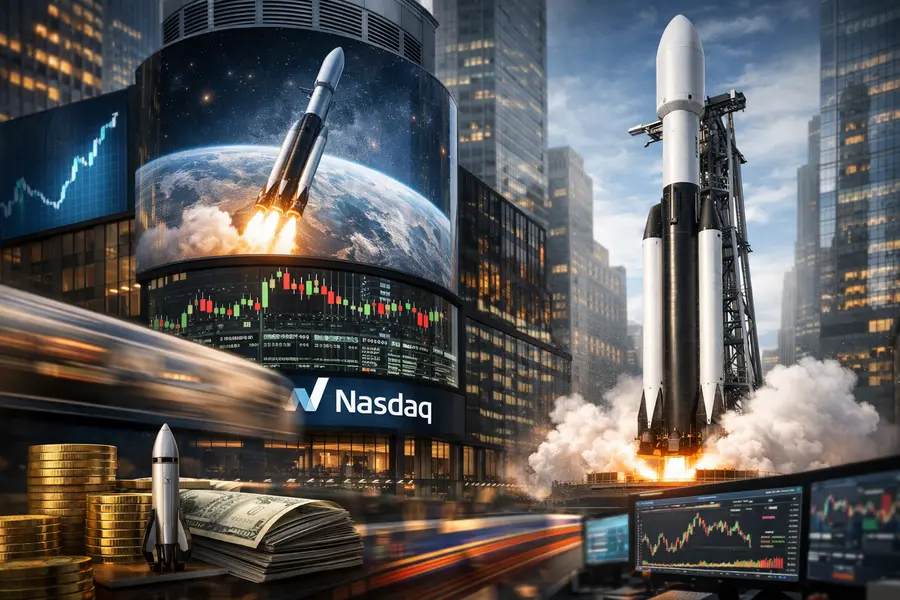
SpaceX (SPCX) becomes the first mega-IPO to join the Nasdaq-100 under new fast-track rules, triggering an estimated $4.3 billion in forced passive buying across index-tracking funds on July 7.
- SpaceX enters the Nasdaq-100 on July 7, exactly 15 trading days after its record June 12 IPO priced at $135 per share.
- Nasdaq's May 2026 methodology change allows top-40 market cap IPOs to bypass the traditional annual reconstitution wait.
- Index-tracking funds face an estimated $4.3 billion in mandatory SPCX purchases; total forced buying across all benchmarks reaches $22–27 billion.
Lead
Space Exploration Technologies Corp., trading as SPCX on the Nasdaq, joined the Nasdaq-100 Index on July 7, 2026 — exactly 15 trading days after completing the largest initial public offering in financial history. The company raised approximately $75 billion at a $135-per-share IPO price on June 12, debuting at a market capitalization of roughly $1.77 trillion. Its entry into the flagship technology index follows a deliberate rule rewrite by Nasdaq Global Indexes that took effect May 1, creating an accelerated pathway for large-cap new listings and reshaping how passive capital flows into transformative IPOs.
What Happened
The SpaceX Nasdaq-100 entry was made possible by a targeted methodology update Nasdaq finalized after a public consultation with market participants. The revised rules establish a "Fast Entry" provision: any newly listed company that ranks among the top 40 constituents by market capitalization qualifies for immediate inclusion after a mandatory 15-trading-day seasoning period, rather than waiting until the next annual reconstitution each December.
SpaceX met that threshold decisively. At its $135 IPO price the company's market cap placed it among the largest Nasdaq-listed companies from day one. The SpaceX IPO closed its first session at $160.95, a 19.2% premium to the offer price, and subsequently traded as high as $201.80 — implying a peak market capitalization above $2.6 trillion — before settling into the $156–162 range in the days preceding index inclusion.
Nasdaq also eliminated the separate minimum float requirement under the new rules, replacing it with a capping mechanism that initially limits the index weight of low-float securities proportionally and scales that weight upward as the float grows. SpaceX's publicly tradeable float at listing was approximately 3% to 5% of shares outstanding, making this provision directly relevant to its index weight and the mechanics of passive rebalancing.
Nasdaq-100 Index Changes and the Rule Rewrite
The Nasdaq-100 index changes announced in May reflect a broader structural shift in how major companies come to market. Businesses have increasingly remained private for longer periods, listing at significantly greater scale and with more complex governance structures — including dual-class and multi-class share arrangements — than was common a decade ago. Traditional index methodologies built for an earlier era struggled to accommodate this evolution without forcing investors to wait up to 12 months before a transformative company entered benchmark portfolios.
Nasdaq's update addresses that friction directly. For fast entry, a company must have completed its listing at least 15 trading days prior, rank among the top 40 Nasdaq-100 constituents by market capitalization, and satisfy existing listing and financial standards. The provision is calibrated to be selective — requiring a minimum top-40 ranking — so it applies only to the most consequential new listings rather than broadly lowering the inclusion bar.
The first quarterly rebalance under the revised methodology took place on June 22, 2026. SpaceX's inclusion on July 7 marks the first application of the Fast Entry rule in a live market setting, establishing a precedent for future large-cap IPOs.
Market Reaction and Forced Buying Mechanics
The SPCX stock trajectory heading into its Nasdaq-100 debut has been shaped significantly by index rebalancing mechanics. Passive funds tracking the Nasdaq-100 — including the Invesco QQQ Trust and Invesco Nasdaq 100 ETF — are required to hold SPCX at a weight proportional to its capped index presence. That obligation translates into an estimated $4.3 billion in mandatory purchases executed at the close of July 6 through the open of July 7.
The impact is amplified by the company's tight public float. When billions of dollars in forced institutional demand encounter a market where only 3% to 5% of shares trade freely, the supply-demand imbalance creates measurable price pressure. Broader passive vehicles tracking large-cap benchmarks beyond the Nasdaq-100 — including Russell index funds — expand the total forced buying obligation, with aggregate passive purchases across all impacted benchmarks estimated between $22 billion and $27 billion.
Funds tracking the Nasdaq-100 must simultaneously trim existing constituent holdings — including large positions in Apple, Microsoft, and Nvidia — to fund the new allocation, redistributing capital at scale irrespective of active managers' views on SpaceX's intrinsic value.
Strategic Context
The S&P 500 declined to follow Nasdaq's lead. S&P Dow Jones Indices rejected a fast-track proposal in June 2026, maintaining its existing requirements of 12 months of trading history and demonstrated GAAP profitability. SpaceX does not satisfy those criteria, placing S&P 500 inclusion no earlier than mid-2027 — and only contingent on the company meeting profitability thresholds by then.
That divergence means the largest single pool of passive equity capital — funds tracking the S&P 500, overseeing an estimated $10 trillion in assets — remains outside SpaceX for at least another year, concentrating near-term index-driven demand entirely within the Nasdaq-100 ecosystem.
Geopolitical and Sector Dimension
SpaceX operates at the intersection of commercial aerospace, satellite broadband, and national defense, giving its public listing a dimension beyond standard technology IPOs. The Starlink network provides communications infrastructure embedded in government and military contracts globally. A publicly traded SpaceX now adds index-level exposure to the commercial space economy for institutional investors worldwide, including sovereign wealth funds and foreign pension systems that benchmark against the Nasdaq-100.
Outlook
The SpaceX Nasdaq-100 entry on July 7, 2026, establishes a new template for how transformative companies transition from private to public markets and integrate into benchmark indices at scale. Nasdaq's Fast Entry provision and the elimination of the minimum float requirement reflect a structural adaptation to an era of larger, later, and more complex listings. The $4.3 billion in Nasdaq-100 forced buying and the broader $22–27 billion in cross-benchmark passive flows underscore the mechanical power of index inclusion at trillion-dollar market capitalizations. Whether the S&P 500 eventually adapts its own methodology — and when SpaceX reaches GAAP profitability — will determine how fully the company integrates into global passive equity portfolios over the next 12 to 24 months.
Mentioned tickers: SPCX, QQQ, QQQM, AAPL, MSFT, NVDA---
Sources:
- [SpaceX joins the Nasdaq-100 on Tuesday. Here's what it means for the stock](https://www.cnbc.com/2026/07/06/spacex-joins-the-nasdaq-100-on-tuesday-what-it-means-for-the-stock.html)
- [SpaceX set for Nasdaq-100 debut on Tuesday after rule change accelerates inclusion](https://finance.yahoo.com/markets/stocks/articles/spacex-set-nasdaq-100-debut-195400738.html)
- [SpaceX to join Nasdaq-100, effective July 7, 2026](https://seekingalpha.com/news/4607865-spacex-to-join-nasdaq-100-effective-july-7-2026)
- [Nasdaq Rewrote Its Rules for SpaceX; Now $4.3B in Passive Buying Forces Index Funds' Hands](https://www.techtimes.com/articles/319768/20260706/nasdaq-rewrote-its-rules-spacex-now-43b-passive-buying-forces-index-funds-hands.htm)
- [Nasdaq‑100 Index® Methodology Update: Why Now, and What It Means](https://www.nasdaq.com/newsroom/nasdaq100-index-methodology-update-why-now)
- [SpaceX IPO takeaways: SPCX closes at $161, jumping 19% after record debut](https://www.cnbc.com/2026/06/12/spacex-ipo-spcx-live-updates.html)
- [SpaceX Nasdaq-100 2026: SPCX Joins the Index July 7](https://thetechmarketer.com/spacex-nasdaq-100-2026/)
- [SpaceX IPO Index Inclusion: How Rule Changes Force Index Funds to Buy SpaceX](https://spotgamma.com/spacex-ipo-index-changes-spotgamma/) }}