Pomegra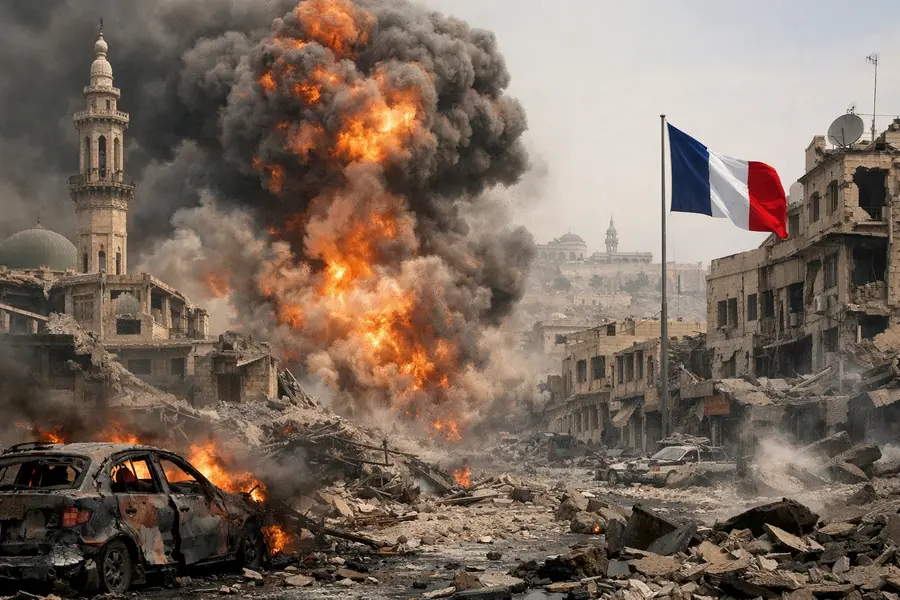
Twin explosions wounded at least 18 people in central Damascus on July 7, 2026, as French President Emmanuel Macron pursued landmark diplomatic talks with Syria's new leadership, exposing fragile security conditions in a country still rebuilding from 13 years of civil war.
- Two explosive devices detonated in central Damascus, wounding at least 18 people including four police officers; no group has claimed responsibility.
- Macron, the first EU head of state to visit post-Assad Syria, was unharmed and 10 kilometers from the blast sites; his talks with President Ahmed al-Sharaa continued uninterrupted.
- Both leaders are traveling to the NATO summit in Ankara, where al-Sharaa is expected to hold a high-profile meeting with U.S. President Donald Trump.
Lead
Two bombs tore through a busy stretch of Damascus city centre on July 7, 2026, wounding at least 18 people — including four police officers — while French President Emmanuel Macron was meeting civil society groups inside the nearby Four Seasons Hotel. The devices detonated roughly eight minutes apart: one concealed in a roadside garbage bin, a second hidden inside a parked car. The blasts struck between Syria's Ministry of Tourism and the national museum, metres from where Macron had spent the night, in the most direct security challenge yet to the government of President Ahmed al-Sharaa.
What Happened
Syrian authorities said explosive specialists were dispatched to the site after the devices were discovered, but both bombs detonated before they could be disarmed. Syria's Interior Ministry confirmed the blast sites fell outside Macron's designated security perimeter and did not directly threaten the French delegation's itinerary. Macron, whose convoy was approximately 10 kilometres away at the time, did not hear the explosions, and the Élysée stated the visit would proceed without alteration.
No militant group had claimed responsibility for the attack as of the time of publication. Syrian security forces launched an immediate investigation into the origin and authorship of both devices.
Macron Syria Visit: A Historic First
The Macron Syria visit carries exceptional diplomatic weight. Macron is the first head of state of a major European Union country to travel to Damascus since rebel forces led by al-Sharaa toppled longtime dictator Bashar al-Assad in December 2024 — a visit that signals a broader Western recalibration toward the new Syrian government.
Speaking upon arrival, Macron stated France's commitment to "a sovereign Syria, united in its diversity and at peace with its neighbours." Substantive meetings centred on post-war reconstruction financing, counterterrorism cooperation, humanitarian assistance, and the normalization of bilateral ties, with the two governments expected to sign multiple memorandums of understanding. France has historically been a leading European power in Levantine affairs, and the visit represents Paris reasserting influence in a strategic corridor connecting the Eastern Mediterranean to the Gulf.
Syria Security and al-Sharaa's Stability Test
For al-Sharaa, the bombing represents a severe test of his administration's control over Syria security. Since seizing Damascus, al-Sharaa — a former al-Qaeda commander turned pragmatic statesman — has invested heavily in projecting stability to attract Western investment, lift international sanctions, and consolidate authority over a country where rival armed factions, remnant Assad loyalists, and foreign-backed proxies remain active. The bombing directly undercuts that narrative at the highest-profile diplomatic moment his government has yet faced.
Syrian state television confirmed 18 wounded in the explosions, with the Interior Ministry seeking to reassure the public that no direct threat was posed to Macron or the Syrian head of state. Nevertheless, the Damascus bomb attack will sharpen scrutiny of the new government's capacity to control Syria's capital and protect senior foreign visitors — a prerequisite for sustained international engagement.
Middle East Geopolitics: NATO Summit Backdrop
The attack lands against a rapidly shifting Middle East geopolitics landscape. Macron arrived in Damascus directly ahead of the NATO summit in Ankara, Turkey, where both he and al-Sharaa are scheduled to travel within hours. At Ankara, al-Sharaa is expected to hold a meeting with U.S. President Donald Trump — a gathering that would mark the most significant American engagement with Syria's new leadership since Assad's fall.
Syria's inclusion in NATO-adjacent diplomacy reflects the speed with which Western capitals have moved to integrate Damascus into regional security frameworks, partly to constrain Iranian and Russian influence in the Levant. For European governments, post-Assad Syria represents both an opportunity — a potential partner against jihadist networks and a destination for reconstruction contracts — and an enduring risk, illustrated starkly by Monday's bombs.
The attack may also complicate the EU's ongoing discussion over lifting the remaining sanctions architecture that was calibrated against the Assad regime but continues to depress Syrian economic activity and deter private investment. Advocates of accelerated sanctions relief will face harder questions about governance and security capacity in Damascus.
What Comes Next
Syria's Interior Ministry said investigators were pursuing leads on the perpetrators. Given the proximity of the blasts to the Macron delegation and the timing of the NATO summit, the attack is likely to be treated as politically motivated, though the absence of any claim of responsibility leaves multiple hypotheses open — including remnant Assad-era security networks, extremist factions opposed to Western engagement, or regional spoilers seeking to destabilize the al-Sharaa government.
Outlook
The Damascus bomb attack during the Macron visit underscores the fragility underlying Syria's diplomatic renaissance. While Macron's decision to continue his programme sends a signal of resolve, the explosions will intensify debate in European capitals over the pace of re-engagement, the robustness of Syria's governing institutions, and the conditions under which reconstruction support should flow. For al-Sharaa, securing the capital — in both physical and symbolic terms — remains the central prerequisite for translating international recognition into economic recovery and long-term political legitimacy.