Pomegra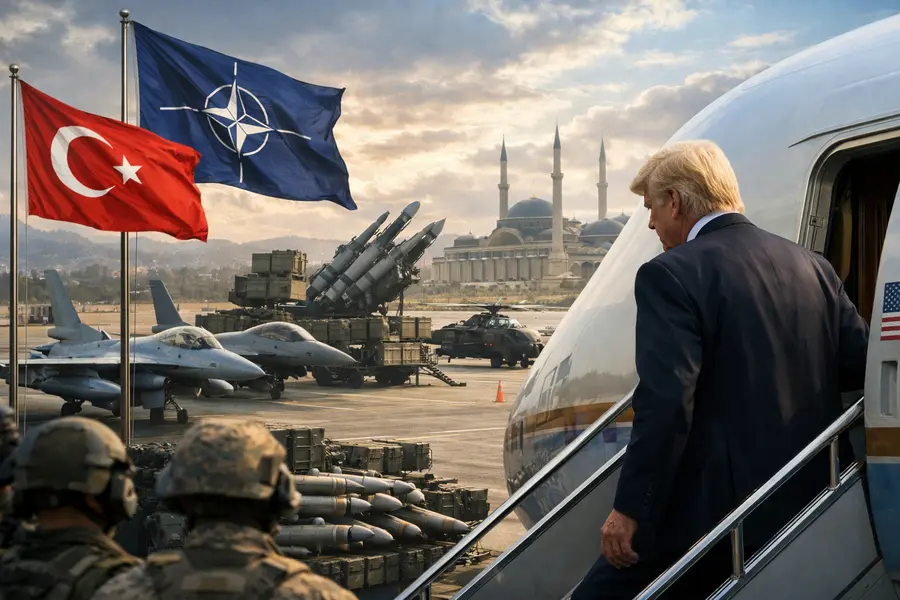
NATO allies unveiled tens of billions in fresh military contracts as U.S. President Trump arrived in Ankara for the 36th NATO summit, with F-35 sales to Turkey and the 5% spending deadline dominating talks.
- NATO Secretary General Rutte announced "tens of billions" in new defense contracts at the Ankara summit, including $40B+ in counter-drone capabilities.
- Trump signaled a potential F-35 sale to Turkey and S-400 sanctions relief, marking a major shift in US Turkey relations.
- All 32 NATO allies now meet the 2% GDP defense floor; Trump is pressing members to reach 5% well before the 2035 target.
Lead
U.S. President Donald Trump arrived in Ankara on July 7, 2026, for the 36th NATO summit—the alliance's first gathering in Turkey since Istanbul in 2004 and the first U.S. presidential visit to Ankara since Barack Obama in 2015. On the summit's opening day, NATO members unveiled tens of billions of dollars in NATO arms deals, signaling that a historic European rearmament cycle is translating from political pledges into signed contracts. Alongside the procurement announcements, the personal chemistry between Trump and Turkish President Recep Tayyip Erdoğan injected new volatility into the long-frozen question of F-35 sales to Ankara—reshaping the calculus of US Turkey relations at the heart of the alliance.
What Happened
Trump arrived at Ankara's Beştepe Presidential Compound declaring he made the trip "out of respect for President Erdoğan," adding that he would not have attended had the summit been held elsewhere. He told reporters he was "very disappointed" with the alliance overall—a signal that his spending demands remain as sharp as ever entering the two-day meeting.
NATO Secretary General Mark Rutte used the summit's opening Defence Industry Forum to announce what he called "tens of billions in new contracts that will provide the crucial kit we need to deter and defend." The headline procurement: 11 allies—Belgium, Canada, Denmark, Germany, Latvia, Lithuania, Luxembourg, the Netherlands, Norway, Romania, and Sweden—announced a joint acquisition of up to ten Saab GlobalEye aircraft to replace NATO's aging Boeing E-3 Sentry AWACS early-warning fleet. Denmark separately confirmed the purchase of two Boeing P-8A Poseidon maritime patrol aircraft, part of a Danish defense package exceeding €3 billion ($3.43 billion), which also included partnerships with Belgium on air defense and the United Kingdom on naval vessels. Four nations—Denmark, Finland, Germany, and Norway—added the procurement of up to five Northrop Grumman MQ-4C Triton high-altitude surveillance drones. Fifteen allies signed onto a joint acquisition of Airbus air-to-air refueling and strategic transport aircraft.The single largest commitment: NATO allies pledged more than $40 billion over the next five years in counter-drone capabilities—a direct institutional response to the battlefield dominance of unmanned systems in the Ukraine war. Rutte framed the overall procurement push as a demonstration that alliance commitments are converting into "real firepower," noting the deals would "support hundreds of thousands of jobs on both sides of the Atlantic."
US Turkey Relations: The F-35 Question
No bilateral dynamic defined the summit's opening hours more acutely than US Turkey relations. Standing alongside Erdoğan in Ankara, Trump stated his administration was "considering" selling F-35 fifth-generation stealth fighters to Turkey, a potential reversal of a ban imposed in 2019 after Ankara activated its Russian S-400 air defense system. That prohibition—subsequently codified in U.S. law—has barred Turkey from the program for seven years. Trump also said sanctions tied to the S-400 acquisition would be lifted "soon."
Turkey has maintained that its exclusion from the F-35 program is a strategic liability for the alliance as a whole. Erdoğan has leveraged the Ankara summit setting—and his standing as host nation—to project Turkey as an indispensable southeastern flank partner, at a moment when U.S. military engagement near Iran, which borders Turkey, adds geopolitical weight to Ankara's positioning.
Congressional resistance remains a meaningful constraint. Bipartisan opposition on Capitol Hill, including from the Senate Foreign Relations Committee chairman, Sen. Jim Risch of Idaho, has conditioned any transfer on Turkey first divesting the S-400. Executive intent and legislative authority remain on a collision course, and no formal agreement was concluded on the summit's first day. Earlier in 2026, Trump's Department of Justice dropped a major sanctions-evasion case against Turkish state lender Halkbank, a prior concession that signals the breadth of the bilateral accommodation underway.
Global Defense Spending: A Structural Shift
The global defense spending backdrop arriving in Ankara reflects the most sustained rearmament cycle in NATO's post-Cold War history. European allies and Canada increased defense expenditure by more than $90 billion in 2025 alone—a nearly 20% year-on-year rise. A chart Rutte referenced as "the Trump Trillion" shows European members and Canada have collectively committed $1.2 trillion in defense investment since 2017. NATO's combined non-U.S. defense expenditure for 2025 and 2026 is estimated at $258 billion, a post-Cold War high.
All 32 alliance members now meet the long-standing 2% of GDP floor for the first time in recorded history, compared to three in 2014. Poland, the Baltic states, and Greece already exceed 4%. Norway has become the first European ally to surpass the United States in per-capita defense spending.
The 2025 Hague summit codified a binding commitment to reach 5% of GDP by 2035—comprising at least 3.5% for core military capabilities and up to 1.5% for infrastructure, cyber resilience, and civil preparedness. The EU's defense lending facility, backed by up to $170 billion raised on capital markets, is partially financing the buildup. Trump arrived in Ankara pressing allies to compress that timeline significantly, refusing to treat 2035 as adequate.
Ukraine and the Wider Agenda
Ukrainian President Volodymyr Zelensky attended as a non-member participant, with a bilateral meeting with Trump scheduled for July 8. Zelensky is pressing for additional Patriot air defense batteries as Russian long-range attacks intensify: a bombardment of Kyiv the day before the summit opened killed at least 11 civilians and deployed hundreds of drones alongside ballistic missiles, a deliberate demonstration of force timed to shape the summit's political atmosphere. Trump also scheduled a sideline meeting with Syrian President Ahmad al-Sharaa, with Syria's potential role countering Hezbollah in Lebanon under discussion.
Outlook
The Ankara summit marks an inflection point in the Trump NATO summit Ankara relationship—not a rupture, but a deep reconfiguration. The volume of NATO arms deals announced on the summit's first day signals that European defense industrialization has moved from aspiration to execution, producing cross-border joint procurement at scale. The F-35 question will determine whether the US Turkey relations thaw yields a durable strategic realignment or stalls in legislative procedure. With every ally now above the 2% GDP floor and the 5% target locked in by treaty commitment, the central contest has shifted from whether Europe will spend to how fast—and whether Washington will accept the pace.
Mentioned tickers: BA, NOC, AIR.PA, SAAB-B.ST