Pomegra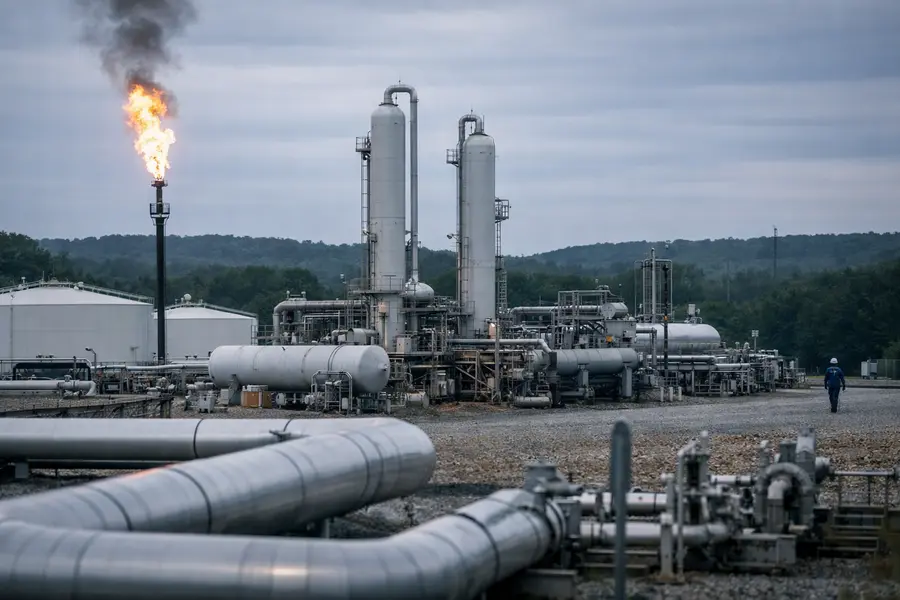
Shares of the Appalachian pure-play producer slid 7.3% as natural gas wellhead prices collapsed, regional supply gluts widened, and multiple analysts slashed price targets, pushing the stock to its weakest level since winter.
- RRC shares fell 7.3%, bringing the stock 25.8% below its March 2026 52-week high of $47.65, as natural gas futures dropped roughly 4% to a six-week low.
- UBS cut its price target from $49 to $44, and Stephens trimmed its target from $53 to $52, both citing a weaker commodity price outlook and persistent oversupply.
- U.S. dry natural gas production is on track to reach 110 billion cubic feet per day in 2026, outpacing demand growth by 0.5 Bcf/d and sustaining pressure on natural gas wellhead realizations across Appalachia.
Lead
Range Resources Corporation (NYSE: RRC) shed 7.3% to close at $35.36, its lowest settlement in months, as U.S. natural gas futures plunged approximately 4% to a six-week low amid a federal report showing a larger-than-expected storage build and curtailed demand from liquefied natural gas export terminals undergoing seasonal maintenance. The Fort Worth–based producer, which draws virtually all of its output from the Marcellus Shale in southwestern Pennsylvania, was further pressured by a simultaneous round of analyst price-target reductions that underscored deteriorating sentiment across the domestic gas sector.What Happened
The session's decline compounded a slide that has erased more than a quarter of Range's market value since its 52-week peak. Two catalysts converged: a macro gas price selloff driven by softer near-term LNG offtake and a week-over-week storage injection that surpassed consensus forecasts, signaling weak spot demand. Simultaneously, three major sell-side desks revised their price targets lower on the stock, amplifying the downward momentum.
Range reported second-quarter 2026 net income of $195 million, or $0.83 per diluted share, on revenue of approximately $760 million — results that beat consensus estimates but failed to arrest the selloff, as investors focused on the trajectory of realized commodity prices rather than the beat-and-raise narrative. Production averaged 2.30 billion cubic feet equivalent per day in the quarter, roughly 67% natural gas, with an average realized price of $3.53 per Mcfe including hedges.
Natural Gas Wellhead and Pipeline Pressure
The core stress point for Range Resources is the widening discount at the natural gas wellhead relative to the Henry Hub benchmark. Appalachian producers face a structural disadvantage: the basin's pipeline takeaway capacity has not kept pace with production growth, and regulatory and permitting hurdles continue to delay new infrastructure. The Dominion South pricing point, which reflects Marcellus-region wellhead realizations, has historically traded at a discount to Henry Hub, and that basis has widened in recent months as regional supply volumes increased.
Pipeline congestion is not a new dynamic in the Appalachian basin, but it has become acute in 2026 as producers maintained capital discipline while sustaining output. Without meaningful new pipeline capacity additions — constrained by permitting and litigation — any incremental production growth risks deeper basis blowouts, squeezing producer economics further at the natural gas wellhead level.Supply Glut Dynamics
The U.S. Energy Information Administration projects domestic dry gas production will grow roughly 2% in 2026 to approximately 110 Bcf/d, with supply growth outpacing demand growth by 0.5 Bcf/d. Appalachian output alone accounts for approximately 32% of total Lower 48 gas production, making the region's supply dynamics central to national price formation.
LNG export demand, which had served as the primary release valve for domestic oversupply in prior years, is temporarily impaired by scheduled pipeline and terminal maintenance. As a result, incremental volumes that would otherwise flow to export markets are backing up into storage, driving the outsized weekly injection figures that rattled the market. The EIA's baseline forecast places Henry Hub at approximately $3.50 per MMBtu in 2026 — a level that, after accounting for regional basis differentials, compresses margins for Appalachian producers operating at the bottom of the cost curve.
Analyst Target Cuts
UBS reduced its price target on Range Resources from $49 to $44, while Stephens trimmed its target from $53 to $52 — both citing deterioration in the near-term commodity price outlook. Morgan Stanley separately cut its target from $50 to $44, a 12% reduction. JPMorgan had moved more aggressively, downgrading the stock to Underweight from Neutral and cutting its target from $44 to $39 in a prior action that reset the floor on sell-side sentiment. The median analyst target now sits around $44.50, implying a roughly 25% premium to the current trading level — a spread that reflects consensus expectations for price recovery rather than near-term fundamental improvement.Across the coverage universe, twelve analysts have revised their forward earnings estimates downward for the upcoming period, consistent with lower natural gas price decks embedded in their models.
Strategic Context
Range has positioned itself as one of the lowest-cost producers in the Marcellus, with a full-year capital budget of $650 million to $700 million and production guidance of 2.35 to 2.40 Bcfe per day. The company improved its full-year NGL guidance to $2.50 per barrel over the Mont Belvieu index and narrowed its natural gas differential guidance to $0.35–$0.40 per Mcf versus Henry Hub. Management has signaled a path to 2.5 Bcfe/d by year-end 2026 and 2.6 Bcfe/d in 2027 — a growth trajectory that assumes modest improvement in both natural gas wellhead prices and pipeline access.
The balance sheet carries $2.85 billion in total liabilities against operating cash flow of $235 million in the most recent quarter, leaving limited room for leverage expansion if commodity prices remain compressed.
Outlook
Near-term catalysts for recovery in Range Resources shares hinge on the pace of LNG export demand resumption post-maintenance, the magnitude of winter storage withdrawals, and any policy-driven acceleration in Appalachian pipeline permitting. The EIA projects Henry Hub to recover sharply to nearly $4.60/MMBtu in 2027, which would materially improve natural gas wellhead economics for basin producers. Until the supply-demand balance tightens — and pipeline egress constraints ease — the stock is likely to remain tethered to commodity price volatility rather than operational execution.
Mentioned tickers: RRC