Pomegra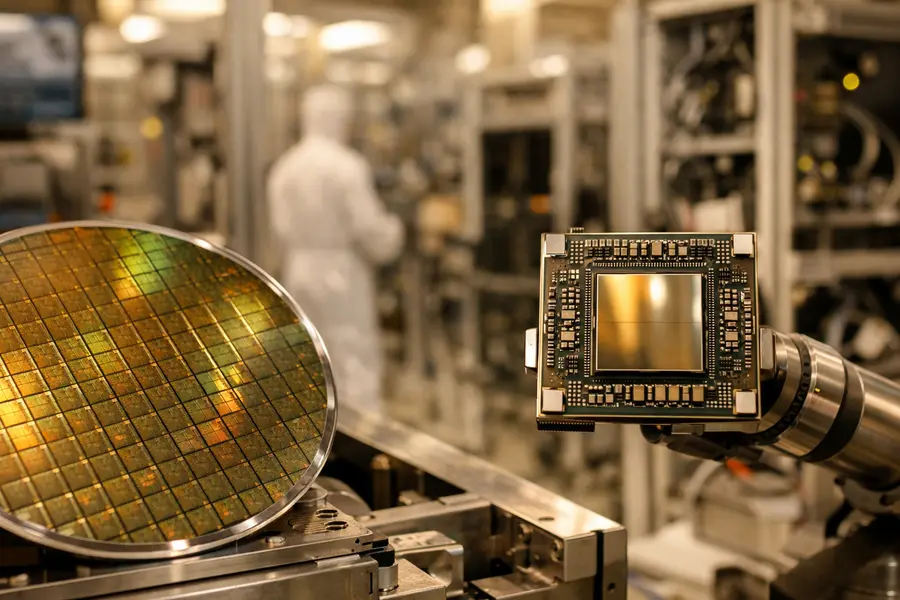
Microsoft's Maia 300 chip promises about 40% more output per unit of power than leading GPU systems, pressuring Nvidia and AI stocks as 2027 deployment nears.
- Microsoft says Maia 300 delivers about 40% more tokens per megawatt than top GPU systems.
- Deployment starts in 2027, with more than 1 million chips planned.
- Nvidia shares fell about 1.7% to $225.32 in morning trading after the unveiling.
Lead
Microsoft (MSFT) unveiled its third-generation Maia 300 AI accelerator on October 12, saying the chip generates about 40% more output for the same amount of power as leading GPU-based systems. The company plans to deploy it at gigawatt scale from 2027 to run its own AI services, a move aimed at cutting reliance on Nvidia (NVDA). The announcement weighed on AI stocks tied to merchant GPU demand, with Nvidia shares down roughly 1.7% to $225.32 in morning trading.What Did Microsoft Announce?
Microsoft announced Maia 300 as its main internal inference system, the part of AI computing that serves answers to users once a model is trained. Inference runs continuously across products such as Copilot, which makes it the largest recurring cost in AI services.
The chip uses 288 GB of HBM4 memory and offers 18 TB/s of bandwidth and up to 13.8 petaflops of FP4 compute. It is built on TSMC's (TSM) N2P process. Microsoft said it delivers about seven times the output of Maia 200. Racks hold 96 chips and draw about 167 kilowatts. Nvidia's GB300 racks hold 72 GPUs and draw about 142 kilowatts.
Microsoft did not name the systems behind its 40% comparison, and the figure has not been independently verified. Rani Borkar, who leads Azure hardware systems, described the aim as more intelligence for every watt, dollar and byte of memory.
Why Did AI Hardware Stocks React This Way?
Nvidia fell because Maia 300 shifts a share of a major customer's inference spending to in-house silicon. Nvidia reported $89 billion in quarterly data-center revenue at a 75% gross margin, a profit pool that gives large buyers a strong incentive to build alternatives.
Microsoft's plan covers more than 1 million Maia 300 chips in 2027. A report in August said Microsoft was in talks with TSMC to produce more than 300,000 units that year. Merchant GPU vendors face a customer that is also a competitor.
The reaction was not uniform across the sector. Marvell (MRVL) and TSMC are viewed as potential beneficiaries of Microsoft's custom-silicon push through design and manufacturing work. Broadcom (AVGO) already supplies custom accelerators to other hyperscalers.
How Does Maia 300 Fit the Custom Silicon Race?
Maia 300 extends a pattern across the largest cloud providers. Alphabet (GOOG) and Amazon (AMZN) already run proprietary AI chips, and OpenAI has worked with Broadcom on custom silicon. Each effort aims to lower inference cost per token and reduce exposure to a single supplier.
Microsoft's stated goal is cost control rather than full replacement of Nvidia. Training workloads and fast-growing demand are expected to keep Nvidia hardware in Microsoft's data centers, while steady inference traffic migrates to Maia. Power availability is now a binding constraint on data-center growth, so efficiency per megawatt is the metric Microsoft chose to lead with.
What Comes Next for Nvidia and AI Chip Demand?
The next test is execution. Microsoft must deliver volume from TSMC, validate the efficiency claim in production Azure clusters, and show that software tooling can move workloads off Nvidia's CUDA ecosystem. Deployment does not begin until 2027, so near-term Nvidia revenue is largely insulated, and total AI capital spending is still rising.
For investors learning how to invest in AI, the announcement shows that the value chain extends beyond GPU vendors to foundries, memory suppliers and custom-silicon designers. The pace of in-house chip adoption at Microsoft, Alphabet and Amazon will shape how much of that spending reaches merchant GPU makers.
Outlook
Maia 300 gives Microsoft a credible path to lower inference costs and less dependence on Nvidia, and the market priced in a modest hit to GPU vendors. Evidence of yields, rack deployments and measured efficiency through 2027 will determine whether the 40% claim reshapes AI hardware spending or remains a complement to Nvidia's systems.
Mentioned tickers: MSFT, NVDA, TSM, MRVL, AVGO, GOOG, AMZN