Pomegra
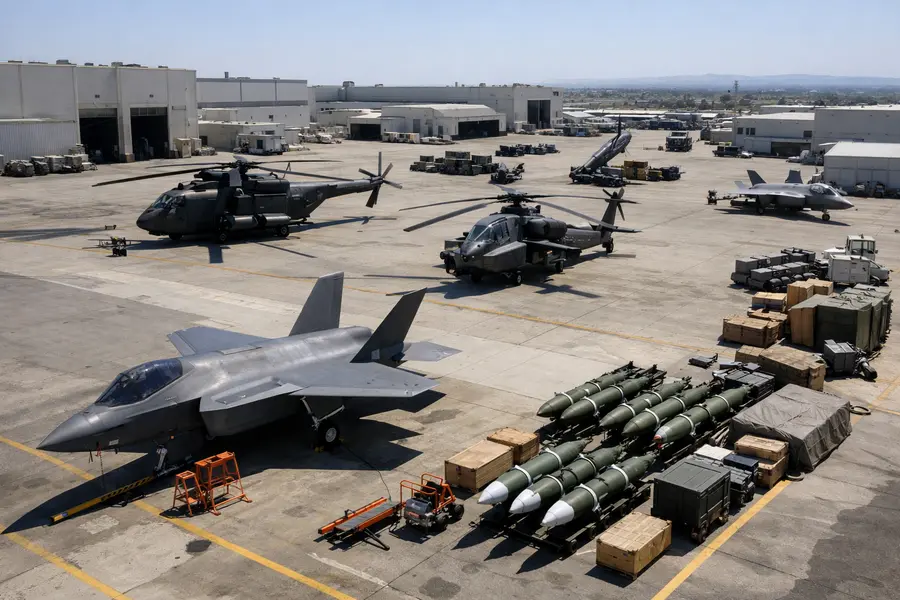
Defense stocks sold off after Democrats swept Congress, with Lockheed Martin down about 7% and Kratos off 8-12% on fears of a tighter 2027 Pentagon budget.
- Lockheed Martin fell about 7% and Northrop Grumman about 4.5% on Wednesday after Democrats won both chambers of Congress.
- Drone makers fell hardest, with Kratos and AeroVironment down roughly 8% to 12%.
- The 2027 request of $1.5 trillion compares with $901 billion currently approved. A Democratic House is seen as likelier to land nearer $1.15 trillion.
Lead
Defense contractors led the declines in the stock market today after Democrats won control of both the House and the Senate in Tuesday's midterm elections. The result raised the prospect of closer scrutiny of military spending. Lockheed Martin (NYSE: LMT) fell about 7% and Northrop Grumman (NYSE: NOC) about 4.5%. Drone and defense-technology names such as Kratos Defense & Security Solutions (NASDAQ: KTOS) fell between 8% and 12%. The move cut against a broad rally in which the Dow industrials average gained nearly 1,000 points at the open.
What Happened to Defense Stocks After the Election?
Defense shares fell sharply across the board on Wednesday, the first session after the vote. Morning trading showed L3Harris (NYSE: LHX) down nearly 8%, RTX (NYSE: RTX) down more than 4%, and General Dynamics (NYSE: GD) down between 3% and 5%.
The sharpest losses came in the smaller, faster-growing part of the sector. Kratos fell about 12%, AeroVironment (NASDAQ: AVAV) about 8%, and Red Cat Holdings (NASDAQ: RCAT) more than 10%. These companies are tied to newer programs, including autonomous aircraft and low-cost munitions, where funding is less entrenched than in legacy platforms.
The selling narrowed at points later in the session. Lockheed Martin pared its decline to roughly 3.6% at one stage, and Northrop, RTX and L3Harris traded with losses of 2% to 3%.
Why Did Defense Shares Fall on the Democratic Sweep?
Defense shares fell because investors priced in a smaller increase in the Pentagon budget than the White House has proposed. The sector had rallied on the president's call for a $1.5 trillion military budget for fiscal 2027, against $901 billion currently approved. That implied a step-up of roughly two-thirds.
A Democratic-controlled House is expected to examine new programs and procurement plans more closely. The House's own roughly $1.15 trillion proposal is widely treated as the likelier landing zone for 2027. That would still be an increase, but well short of the administration's figure.
Contractors had already underperformed this year on concerns about oversight and funding delays. The election removed the main uncertainty about control of Congress, and the outcome was the unfavorable one for the sector.
Drone makers carry the most exposure. Funding for the Pentagon's drone production ambitions depends on new appropriations and multi-year commitments. Those are more exposed to congressional review than long-running programs such as combat aircraft and missile systems.
Market Reaction Beyond Defense
Broader equities rose while defense fell. Futures climbed overnight and the Dow industrials average jumped almost 1,000 points at the opening bell. Investors treated the result as lowering policy volatility and favored sectors such as healthcare and clean energy. That rotation sharpened the contrast with defense, which had been among the year's more crowded trades.
The sell-off also reached European defense names, which traded lower alongside their U.S. peers as the budget outlook clouded the sector's global read-across.
What Comes Next for the Pentagon Budget?
The fiscal 2027 appropriations process is the next test, and the timing may favor the sector in the near term. The current Republican-controlled Congress remains in place until January, so action on defense funding during the lame-duck period is possible before the new majority is seated.
Beyond that, the 2006 midterms are the closest precedent. Democrats took both chambers from a sitting Republican president, and defense stocks initially fell about 2%. They recovered as military budgets kept rising, driven by active wars. Current demand drivers include the conflict involving Iran and the war in Ukraine, along with European rearmament. These keep a floor under baseline spending even if the top-line growth rate slows.
Three variables will determine how far the sector recovers:
- Topline compromise: a deal that pairs defense increases with healthcare or domestic funding would support higher numbers.
- Program-level scrutiny: new-start programs, including drone and autonomy initiatives, carry more risk than established platforms.
- Backlog conversion: large contractors with multi-year order books are better insulated than smaller suppliers reliant on new awards.
Outlook
Defense stocks gave back a sizable portion of their year-to-date premium in a single session. Lockheed Martin lost about 7%, Northrop about 4.5% and drone makers 8% to 12%. The sell-off reflects a repricing of budget growth, not a forecast of cuts. The next signals are the lame-duck appropriations activity, the House's opening budget posture in January, and whether geopolitical demand sustains orders for the largest primes. Smaller, program-dependent names face the widest range of outcomes.
Mentioned tickers: LMT, NOC, KTOS, RTX, LHX, GD, AVAV, RCAT