Pomegra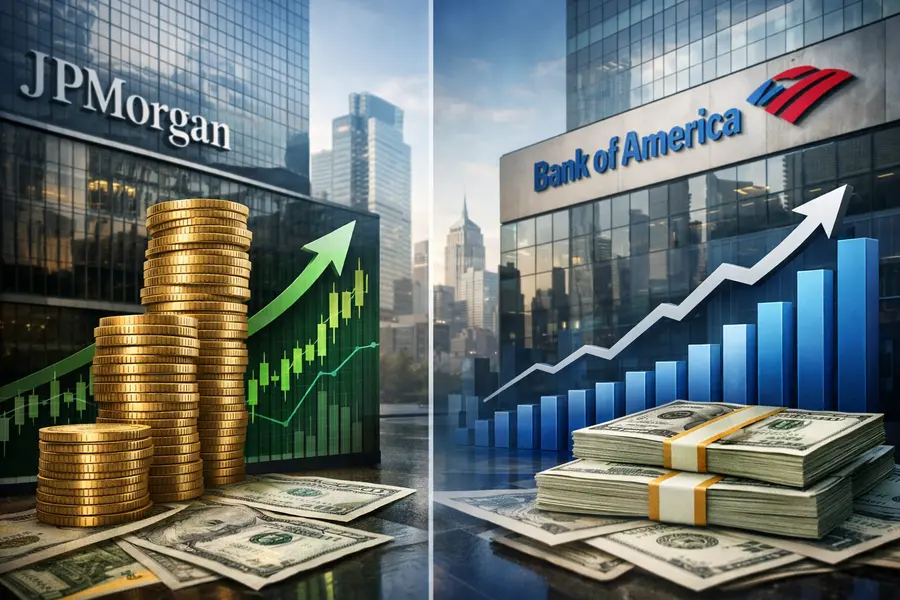
JPMorgan Chase posted the highest quarterly profit in its history while Bank of America's net income surged 27%, signaling a robust start to the US bank earnings season driven by trading windfalls and resilient consumer spending.
- JPMorgan Q2 net income hit $21.2 billion, or $7.70 per share, a record, fueled by an 86% equity-trading surge and a $4.6B Visa gain.
- Bank of America earned $9.10 billion in Q2 2026, up 27% year-over-year, with every business segment posting double-digit income growth.
- US bank earnings season is off to a strong start, though both CEOs flagged macro headwinds including geopolitical risk, inflation, and elevated valuations.
Lead
JPMorgan Chase (JPM) reported second-quarter 2026 net income of $21.2 billion, or $7.70 per share — the largest quarterly profit in the bank's history — on Monday, July 14, as a surge in stock-trading revenues and a one-time $4.6 billion gain on its Visa stake propelled results well past analyst estimates. Hours later, Bank of America (BAC) posted net income of $9.10 billion for the same period, up 27% from a year earlier, driven by broad-based revenue growth and an acceleration in consumer card spending, firing the starting gun on what Wall Street expects to be a strong US bank earnings season.What Happened at JPMorgan
Total managed net revenue at JPMorgan reached $58.0 billion in the second quarter, a 27% increase year-over-year, with every line of business posting record revenue. Net interest income rose 10% to $25.6 billion, and the bank lifted its full-year 2026 net interest income outlook to approximately $105.5 billion, up from a prior forecast of $103 billion.
Equity markets revenue surged 86% year-over-year to $6.0 billion, a quarterly record, while fixed-income markets revenue rose 6%. Combined, total markets revenue reached $12.1 billion — surpassing the bank's prior record set in the first quarter of 2026. Investment banking fees climbed 30% to $3.3 billion, the highest level since 2021, led by equity underwriting.
Excluding significant items, including the Visa-related gain, earnings per share came in at $6.14 — still well ahead of the $5.44 Wall Street consensus.
Chairman and CEO Jamie Dimon described the quarter as reflecting "a particularly favorable environment with an elevated level of market activity, as well as rigorous execution," and cited AI-driven capital investment, fiscal stimulus, and more efficient regulation as supporting tailwinds. However, Dimon issued a pointed caution, warning that geopolitical instability, persistent inflation, swelling sovereign debt loads, and stretched asset valuations were "shifting below the surface like tectonic plates."What Happened at Bank of America
Bank of America reported Q2 2026 revenue of $31.6 billion, up approximately 15% year-over-year, beating analyst expectations of roughly $30.7 billion. Earnings per share of $1.21 topped the $1.13 consensus estimate and marked a 34% increase from $0.90 in the year-ago quarter; the gap between per-share and net-income growth rates reflects ongoing share repurchases.Combined credit and debit card spending grew 9% for the quarter, and consumer spending overall accelerated to a 6%-plus year-over-year rate in Q2, up from a 5% pace in the first half of the year. CEO Brian Moynihan highlighted that every business segment delivered double-digit net income growth and strong returns on equity — a performance he attributed to both a resilient American consumer and a rebounding Wall Street fee environment.
Market Reaction
Despite the headline-beating figures, JPMorgan shares fell more than 2% in Tuesday premarket trading as investors scrutinized the degree to which the Visa-related gain and unusually elevated trading activity contributed to the record result. The stock's retreat is consistent with a broader pattern this earnings season: outsized beats driven by non-recurring items tend to prompt modest selloffs even when underlying business trends remain strong.
Bank of America shares responded more favorably, with the market appearing to credit the broad-based nature of its revenue gains.
Financial Sector Performance in Context
The results from JPMorgan and Bank of America arrive after a quarter in which financial sector performance was underpinned by heightened market volatility, a revival of capital markets activity, and sustained household spending despite elevated interest rates. For the broader US bank earnings season, the two reports set an optimistic tone ahead of results from Goldman Sachs, Citigroup, and Wells Fargo.
Outlook
JPMorgan's raised net interest income guidance and Bank of America's accelerating consumer-spending metrics suggest the financial sector entered the second half of 2026 with considerable momentum. The key risk — flagged by both Dimon and Moynihan — is an external shock that disrupts either credit quality or capital markets activity. For now, the data from Q2 indicates that US bank earnings season is tracking materially ahead of year-ago comparisons, even when stripping away one-time gains that boosted JPMorgan's record headline number.