Pomegra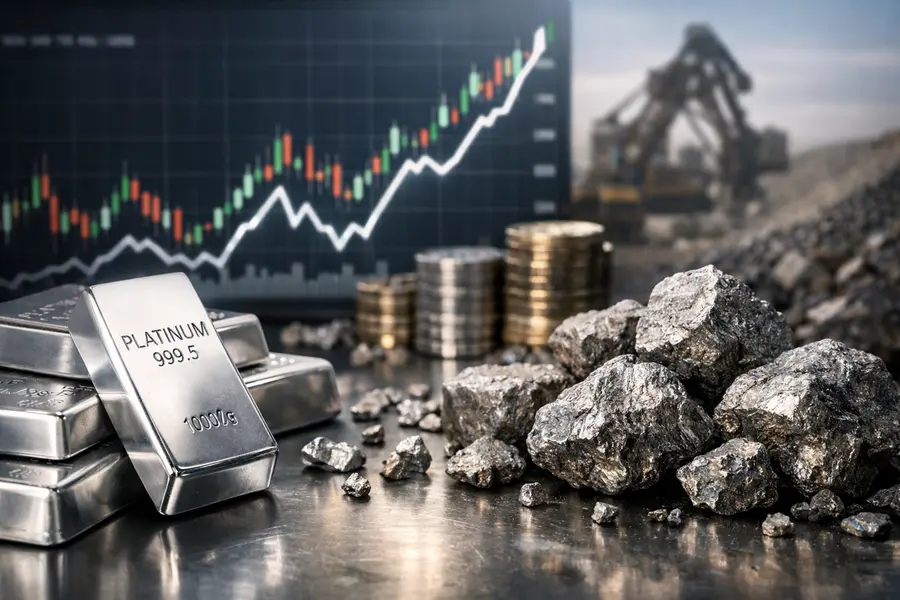
Lead
Platinum cleared $1,400 per troy ounce for the first time since early 2022, extending a rally driven by structural supply erosion in South Africa and accelerating industrial demand tied to clean-energy technology. The metal, which traded below $900 an ounce as recently as late 2023, has staged a steady ascent as the platinum supply disruption narrative shifts from a cyclical story to a structural one. World Platinum Investment Council data show the market heading into a third consecutive annual deficit, with inventories sitting at fewer than four months of demand coverage — a threshold that historically correlates with sharper price moves.What Happened
Platinum's move through the psychologically significant $1,400 level follows months of incremental progress. The metal cleared $1,300 per ounce in June 2025 — a five-year high at the time — and sustained buying pressure from both industrial users and financial investors carried it through the next major resistance band within weeks.
- Platinum's spot price has cleared $1,400/oz amid a projected 2025 supply deficit of 692,000 troy ounces — the third straight annual shortfall.
- South African primary output has declined roughly 26% since 2006; industry leaders now warn of irreversible terminal decline and a 10% further output fall over the next five years.
- Surging interest from hydrogen fuel-cell developers and rising precious metals investment are compressing an already inventory-thin market.
Concurrent moves in precious metals investment vehicles amplified the price action. Exchange-traded funds backed by physical platinum absorbed net inflows of roughly 65,000 ounces in the two weeks leading up to the breakout as institutional allocators rotated toward metals with a supply-constrained fundamental story distinct from gold's rate-sensitivity narrative.
Supply: A Structural, Not Cyclical, Problem
Approximately 70 to 80 percent of global mined platinum originates in South Africa, making the Bushveld Igneous Complex the single most consequential piece of real estate in the platinum price surge equation. That concentration is now a systemic vulnerability.
South African primary output contracted from approximately 5.3 million ounces in 2006 to approximately 3.9 million ounces in 2025 — a decline of roughly 26 percent sustained across multiple commodity price cycles. Sector leaders have escalated the language around the outlook, describing what one chief executive called an "irreversible terminal decline," with projections of a further 10 percent fall in national output over the next five years absent a substantial wave of greenfield investment that is nowhere on the horizon.
Energy costs have been a central aggravating factor. Electricity tariffs for South African mining operations rose approximately 60 percent between 2021 and 2026, driven by Eskom's ongoing financial restructuring and persistent grid capacity constraints. Layered onto those costs are some of the highest labor-to-output ratios in global hard-rock mining, with mandatory safety compliance and community obligations adding fixed costs that squeeze margins even at elevated prices.
More than 20,000 mining jobs have been shed across the platinum sector since 2024. Sibanye-Stillwater has characterized its recent restructuring as a survival phase, while Valterra Platinum — the stand-alone entity created following Anglo American's platinum demerger in 2025 — has publicly stated that developing new deep-level mines would require a sustained price of $2,500 per ounce to justify the capital risk. Sibanye's own projections indicate that global mined platinum production will fall from roughly 6.2 million ounces in 2019 to approximately 4.7 million ounces by 2034, a structural reduction that no recycling uptick is expected to offset.
Demand: A Shifting Composition
Traditional automotive catalyst demand, which accounts for roughly half of annual platinum consumption, has faced headwinds from the gradual penetration of battery-electric vehicles. However, that softening has been countered by an emerging demand driver: platinum's role in hydrogen fuel cell technology.
The World Platinum Investment Council projects that hydrogen end-uses will account for 11 percent of total annual platinum demand by 2030, equivalent to approximately 875,000 ounces. Within that segment, heavy-duty fuel-cell electric vehicles — trucks and buses — represent the largest near-term opportunity, with manufacturers projecting cost parity with diesel in Europe and China by 2030. The electrolyzer market, which uses platinum-group catalysts to produce green hydrogen, adds an additional and growing demand vector that did not exist at meaningful scale five years ago.
Precious metals investment demand has also shifted its footing. For much of the past decade, platinum traded at a discount to gold — an unusual inversion relative to historical norms — which attracted value-oriented buyers. As that discount narrows with the current rally, institutional interest has moved toward the supply-deficit thesis as the primary investment rationale.What Comes Next
With the deficit expected to consume approximately 692,000 ounces of above-ground stocks in 2025 alone, and no near-term production catalyst visible in South Africa, the structural argument for continued platinum price surge pressure remains intact. Bank of America Securities has raised its 2026 platinum price forecast to $2,450 per ounce, while consensus estimates cluster around an $1,500 to $1,700 average for the year with the potential for higher peaks if any acute disruption — a labor action, an extended Eskom outage, a severe weather event at the mines — hits at a moment of thin inventories.