Pomegra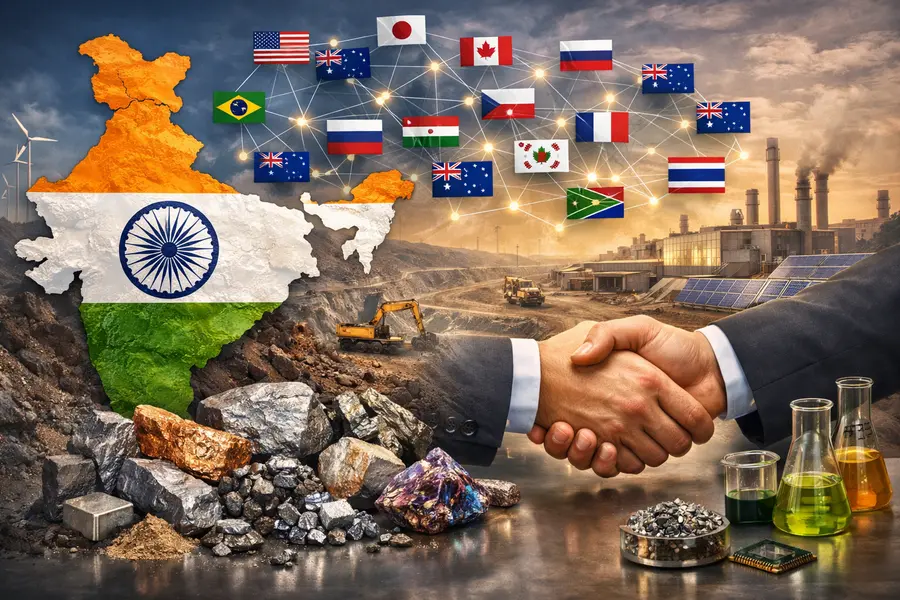
India's National Critical Mineral Mission has secured formal supply-chain cooperation frameworks with 24 countries and is in active commercial dialogue with 11 more, building the world's most ambitious emerging-market mineral diplomacy network.
- India has signed critical minerals MoUs with 24 countries; negotiations ongoing with 11 more, covering lithium, cobalt, copper, and rare earths.
- The India-France Joint Working Group on critical minerals held its inaugural session in New Delhi on July 6, 2026, deepening European partnerships.
- A Quad-backed minerals framework signed in May 2026 targets up to $20 billion in mobilized investment for mining, processing, and recycling.
Lead
India's Ministry of Mines confirmed this month that the country's National Critical Mineral Mission has formalized partnerships with 24 nations while holding active negotiations with 11 others, bringing its total mineral diplomacy network to 35 countries across six continents. The announcement caps a two-year acceleration of India's India critical minerals MoU strategy, with the most recent milestone being the inaugural India-France Joint Working Group meeting held July 6, 2026, in New Delhi — the first operational session under a framework signed during French President Emmanuel Macron's state visit in February.
What Happened
The July 6 working group session, co-chaired by France's Interministerial Delegate for Strategic Minerals Benjamin Gallezot and Kameshwar Saip, Joint Secretary of India's National Critical Mineral Mission, focused on joint exploration, processing technologies, recycling of rare earth elements, and research collaboration. Gallezot travelled with Olivier Froz, Regional Director for Asia at the Bureau of Geological and Mining Research (BRGM), the French national geological survey, signaling France's intent to deploy institutional expertise alongside diplomatic commitment.
The meeting built on the France-India Joint Declaration of Intent on Cooperation in Critical Minerals signed in February 2026 — itself a product of deeper India commercial dialogue efforts that have accelerated since 2024.
Strategic Context
India's established network already includes the United States, Canada, the United Kingdom, Germany, France, Italy, the Netherlands, Japan, Australia, Brazil, Argentina, the Democratic Republic of Congo, Ghana, Namibia, Saudi Arabia, the UAE, Israel, Vietnam, Mozambique, Zimbabwe, Malawi, and Russia. The global mineral supply chain agenda spans India economic policy pillars — clean energy, electric vehicles, advanced defense manufacturing, and semiconductor production — that all depend on uninterrupted access to lithium, cobalt, copper, and rare earth elements.
The framework's geographic architecture is deliberate. Africa provides raw extraction capacity through partners in the DRC, Namibia, Ghana, and Mozambique. Latin America adds lithium-triangle exposure via Brazil and Argentina, with Chile, Peru, Bolivia, and Zambia in active negotiations. Central Asia — Kazakhstan, Mongolia, Uzbekistan, Kyrgyzstan, Turkmenistan, and Tajikistan — represents a new frontier, while Southeast Asian talks with Myanmar and Indonesia target nickel and tin.
The Quad Dimension
The bilateral MoU activity sits within a larger multilateral architecture. In May 2026, India and the United States signed a formal critical minerals cooperation framework during the Quad Foreign Ministers' Meeting, with External Affairs Minister S. Jaishankar and U.S. Secretary of State Marco Rubio as signatories. The agreement was embedded in a broader Quad initiative — involving the U.S., India, Japan, and Australia — that set a mobilization target of up to $20 billion for mining, processing, and recycling investment across trusted supply networks.
The Quad framework explicitly moves beyond raw extraction. Its emphasis on local processing and technology transfer reflects a strategic lesson drawn from years of dependence on Chinese refining capacity: controlling the mine is not enough if the refinery sits beyond allied jurisdiction.
Geopolitical Dimension
The scale and pace of India's mineral diplomacy directly responds to China's structural dominance of the global mineral supply chain. Beijing controls an estimated 60–90 percent of refining capacity for cobalt, lithium, and heavy rare earths — leverage it has demonstrated through export controls on gallium, germanium, and graphite since 2023. India's Ministry of Mines has framed its 35-country network as a hedge against single-source dependency, using language that echoes supply-chain resilience strategies in Washington, Brussels, and Tokyo.
The Forum on Resource Geostrategic Engagement (FORGE), launched by U.S. Secretary Rubio in February 2026, provided an institutional home for U.S.-India India commercial dialogue on minerals and has since become a coordination mechanism linking bilateral agreements into a coherent allied supply web. India's simultaneous cultivation of partnerships with Russia, Saudi Arabia, and the UAE adds a non-aligned dimension, preserving optionality outside the formal Quad grouping.
What Comes Next
India's Ministry of Mines has indicated ongoing negotiations with Chile, Peru, Bolivia, and several Central Asian states will be a priority for the remainder of 2026. The operationalization question — converting signed MoUs into funded projects, functioning mines, and certified processing facilities — is the acknowledged gap. As analysts tracking India's mineral ecosystem have noted, diplomatic frameworks must translate into binding investment commitments, technology-transfer schedules, and off-take agreements to deliver supply-chain resilience rather than strategic optics.
The BRGM's participation in the France talks, alongside the Geological Survey of India, points to one model: pairing government geological agencies with private-sector investment pipelines to move from declaration to production. Whether that template can scale across 35 bilateral relationships simultaneously will define India economic policy credibility in the critical minerals era.
Outlook
India's critical mineral MoU network is the most expansive of any emerging economy and reflects a deliberate effort to hedge against geopolitical concentration risk in materials essential for the clean-energy and defense technology transitions. With $20 billion in Quad-mobilized capital on the table, a newly activated India-France joint working group, and negotiations active across three additional continents, the structural foundations of a diversified global mineral supply chain anchored by New Delhi are forming. Execution — financing, processing infrastructure, and binding offtake — remains the determining variable.