Pomegra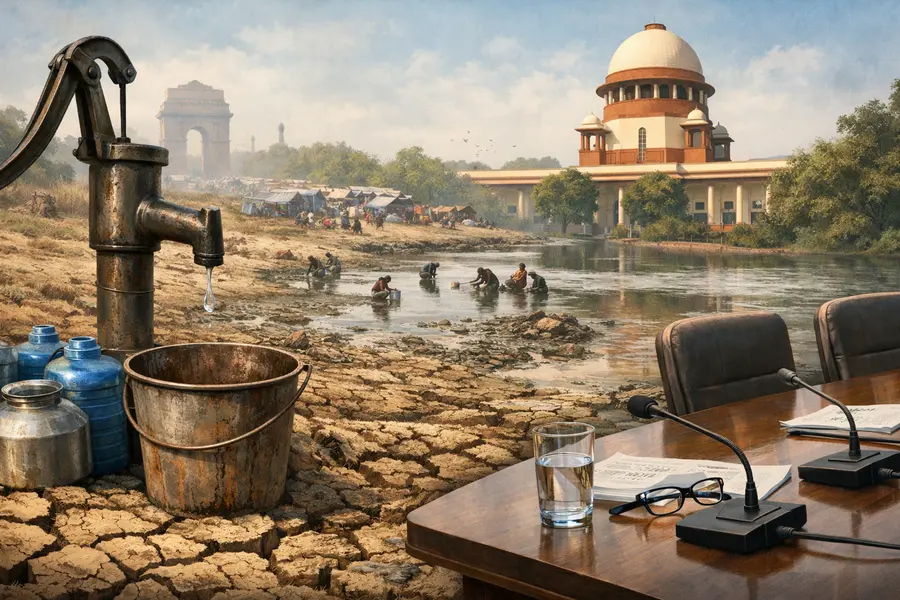
India's Supreme Court convenes an urgent inter-state board meeting to address Delhi's acute drinking water shortage as record summer heat drives demand to historic levels.
- Supreme Court directed the Upper Yamuna River Board to hold an emergency meeting on June 5, 2024, to resolve Delhi's water deficit.
- The court ordered Himachal Pradesh to release 137 cusecs of surplus water and directed Haryana to ensure uninterrupted delivery to Delhi's Wazirabad Barrage.
- Justices described the shortage as "an existential problem" for the capital, with temperatures reaching 50°C and demand far outstripping supply.
Lead
India's Supreme Court intervened directly in the Delhi water crisis on June 5, 2024, ordering the Upper Yamuna River Board (UYRB) to convene an urgent session of all five riparian states to address a drinking-water emergency gripping the national capital. A vacation bench of Justices Prashant Kumar Mishra and KV Viswanathan, hearing an emergency plea filed by the Delhi government, described the situation as "an existential problem" and demanded crisis minutes and a plan of action by the following day.
What Happened
The Delhi government approached the Supreme Court citing an acute shortage of potable water driven by a prolonged and severe heatwave that pushed maximum temperatures to nearly 50°C across parts of North India, triggering an extraordinary surge in demand. The capital, which draws its supply from the Yamuna, Ravi-Beas, and Ganga river systems — receiving approximately 470 cusecs via the Upper Ganga Canal and 1,094 cusecs through Haryana-managed channels — had exhausted its buffer capacity.
The bench first directed the Delhi government to seek an additional 150 cusecs from the UYRB, the statutory inter-state body established under the 1994 Memorandum of Understanding among Himachal Pradesh, Haryana, Uttar Pradesh, Rajasthan, and Delhi. After the board convened, the court issued a further order on June 6 instructing Himachal Pradesh to release 137 cusecs of surplus water by June 7, with prior notice to Haryana, and directed Haryana to facilitate the uninterrupted passage of that water from Hathnikund Barrage to Wazirabad Barrage in Delhi.
Inter-State Friction
The episode exposed deep fault lines in urban water management in India and the politicization of shared river resources. Haryana, governed by a rival political administration, was placed under explicit court direction to allow transit flows — a signal that voluntary inter-state cooperation had broken down. A subsequent complication emerged on June 13, 2024, when the Himachal Pradesh government stated that no surplus water remained to be released, prompting the court to revisit its interim order. The reversal underscored the difficulty of operationalizing judicial directives across state administrations with competing interests.
Delhi Environmental and Structural Context
Delhi's vulnerability to summer water emergencies is structural. The megacity's water infrastructure — aging treatment plants, heavily leaking distribution networks, and near-total dependence on surface flows from other states — leaves it exposed each year as temperatures rise. Analysts focused on Delhi environmental planning point to three compounding factors: rapid population growth exceeding infrastructure investment, significant non-revenue water loss estimated at more than 40 percent, and the absence of large-scale groundwater recharge or recycled-water programs. Climate projections indicating longer and more intense heat seasons suggest the frequency of such crises will increase without systemic reform.
India Supreme Court Ruling: Legal Precedent
The India Supreme Court ruling in the Delhi water case reinforces a growing body of jurisprudence treating access to clean drinking water as a fundamental right under Article 21 of the Constitution. The court's willingness to summon inter-state boards and issue operational directives to state governments in real time reflects an expanding judicial role in environmental governance — one that fills institutional gaps left by legislative deadlock and administrative inertia.
Outlook
Delhi's water emergency has passed its acute phase, but the underlying structural deficit remains unaddressed. The UYRB's ability to allocate additional flows is constrained by seasonal variability and upstream demand, leaving the capital structurally exposed each summer. The Supreme Court's intervention has set a precedent for faster judicial recourse during extreme-weather emergencies, but lasting resolution will require the central government, riparian states, and urban water management India planners to agree on long-term infrastructure investment, metered distribution, and binding inter-state water-sharing frameworks — negotiations that have stalled for decades.
Mentioned tickers: