Pomegra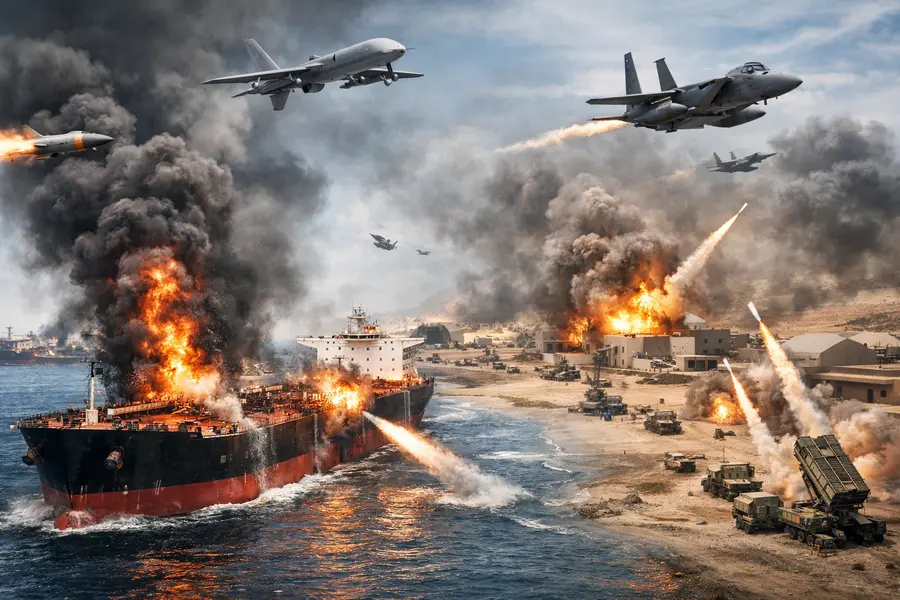
Iran's IRGC struck two UAE oil tankers in the Strait of Hormuz and hit US military installations across Kuwait, Bahrain, and Jordan on July 14, driving Brent crude above $86 per barrel.
- ADNOC tankers Mombasa and Al Bahiyah struck by Iranian cruise missiles within Omani territorial waters; one crew member killed, eight injured.
- IRGC claimed destruction of two HIMARS launchers and warehouses in Kuwait, plus radar systems at US bases in Bahrain and Jordan's Prince Hassan Air Base.
- Brent crude surged 3.8% to $86.06 per barrel on Tuesday, extending an approximately 12% rally since Friday as Strait of Hormuz transit risks intensify.
Lead
Iran's Islamic Revolutionary Guard Corps launched coordinated strikes on two UAE-flagged oil tankers and US military facilities in Kuwait, Bahrain, and Jordan on July 14, escalating a conflict that has already seen more than 300 American air strikes on Iranian territory since the collapse of a short-lived ceasefire. One crew member was killed and eight others injured in the tanker attacks, while Brent crude futures surged to their highest level since June 15 as shipping risk across the world's most critical oil chokepoint reached its most acute point in months.
Tanker Attacks in the Strait of Hormuz
ADNOC Logistics and Services confirmed that its tankers Mombasa and Al Bahiyah were hit by two Iranian cruise missiles in the early hours of Tuesday while transiting the southern shipping lane of the Strait of Hormuz, within Omani territorial waters. One Indian crew member aboard the Mombasa was killed, and eight others sustained injuries, four of them serious. The Mombasa suffered significant structural damage from the strike. The attacks represent the most direct targeting of UAE commercial shipping assets since the current Strait of Hormuz war phase began, raising the risk premium on all vessels transiting the passage.The IRGC framed the strikes as a calibrated response to resumed US bombardment of Iranian coastal provinces, which US Central Command said covered more than 300 targets across three nights of operations. Iran had declared the strait closed the previous day after US naval vessels intercepted Iranian fast-attack craft enforcing an unauthorized transit corridor.
Middle East Military Strikes on US Bases
The Iran tanker attacks July 14 unfolded alongside a new phase of Middle East military strikes on American installations across three Gulf host nations:
Kuwait: The IRGC said it targeted a US surface-to-surface missile base, claiming to have set fire to two HIMARS multiple-launch rocket systems and adjacent missile-packed warehouses. In a subsequent phase, Iran claimed destruction of a fuel depot, a Patriot air defense battery, and an FPS radar installation at US positions in Kuwait. Bahrain: The IRGC said it struck several facilities at Sheikh Isa Air Base and later targeted Naval Support Activity Bahrain at the Juffair district, claiming destruction of a long-range FPS air surveillance radar and a maritime vessel-detection radar system. Bahrain hosts the US Navy's Fifth Fleet headquarters, making it among the most strategically sensitive American installations in the region. Jordan: IRGC ballistic missiles and drones targeted Prince Hassan Air Base, with Iran claiming fires at fuel depots and ammunition storage. Jordan's military said its air defense systems intercepted and destroyed four missiles that entered Jordanian airspace from Iranian territory, the most direct test of Jordanian air defenses in the current conflict.The US bases Kuwait Bahrain Jordan strikes mark a geographic expansion of IRGC targeting beyond Iran's immediate maritime perimeter, designed to raise costs for Gulf states hosting American military infrastructure.
Market Reaction
Brent crude surged 3.8% to $86.06 per barrel by 08:00 GMT on Tuesday — the session's highest print and the contract's strongest level since June 15. WTI followed, with the front-month contract advancing in parallel. The moves extend oil's rally to roughly 12% from Friday's close as markets price in an elevated geopolitical risk premium across the Persian Gulf energy corridor.The Strait of Hormuz handles approximately one-fifth of global oil supply, and each escalation cycle in the current conflict has compressed the window for secure transit. Shipping insurance rates for vessels transiting the strait have risen sharply since Iran declared the waterway closed, with marine war-risk underwriters now requiring explicit route verification before issuing cover.
Strategic Context
A memorandum of understanding signed on June 17 between US President Donald Trump and Iranian President Masoud Pezeshkian had formally ended hostilities and suspended the blockade. The agreement broke down when Tehran cited Israeli operations as a material violation of the accord, and Trump subsequently notified Congress that "limited" US military action had resumed. Since then, the conflict has re-escalated rapidly, with American strikes targeting Iranian military infrastructure, and Tehran responding with attacks reaching across five Gulf nations.
Iran's simultaneous prosecution of Strait of Hormuz war tactics — tanker strikes, maritime interdiction, and shore-based radar denial — alongside deep strikes on US bases Kuwait Bahrain Jordan reflects a strategy of multi-front pressure designed to impose costs beyond Iran's own territory. Gulf host governments, including Kuwait and Bahrain, face acute diplomatic pressure between treaty obligations to Washington and economic exposure to Iranian escalation.
Outlook
The dual tanker attack and multi-base strike campaign of July 14 signals a deliberate Iranian escalation across both the commercial and military dimensions of the conflict. With the June ceasefire formally collapsed and no active diplomatic framework in place, the conflict retains significant near-term upward pressure on energy prices and shipping costs. Brent crude's trajectory above $86 per barrel will deepen cost burdens for energy-importing economies and sustain inflationary pressure on global freight markets. The resumption of US strikes on Iranian territory and Iran's corresponding targeting of Gulf-based American infrastructure increases the risk of further response cycles in coming days.
Mentioned tickers: ADNOCLOGIS, XOM, CVX, USO, BNO