Pomegra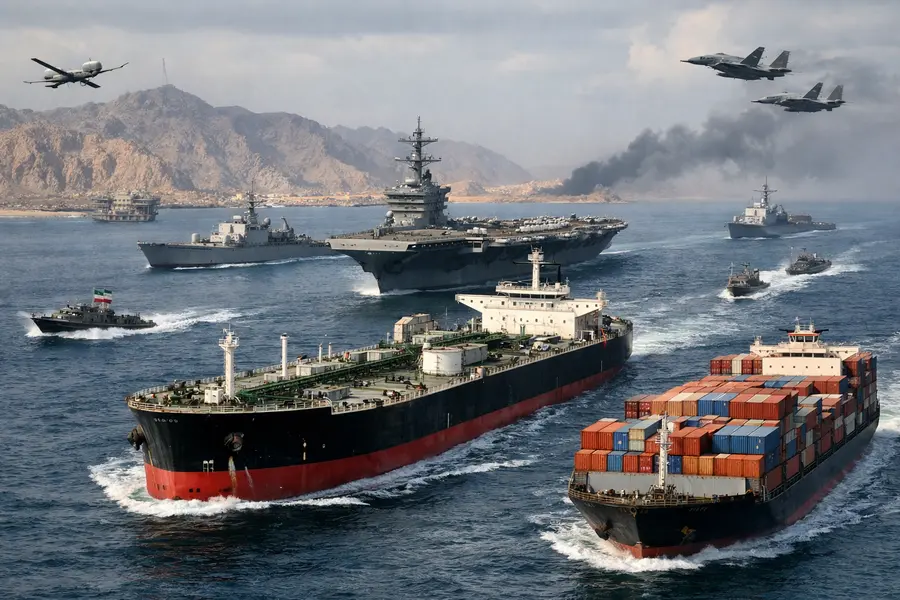
Trump reimposed the US naval blockade on Iran in the Strait of Hormuz and announced a 20% cargo toll, sending Brent crude to its largest single-session gain since May 2020.
- Trump reimposes the Hormuz blockade effective July 14, 4 p.m. ET, after Iran struck two UAE tankers and the June 17 ceasefire collapsed
- Brent crude surges 9.6% to $83.30 per barrel; WTI gains 9.4% to $78.14; S&P 500 falls 0.8% as risk-off sentiment dominates
- The International Maritime Organization states the 20% transit toll has "no legal basis" under international maritime law
Lead
President Donald Trump on July 13 reimposed a US naval blockade on Iranian shipping through the Strait of Hormuz and declared the United States the permanent "guardian" of the world's most critical oil chokepoint, demanding a 20% levy on the value of all cargo transiting the waterway. The blockade took effect July 14 at 4:00 p.m. Eastern time, ending a weeks-long ceasefire that had temporarily eased the most acute maritime crisis in years. Brent crude surged 9.6% to $83.30 per barrel — its largest single-session gain since May 2020 — while the S&P 500 shed 0.8% and the Nasdaq Composite dropped 1.55% as markets priced in renewed supply disruption.
What Happened
Trump announced via social media that the United States "will be, from this point forward, known as 'THE GUARDIAN OF THE HORMUZ STRAIT'" and that Washington "will be reimbursed, at the rate of 20% on all cargo shipped, for any and all costs necessary to do the job of providing safety and security." US Central Command confirmed resumption of the naval blockade of ships transiting to and from Iranian ports at 4 p.m. ET on July 14.
The declaration followed Iran's strike on two UAE-flagged tankers in Omani territorial waters, killing one crew member — a direct provocation Trump cited as proof the June ceasefire was irreparably broken. US forces also conducted a fresh wave of airstrikes against Iranian military targets on July 13, continuing a pattern of tit-for-tat exchanges that had steadily eroded the truce through the first two weeks of July.
Ceasefire Collapse
The current escalation traces to a June 17 memorandum of understanding between Trump and Iranian President Masoud Pezeshkian, intended to end hostilities and reopen the strait. The two parties immediately diverged on the accord's meaning, particularly clauses governing maritime authority. Iran maintained it retained supervisory rights over transit passage; Washington held that the deal required an unconditionally open waterway within 60 days. Repeated tanker strikes by Iran's Revolutionary Guard Corps (IRGC) in the intervening weeks steadily dismantled the ceasefire. On July 8, Trump formally declared it "over" and authorized resumed military action before escalating further on July 13 with the blockade reinstatement and the Hormuz toll fee announcement.
Market Reaction
Energy markets logged their most volatile session in months. Brent crude settled at $83.30 per barrel, its highest close since mid-June, before extending gains to $86.35 in early July 14 trading as the physical blockade came into effect. WTI crude closed at $78.14, up 9.4% on the day. Both benchmarks posted their largest single-day advances in over a year.
The Dow Jones Industrial Average fell 0.26% while the S&P 500 retreated 0.8% and the Nasdaq Composite dropped 1.55%. Energy-sector equities diverged from the broader selloff — integrated oil producers gained as higher crude prices expanded realised margins — while tanker operators exposed to Gulf of Oman routes faced uncertainty over cargo access, insurance eligibility, and potential US-imposed toll liabilities.
What the 20% Fee Means for Global Shipping
The Strait of Hormuz handles approximately 25% of the world's seaborne oil and 20% of global liquefied natural gas (LNG) shipments at its narrowest point, a 34-mile corridor between Iran and Oman. Under the Trump framework, vessels transiting the strait would owe a fee equal to 20% of their cargo's value. At current Brent prices, a standard very large crude carrier (VLCC) carrying two million barrels would face a toll of roughly $173 million per transit — a figure that would fundamentally reshape Gulf energy trade economics if enforced uniformly.
The US Iran maritime conflict has already elevated baseline global shipping costs significantly since February 2026. Carriers on Gulf-linked lanes have imposed Emergency Conflict Surcharges of $2,000–$4,000 per container and War Risk Surcharges of up to $1,500 per TEU. War risk insurance for Middle East routes now commands premiums of 1–3% of cargo value, four times pre-crisis levels. The 20% Strait of Hormuz toll fee would compound these costs substantially, though enforcement mechanisms for vessels not under US-allied flags remain undefined.
International Opposition
The International Maritime Organization (IMO), the UN shipping regulator, moved swiftly to contest the toll. The IMO stated it "stands firmly against charging fees for passage through straits used for international navigation" and that "there is no legal basis through which to introduce mandatory tolls simply to transit through a strait." The IMO's position reflects long-standing principles embedded in UNCLOS — the United Nations Convention on the Law of the Sea — which guarantees free transit passage through international straits to all vessels without fees or prior authorization.
Countries heavily dependent on Gulf crude imports — China, Japan, South Korea, and India — receive roughly 60–70% of their oil from producers that route exports through the Hormuz corridor. Governments in Tokyo, Seoul, and New Delhi have signaled discomfort with any unilateral US toll regime, though no formal countermeasures have been announced.
Strategic Context
The reimposition of the Trump Hormuz blockade also places pressure on OPEC+ supply management. Gulf members including Saudi Arabia, the UAE, and Kuwait face interrupted export pathways at precisely the moment when any production shortfall would amplify price shocks in an already volatile market. Iran began allowing limited vessel passage in late March in exchange for per-ship fees of up to $2 million — an arrangement the US blockade effectively nullifies. The new US toll structure, in effect, asserts Washington's claim as the sole arbiter of safe transit, inverting Iran's prior leverage and introducing a competing fee regime over the same waterway.
Outlook
The restored Trump Hormuz blockade and the 20% Strait of Hormuz toll fee represent the most significant escalation in the US Iran maritime conflict since hostilities began in February 2026. Global shipping costs — already elevated by months of conflict-related surcharges, war risk insurance spikes, and rerouting premiums — face an additional structural cost layer that will flow through to LNG and crude importers worldwide. Brent's move to multi-week highs reflects the market's judgment that the ceasefire's collapse is a durable realignment rather than a transient setback. The critical near-term variables are US naval enforcement posture, compliance by non-allied flagged vessels, and whether Iran's IRGC escalates further inside the strait. Until those questions resolve, energy prices and global shipping costs are likely to remain elevated well above pre-conflict baselines.