Pomegra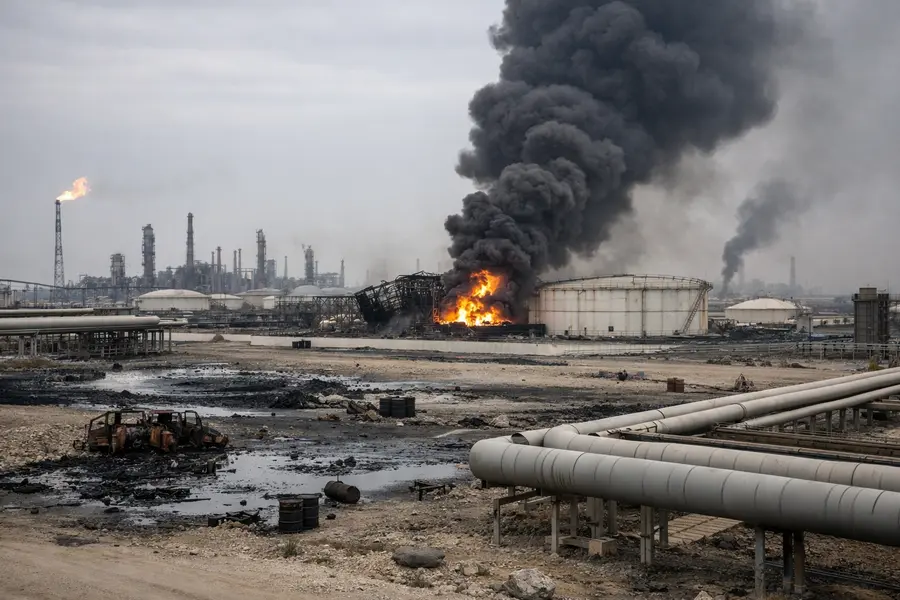
Kuwait's armed forces confirmed active Iranian missile and drone engagement Thursday, widening Tehran's retaliatory campaign to U.S. Gulf allies and driving Brent crude to $106.20 - a near-7% weekly surge.
- Iran launched ballistic missiles and armed drones at Kuwait Thursday, the first direct strike on a Gulf Cooperation Council member in the current conflict
- Brent crude reached $106.20 per barrel as traders repriced Strait of Hormuz disruption risk at wartime levels
- A record 17 million barrels per day are transiting the Strait under active U.S. naval protection, the highest throughput ever recorded during a live conflict
Lead
Iran launched a coordinated wave of ballistic missiles and armed drones against Kuwait on Thursday, Kuwait's armed forces confirmed in an official statement, marking the most significant territorial expansion of Tehran's retaliatory campaign since hostilities began. The strikes pushed Brent crude to $106.20 per barrel in early European trading - the benchmark's highest reading in months - as energy markets moved rapidly to reprice sustained disruption risk across Gulf shipping lanes now carrying a wartime record 17 million barrels of oil daily under U.S. military escort.
Why Did Iran Target Kuwait?
Kuwait was selected to pressure Washington through its regional alliance network rather than through direct confrontation with U.S. forces. The country hosts multiple U.S. military installations and has provided logistical and basing support to American operations throughout the current conflict, making it a high-value secondary target in Tehran's escalation framework. By striking a Gulf Cooperation Council member that has not participated directly in combat operations, Iran signals that alliance membership with the United States carries a tangible military cost - a message calibrated as much for Riyadh and Abu Dhabi as for Kuwait City itself.
Market Reaction
The crude oil price surge to $106.20 - nearly 7% higher on the week - reflected an immediate and broad-based reassessment of Strait of Hormuz closure risk. West Texas Intermediate moved in tandem, trading above $103 per barrel. The Energy Select Sector SPDR ETF (XLE) gained more than 3% in premarket trading, while the United States Oil Fund (USO) advanced 4.1%. Safe-haven flows lifted gold tracked through the SPDR Gold Shares ETF (GLD) to $2,680 per troy ounce, with silver (SLV) registering parallel gains.
Options markets reflected the severity of the shift: implied volatility on front-month Brent contracts reached levels unseen since the 2022 energy shock. War-risk insurance surcharges on tankers bound for Kuwaiti and UAE ports rose an estimated 40% over 48 hours as underwriters repriced Strait exposure.
What Is the Strait of Hormuz Risk Now?
Strait disruption is no longer a tail risk priced in options - it is the central scenario. The 17 million barrels transiting the chokepoint daily under U.S. naval protection represent roughly 20% of global seaborne oil trade, a volume for which no short-term rerouting alternative exists. A confirmed Iranian interdiction effort targeting Kuwaiti port approaches or Mina Al-Ahmadi terminal - the country's primary export facility handling approximately 1.7 million barrels per day - would simultaneously draw on strategic petroleum reserve capacity across every International Energy Agency member nation.
Geopolitical Dimension
Thursday's strikes end the implicit boundary that had insulated Gulf Cooperation Council states from direct Iranian targeting throughout the conflict. Saudi Arabia, the UAE, Qatar, Bahrain, and Oman now face the same calculus that Kuwait encountered Thursday: U.S. alliance guarantees that detered a previous generation of Iranian escalation are being stress-tested in real time against a Tehran that has demonstrated both the targeting capability and the operational willingness to cross what were once considered red lines.
Kuwait's geography adds strategic weight beyond its oil output. The country sits at the northwestern tip of the Arabian Gulf where Strait of Hormuz tanker traffic begins its southbound passage, and its border with Iraq provides Iran with an additional vector for pressure separate from maritime interdiction.
U.S. carrier group deployments in the Arabian Sea and Persian Gulf represent the largest American naval concentration in the region since 2003, operating under heightened rules of engagement since the initial Iranian retaliatory strikes began.
How Does This Affect Global Oil Supply?
Kuwait's oil exports continued Thursday evening, limiting immediate physical supply disruption. The impact is structural: a sustained conflict phase near the Strait historically embeds a $10 to $20 risk premium into Brent, and at current throughput levels, OPEC+ spare capacity concentrated in Saudi Arabia and the UAE provides limited credible buffer if both nations face Iranian targeting themselves.
The IEA's coordinated reserve release mechanism exists precisely for scenarios of this kind, but its deployment would signal that member governments view a prolonged supply disruption as the base case rather than a transient spike.
Outlook
Iran's decision to strike Kuwait closes the diplomatic space that Gulf Cooperation Council states had occupied as potential intermediaries. Brent crude sustaining above $100 per barrel is now the market's base case for as long as active hostilities continue in proximity to the Strait. A formal Iranian mining or blockade of Hormuz shipping lanes would represent a discontinuous shock - the kind that overruns strategic reserve buffers and forces emergency international coordination within days. Thursday's escalation does not make that scenario inevitable, but it moves it meaningfully closer to the center of the probability distribution that energy markets are now pricing.
Mentioned tickers: XLE, USO, GLD, SLV