Pomegra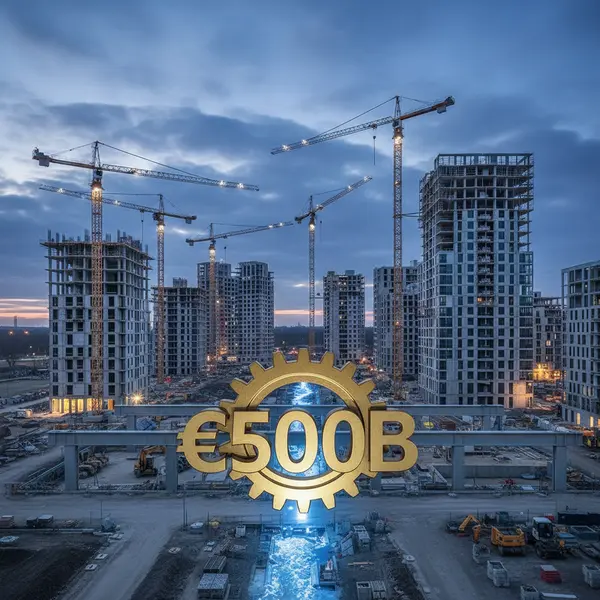
Germany's construction sector rebounds in 2026 as the €500 billion state fund and new building laws drive orders across civil, housing, and defense segments.
- The ZDB forecasts 2.5% real sector growth in 2026, with nominal revenue reaching €178 billion, reversing a cumulative contraction exceeding 10% since 2020.
- Germany's €500 billion Special Infrastructure Fund allocates €58 billion in 2026 to transport, housing, and digital infrastructure projects.
- Hochtief's order backlog hit a record €72.5 billion in 2025; STRABAG's infrastructure orders surged 38.7%.
Lead
Germany's construction sector is returning to growth in 2026 after more than five years of decline, propelled by a historic €500 billion government infrastructure fund, sweeping building code reforms, and a sharp rise in defense spending that together are reversing one of the most protracted downturns the industry has endured in decades.
The Central Association of German Construction Industry (ZDB) projects 2.5% real output growth for 2026, with nominal revenues rising to €178 billion from €168 billion in 2025 — ending a cumulative real-terms contraction of more than 10% since 2020. The turnaround is led by civil engineering and public infrastructure, which are absorbing the first large disbursements from the government's multi-year capital programs.
What Happened
The primary catalyst is Germany's Special Infrastructure Fund — a €500 billion envelope approved by the Bundestag and operational since late 2025, financed outside the constitutional debt brake through a one-time exemption. The federal government contributes €300 billion, federal states and local authorities €100 billion, and the Climate and Transformation Fund a further €100 billion. For 2026 alone, €58 billion has been budgeted from the fund, with transport infrastructure receiving €21.3 billion and digitalisation €8.5 billion.
Alongside the fund, the "Building Turbo" legislation — enacted October 30, 2025 — streamlines residential planning approvals, cutting processing timelines and broadening projects eligible for fast-track permitting. Industry estimates suggest 18,000 to 74,000 projects annually stand to benefit. A parallel Infrastructure Future Act grants railways, motorways, bridges, and waterways the status of "overriding public interest," compressing approval timelines that had previously stretched years.
Defense-related construction provides a third engine of demand. Germany's 2026 defense budget of €82.6 billion — a 24% year-on-year increase and the largest since reunification — includes an equipment and procurement envelope of €22.4 billion, nearly triple the 2025 level. Infrastructure hardening, barracks expansion, and military logistics facilities are generating new contracts, with 154 major projects worth more than €83 billion being finalized through December 2026.Market Reaction
Listed sector leaders have moved decisively ahead of the broader recovery. Hochtief (HOT) closed 2025 with an operational net profit of €789 million, up 26% year-on-year and above the company's own revised guidance. New orders surged 32% on a foreign-exchange-adjusted basis to €52.6 billion, and the total order backlog reached a record €72.5 billion — with the Germany-specific backlog nearly doubling over three years to €5.2 billion. Hochtief has guided for a further 20–30% profit growth in 2026.
Strategic Context
The recovery is arriving after an extended period of industry stress. Interest rate increases between 2022 and 2024 suppressed private residential demand sharply, while building materials input costs surged. Residential completions fell to 225,000 units in 2025 against a government target of 320,000 per year, and numerous small and mid-sized firms exited the market, compressing available capacity.
That structural thinning now presents an upside risk. As public-sector demand accelerates through civil engineering and defense contracts, labor and materials markets face renewed tightening. ZDB president Wolfgang Schubert-Raab observed that "confidence is returning to the construction industry for the first time," while cautioning that planning bottlenecks could slow absorption of the available funds at the local government level.
Railway modernization is a particular focus. A €100 billion network investment program targets Germany's chronic infrastructure backlog, with the long-delayed Stuttgart 21 station now slated to open in 2026 and the Munich S-Bahn Second Core Line under active construction.Geopolitical Dimension
The defense spending surge reflects Germany's fundamental reassessment of its security posture. Chancellor Friedrich Merz's government has committed to exceeding NATO's 2% of GDP defense threshold for the first time since 1990, with total defense outlays projected to reach €162 billion by 2029 — a 72% increase from 2025 levels. Infrastructure resilience — hardened logistics corridors, fuel depots, and command facilities — now constitutes a dedicated category of public investment, competing for the same contractor pool as civilian projects.
EU funds amplify the domestic commitment. Germany's Recovery and Resilience Plan draws on €25.6 billion in grants from the EU's Recovery and Resilience Facility, with an estimated macroeconomic impact of €66 billion equivalent to 1.6% of GDP — nearly half directed toward climate objectives feeding directly into energy-efficient green building retrofits and sustainable infrastructure.
Outlook
Germany's construction sector has passed its cyclical trough. The ZDB projects a 3.1% compound annual growth rate through 2029, underpinned by committed public-sector pipelines that are structurally less sensitive to borrowing costs than private residential investment — which is itself stabilizing as interest rates ease and the Building Turbo reforms work through the approvals system.
Execution risks remain the primary constraint: skilled-labor shortages, residual planning inertia, and potential delays in disbursing Special Fund allocations at the municipal level. Contractors with established public-sector relationships and deep existing backlogs — notably Hochtief and STRABAG — are best positioned to capture the initial wave of contracts, while building materials producers and regional specialists stand to benefit as the pipeline broadens into 2027 and beyond.
Mentioned tickers: HOT, SBG, HDMGEconomic Report