Pomegra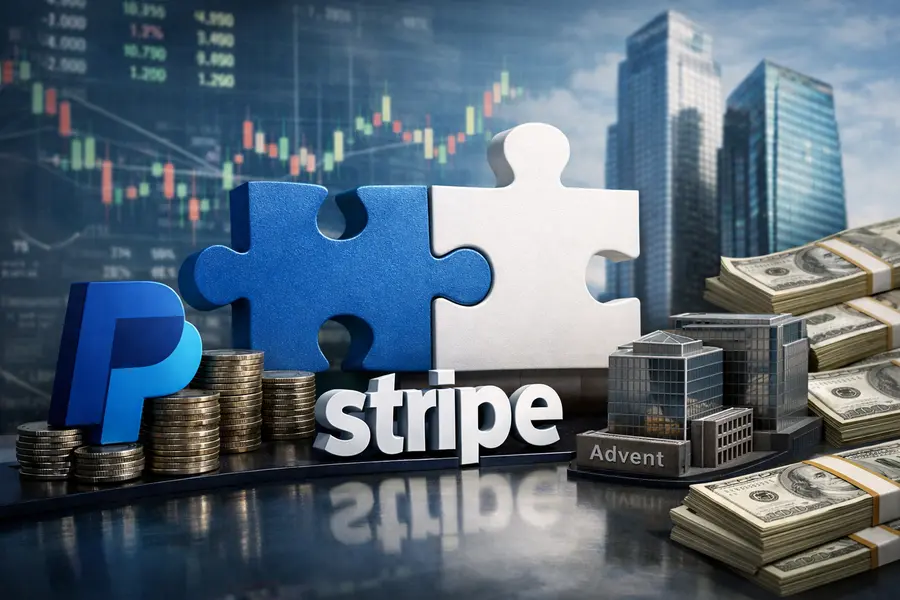
PayPal shares jumped more than 20% on July 15 after Stripe and Advent International jointly offered $60.50 per share to acquire the payments giant in what would be the largest fintech acquisition in history.
- Stripe and Advent offered $60.50/share for PayPal, a 28% premium, valuing the company at over $53 billion.
- PYPL stock surged 20.76% to $57.16 on July 15; the consortium has secured roughly $50B in bank financing.
- PayPal's board has not yet responded; prediction markets assign an 80% probability the deal closes by late 2026.
Lead
PayPal Holdings (PYPL) shares surged 20.76% to $57.16 on Tuesday, July 15, after Reuters reported that Stripe and private-equity firm Advent International submitted an unsolicited offer of $60.50 per share — a 28% premium over PayPal's prior close — in a proposed all-cash fintech acquisition valued at more than $53 billion. The consortium has secured approximately $50 billion in committed bank financing to support the proposal.What Happened
Stripe first signaled acquisition interest in February 2026, making an initial approach to PayPal's board in early April that went unanswered. The revised joint offer with Advent, submitted earlier this month, set an informal deadline of end-July 2026, giving PayPal's directors roughly two weeks to respond. Under the terms, Stripe and Advent would each hold a 50% stake in the combined entity with no plans to break PayPal apart.
PayPal's board has not publicly accepted or rejected the proposal. The company has not filed an 8-K or issued an official statement as of Tuesday's session close.
Market Reaction
The PYPL stock surge was one of the most dramatic single-session moves for a large-cap U.S. financial company in 2026. Shares opened sharply higher in premarket trading — up 16.2% — and extended gains intraday to close at $57.16, well below the bid price of $60.50, a gap reflecting residual deal-close uncertainty. Prediction markets placed the probability of a completed Stripe Advent PayPal buyout at approximately 80%.
Not all investors welcomed the bid. Some shareholders argued the offer significantly undervalues PayPal, citing the company's improving free cash flow, 439 million active accounts, and the embedded optionality of its digital-asset infrastructure.
Strategic Context
The PayPal Stripe takeover bid is driven by a clear structural logic. Stripe has built dominant infrastructure for merchant payment processing, powering the backend of e-commerce globally. PayPal controls the consumer-facing wallet layer — Venmo, a buy-now-pay-later platform, and PYUSD, a dollar-pegged stablecoin with growing institutional adoption.
A combined entity would own both ends of the payments stack in a single firm. Under the proposal, PYUSD would be integrated into Stripe's Tempo and Bridge stablecoin payment rails, creating a unified digital-dollar clearing network.
Advent brings deep sector expertise: the Boston-based firm has deployed more than $7.8 billion across 18 fintech companies since 2008, and its operational experience with regulated financial businesses would help manage the regulatory complexity of combining two systemically significant payment processors.
What Comes Next
Antitrust scrutiny in the United States and European Union represents the primary structural hurdle. A combined Stripe-PayPal entity would control a substantial share of global digital payments volume, likely triggering in-depth reviews by the DOJ and European Commission. Negotiations over remedies — potentially including divestitures of overlapping merchant services — could extend the timeline well past the consortium's July target.
PayPal's board will also face pressure to run a formal process to determine whether competing bids exist and whether $60.50 represents fair value.
Outlook
The $53 billion Stripe Advent PayPal buyout bid marks a generational consolidation moment in fintech. If completed, it would unite the two largest private and public payments networks under a single ownership structure, reshaping competitive dynamics for banks, card networks, and digital-wallet rivals globally. The board's response — and whether a higher counter-bid emerges — will define the deal's trajectory over the next 30 to 60 days.