Pomegra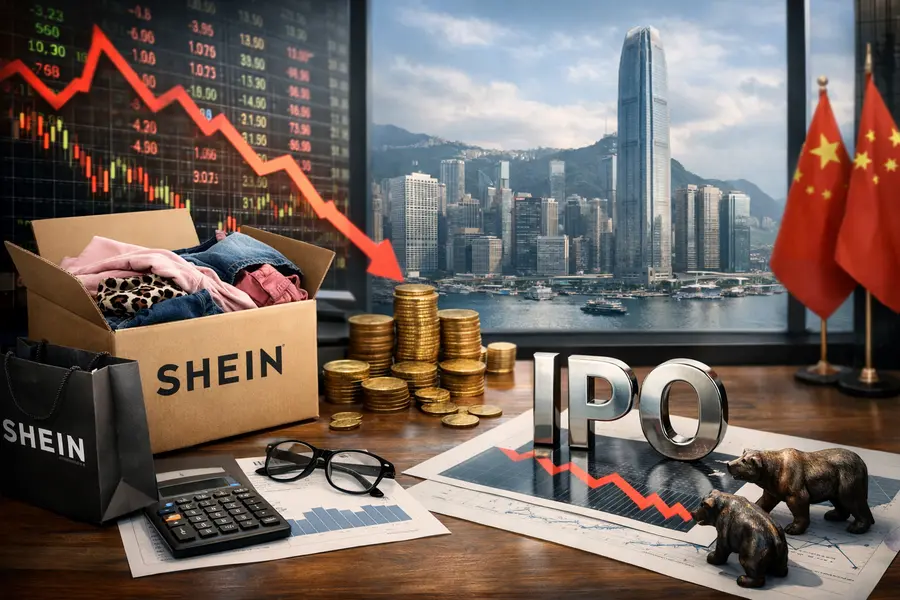
Shein faces its Hong Kong market debut with decelerating growth, falling U.S. traffic, and intensifying fast fashion competition pressuring its valuation below $50 billion.
- Shein's global web traffic growth decelerated from 60%-plus year-on-year in late 2025 to single digits in June 2026.
- U.S. sales fell 13% year-on-year in June, driven by the end of the de minimis exemption and new tariffs on Chinese goods.
- The Shein IPO is targeting a Hong Kong listing as early as August 2026, seeking to raise $2–$3 billion at a $40–$50 billion valuation.
Lead
Shein is pressing ahead with a Hong Kong IPO that could raise as much as $3 billion, but the ultra-fast fashion retailer's own growth metrics are testing investor confidence. Global web traffic, app downloads, and U.S. sales have stagnated or declined in 2026, compounding the competitive and regulatory pressures that have already compressed the company's implied valuation to less than half its 2022 peak of $100 billion. China's securities regulator granted approval on July 10, 2026, opening the door for a listing as early as August.What Happened
Shein's momentum — built on algorithmic micro-trend sourcing and sub-$10 price points — is visibly fading. Web analytics firm Similarweb recorded the company's global traffic growth slowing from above 60% year-on-year in the second half of 2025 to roughly 30% early in 2026, before easing to single digits in June. U.S. sales dropped 13% year-on-year that same month.The deceleration reflects two simultaneous shocks. First, the U.S. eliminated the de minimis exemption that had allowed packages valued under $800 to enter duty-free — a provision that undergirded Shein's entire direct-from-China fulfillment model. Combined with sweeping tariffs on Chinese goods, the rule change forced the company to raise prices in its largest single market, triggering a 12% loss in U.S. users by June. Second, fast fashion competition has intensified sharply, with Temu, Zara, and H&M each recalibrating their strategies in ways that compress Shein's once-distinctive advantages.
Fast Fashion Competition Landscape
Temu has moved aggressively into apparel, leveraging its marketplace model and supplier data to replicate Shein's speed-to-market cycle while undercutting even Shein on price during flash promotions. The platform's willingness to absorb short-term losses on customer acquisition has put direct pressure on Shein's app downloads and repeat purchase rates.Meanwhile, Zara — owned by Inditex — has pivoted upmarket, raising prices, opening flagships in premium locations, and partnering with haute couture labels to claim a position that de-emphasizes direct fast fashion competition with ultra-cheap rivals. H&M has similarly pursued a dual strategy: maintaining affordability at the mass-market level while investing in sustainability credentials that appeal to regulatory environments in Europe and elsewhere.
France passed an anti-fast fashion law in June 2026 imposing per-item fees on mass-produced textile platforms and banning advertising for ultra-fast fashion brands — a measure explicitly targeting Shein, Temu, and AliExpress. The regulation adds a compliance cost layer and potential reputational drag in one of Shein's key European markets.
IPO Valuation and Financial Context
Shein's full-year 2025 revenue reached approximately $38 billion, up 23% year-on-year — a sharp deceleration from the 40-to-45% expansion that characterized earlier years. Management targeted mid-teen percentage sales growth for 2026. Net profit was projected at $2 billion for 2025, with Q1 2025 alone generating more than $400 million in net income, partly inflated by a pre-tariff rush of U.S. orders.The valuation trajectory reflects the same arc. A 2023 funding round priced the company at $66 billion; early 2026 investor negotiations were centering on approximately $30 billion. The most recent guidance suggests a range of $40–$50 billion for the global retail IPO, representing a roughly 50% markdown from the 2022 all-time high. Shein is targeting a raise of $2–$3 billion in the offering.
The Hong Kong venue itself is a compromise. Shein's original plan for a London Stock Exchange listing was shelved following U.S. congressional scrutiny over supply-chain practices and labor conditions among its Chinese manufacturing partners.
Regulatory and Geopolitical Dimension
Shein's business model depends structurally on cross-border e-commerce flows that are now subject to heightened policy risk in every major market. The end of U.S. de minimis treatment, French advertising restrictions, and broader scrutiny of Chinese-linked tech companies by Western regulators create a multi-front compliance burden the company had not priced into earlier valuations.The decision to list in Hong Kong rather than New York or London narrows the potential institutional investor base and places the company within a regulatory ecosystem that, while accessible, carries its own political risk premium for international fund managers.