Pomegra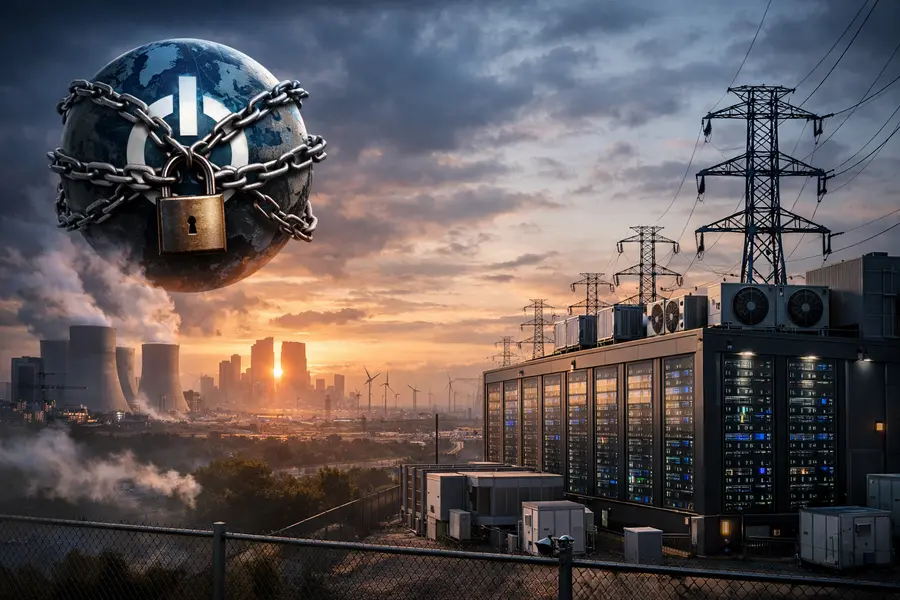
New York became the first U.S. state to impose a moratorium on large AI data centers July 14 as governments worldwide move to protect strained power grids and water supplies from surging AI infrastructure demand.
- New York Governor Hochul signed an executive order barring new hyperscale data center construction of 50 MW or more for up to one year.
- At least 75 U.S. data center projects worth $130 billion were disrupted in Q1 2026 alone due to local opposition and infrastructure limits.
- North American data centers consumed nearly 1 trillion liters of water in 2025, equal to New York City's annual water demand.
Lead
Governor Kathy Hochul signed an executive order on July 14, 2026, imposing the first statewide moratorium on hyperscale AI data center construction in the United States, blocking facilities requiring 50 megawatts or more of power for up to one year. The action followed the New York Legislature's passage of the Responsible Data Center Development Act on June 4, which would extend similar restrictions to facilities using 20 megawatts or more. The moves mark the leading edge of a global regulatory wave as power grids and freshwater systems buckle under the mounting data center power consumption driven by artificial intelligence workloads.
What Happened
New York's moratorium targets "hyperscaler" facilities — the warehouse-scale complexes built by Microsoft (MSFT), Alphabet/Google (GOOGL), Amazon (AMZN), and Meta (META) to run large language models and cloud computing operations. The state joins more than 100 municipalities across the United States that have already enacted local moratoriums, according to legislative tracking data. At least 11 states introduced moratorium bills in 2026, and more than 190 bills addressing AI data center restrictions were filed in state legislatures during the first 11 months of 2025 — roughly nine times the number from 2024.
The Federal Energy Regulatory Commission added a federal dimension on April 16, 2026, issuing an order establishing uniform rules for large electrical loads of 20 megawatts or more, including data center power consumption interconnection costs and grid upgrade responsibilities.
Global AI Infrastructure Under Pressure
The United States is not acting in isolation. The regulatory response to global AI infrastructure expansion has been building for several years across multiple continents.
Ireland imposed a moratorium on new data center grid connections in the Dublin region beginning in 2021, a freeze maintained until December 2025. The lifting of the ban came with strict conditions: new facilities must install on-site dispatchable generation or battery storage matching their grid import capacity and must source 80% of annual energy demand through renewable procurement over a six-year transition period. The Netherlands has enacted some of the continent's most restrictive measures. Amsterdam barred new data centers or expansions through at least 2030 in April 2025. A national hyperscale ban limits facilities with IT capacity above 70 megawatts or footprints exceeding 10 hectares to two designated locations in less-congested northern regions. Microsoft navigated that framework in January 2026, winning approval for a project structured as three towers, each individually below the restricted size threshold. Singapore imposed a moratorium in 2019 citing power and land constraints, partially relaxing it in 2022 by allowing new developments subject to government licensing.The Power and Water Math
The scale of data center power consumption explains the regulatory urgency. The U.S. Department of Energy estimated data center electricity use at 176 terawatt-hours in 2023 and projected consumption would climb to between 325 and 580 terawatt-hours by 2028 — a potential tripling driven primarily by AI workloads.
Grid stress is already measurable in wholesale electricity markets. In the PJM Interconnection, which serves 13 states from New Jersey to Illinois, data centers are attributed with approximately 63% of the capacity-price increase between the 2024-25 and 2025-26 planning years — a $9.3 billion single-year jump. PJM capacity auction prices surged from $28.92 per megawatt-day in 2024-25 to $269.92 in 2025-26, with 2026-27 prices reaching the FERC cap of $329.17. PJM recorded its first-ever capacity-market shortfall in 2026.
The environmental impact of AI extends beyond carbon emissions to freshwater. North American data centers consumed nearly 1 trillion liters of water in 2025 for cooling — equivalent to the annual water demand of New York City. A global analysis identified approximately 38 active and 24 planned large-scale technology data centers in water-scarce regions. The environmental impact of AI infrastructure creates a compounding dilemma: reducing water consumption through air cooling increases electricity demand, while cutting power use typically requires more water-intensive cooling.
Corporate Response
Major technology companies face mounting pressure from multiple directions. In April 2026, more than a dozen institutional investors filed shareholder resolutions urging Amazon, Microsoft, and Google to disclose site-specific water and power usage data for U.S. data centers — a move reflecting ESG concerns that have yet to produce consistent transparency. Google reports data for owned and leased sites but excludes third-party operated facilities; Microsoft discloses aggregate water usage without site-level breakdowns; Amazon disclosed only per-unit-of-power metrics in its 2025 sustainability report.
At the project level, nearly half of planned U.S. data center builds for 2026 have been delayed or canceled due to infrastructure demands. In Q1 2026 alone, 75 projects valued at $130 billion were disrupted by local opposition.
Alphabet announced commitments to fund 1,900 megawatts of wind, solar, and energy storage plus associated grid infrastructure to power a planned Minnesota facility — a model other operators may be required to replicate under emerging "bring your own power" regulatory frameworks taking shape in multiple jurisdictions.Texas enacted Senate Bill 6 in June 2025, establishing a regulatory model requiring large-load customers of 75 megawatts or more to fund interconnection studies and infrastructure upgrades. The law also mandates remote-disconnection capability during grid emergencies.
Outlook
The global regulatory framework governing AI data center restrictions is shifting from case-by-case municipal resistance to structured national and state-level policy. The convergence of moratoriums in Ireland, the Netherlands, Singapore, and now New York — alongside FERC's interconnection overhaul and a surge of state legislation — signals that permitting, grid access, and environmental disclosure are becoming primary constraints on global AI infrastructure expansion. With projected electricity demand from data centers potentially tripling by 2028, the pressure on grid operators, water authorities, and regulators is set to intensify before it eases. Companies that secure power rights, meet renewable procurement mandates, and reduce per-unit water intensity will hold a structural advantage as new restrictions filter through permitting pipelines worldwide.
Mentioned tickers: MSFT, GOOGL, AMZN, META