Pomegra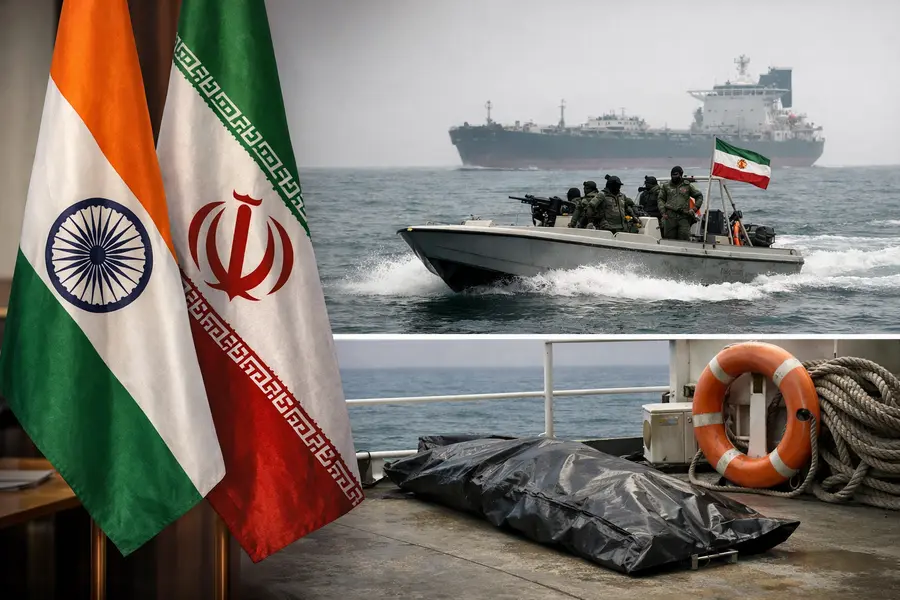
India lodged a formal protest with Tehran on July 14 after an IRGC missile strike on two UAE-linked oil tankers in the Strait of Hormuz killed one Indian sailor and wounded six others.
- Iran's IRGC struck tankers MT Mombasa and MT Al Bahiyah in the Strait of Hormuz on July 14, killing one Indian national.
- New Delhi summoned Mohammad Javad Hosseini, Iran's Deputy Chief of Mission, to lodge a "strong protest" over the attack.
- India's Navy has been running Operation Urga Suraksha to escort energy-cargo vessels through the Strait since May 2026.
Lead
New Delhi summoned a senior Iranian diplomat on July 14, 2026, after a missile strike by Iran's Islamic Revolutionary Guards Corps killed one Indian sailor and injured six more aboard an oil tanker transiting the Strait of Hormuz. The Indian Ministry of External Affairs called in Mohammad Javad Hosseini, Iran's Deputy Chief of Mission, to deliver a formal protest, marking one of the sharpest episodes of India-Iran diplomatic tension in recent years.
What Happened
The IRGC struck two UAE-linked tankers — MT Mombasa and MT Al Bahiyah — with cruise missiles as they navigated the southern shipping lane of the Strait of Hormuz in Omani territorial waters. The vessels carried a combined crew of 46, including 30 Indian nationals. Fires broke out on both ships before emergency teams brought them under control.
The Indian sailor who died was serving aboard MT Mombasa. Six other Indian crew members and two Ukrainian nationals sustained injuries. Iran's IRGC claimed the tankers had ignored VHF radio warnings, switched off navigation systems, and entered what it described as a restricted route — allegations the shipowners have not publicly accepted.
India's Diplomatic Response
India's Ministry of External Affairs described the strikes as "aggressive acts directed at crew members that jeopardise the unhindered and secure passage of shipping traffic." Beyond the immediate protest, New Delhi called for a swift cessation of hostilities across West Asian waters and a return to diplomatic negotiations between Tehran and Washington.
The summoning of Hosseini signals a deliberate escalation in India's foreign policy posture toward Iran. While New Delhi has historically sought to insulate its commercial ties — particularly the Chabahar Port development — from geopolitical turbulence, the death of an Indian national in what was effectively a state-directed military strike has narrowed that diplomatic room.
Strategic Context
The July 14 incident unfolds against the backdrop of the 2026 Strait of Hormuz crisis, a sustained IRGC campaign to restrict tanker traffic that began after the collapse of nuclear negotiations in Geneva and a subsequent 12-day US-Israeli air conflict with Iran in 2025. The Strait carries roughly 20 percent of global seaborne oil, making any prolonged interdiction a direct threat to energy markets and supply chains from Asia to Europe.
Middle East Maritime Security Dimension
The Indian Navy launched Operation Urga Suraksha (energy protection) in response to the escalating crisis, deploying warships at high alert in the Gulf of Oman and northern Arabian Sea. The operation has escorted between 14 and 22 energy-cargo ships through the Strait since activation. The July 14 strikes demonstrate the limits of that protective envelope when vessels deviate from escorted corridors or navigate contested lanes independently.
Middle East maritime security has deteriorated sharply in 2026, with the IRGC periodically barring commercial traffic entirely from sections of the Strait — a measure with no modern precedent in the waterway's peacetime history. International shipping insurers have applied war-risk surcharges to vessels transiting the region, raising freight costs for Indian refiners and manufacturers dependent on Gulf energy.Geopolitical Dimension
The incident places India's foreign policy in an uncomfortable position. Tehran and New Delhi share long-standing economic and connectivity interests, anchored by the Chabahar corridor that gives India overland access to Afghanistan and Central Asia, bypassing Pakistan. That relationship is now subject to a structural strain it has not previously encountered: Iranian state forces directly killing Indian citizens.
Iran's theocratic government and its IRGC operate with a degree of institutional separation that New Delhi has historically exploited to manage tensions. Summoning a deputy chief of mission rather than the ambassador himself reflects a calibrated escalation — firm enough to signal seriousness, measured enough to preserve back-channel options.
Outlook
The death of an Indian sailor in the Strait of Hormuz marks a qualitative shift in the India Iran diplomatic tension that has simmered since the IRGC began its tanker interdiction campaign. New Delhi faces a narrowing set of options: deepening naval escorts, pressing Tehran through diplomatic channels, or coordinating with the United States and Gulf partners on broader maritime security frameworks. All three carry costs. What is no longer available is studied neutrality. The trajectory of India foreign policy in the Gulf will be tested in the weeks following this episode as both governments weigh how far the relationship can bend before it breaks.