Pomegra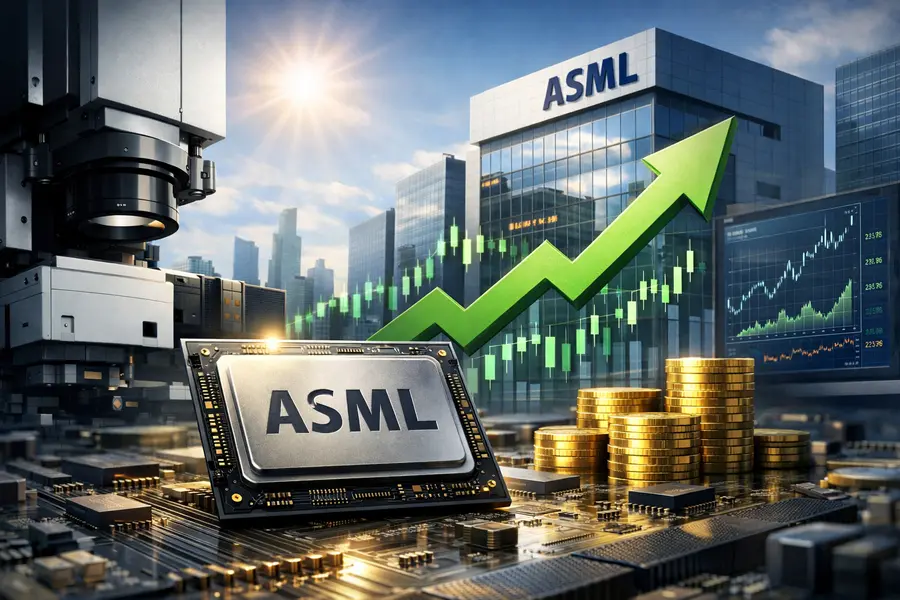
ASML shares climbed 3% on July 15 after the Dutch semiconductor equipment maker posted second-quarter revenue of €9.33 billion, topping estimates by nearly €500 million, and raised its full-year 2026 sales forecast for the second consecutive quarter amid relentless AI chip equipment demand.
- Q2 2026 net sales of €9.33 billion beat the €8.8 billion consensus; net income reached €2.92 billion, or €7.59 per share
- ASML raised its 2026 full-year revenue forecast to €43–€45 billion, with gross margin guidance of 54–56%
- CEO Christophe Fouquet described first-half orders as "extremely strong," with plans to expand EUV and DUV production capacity by roughly 30% in 2027
What Happened
ASML Holding released second-quarter 2026 results before European markets opened on Wednesday, July 15, triggering an intraday gain of more than 7% that settled to approximately 3% as the session progressed. Revenue of €9.33 billion — equivalent to roughly $10.66 billion — exceeded guidance of €8.4–€9.0 billion and the analyst consensus of €8.8 billion. Net income of €2.92 billion produced earnings per share of €7.59 ($8.67), also above forecasts.The installed base management segment — covering service contracts, upgrades, and refurbishments — outperformed by the widest margin, generating €2.8 billion against expectations of roughly €2.5 billion, a gap of €300 million. That figure reflects how aggressively chip manufacturers are extracting additional throughput from existing tools while waiting for new systems to arrive.
Market Reaction
Broader chip stocks also rose. The Philadelphia Semiconductor Index extended its year-to-date gain, which stands at approximately 47% — its strongest first-half run in recent memory. Peer equipment makers and leading chip designers moved higher in sympathy, as ASML's bookings data and guidance served as an early-cycle indicator for the health of the entire AI chip equipment demand ecosystem.
Strategic Context
ASML occupies a structurally unique position in global technology supply chains as the sole manufacturer of extreme ultraviolet (EUV) lithography systems. No chip manufacturer can produce semiconductors at the most advanced process nodes — including 3-nanometer and emerging 2-nanometer geometries — without ASML's tools. That monopoly in critical infrastructure has made the company's quarterly results a proxy for the direction of global semiconductor capital expenditure.
The second consecutive guidance increase underscores that AI-driven chip demand is not plateauing. Hyperscaler capital expenditure commitments remain substantial: Microsoft is investing more than $80 billion in AI-enabled data centers in fiscal 2026 alone, Alphabet is guiding for approximately $75 billion in capital spending, and Meta Platforms has set a capex range of $60–$65 billion, the bulk of it directed toward AI infrastructure. Each dollar of that infrastructure spending creates downstream demand for advanced logic and memory chips, and therefore for the lithography equipment used to manufacture them.
CEO Christophe Fouquet characterized first-half order intake as "extremely strong," noting that customers are accelerating their capacity expansion plans rather than pacing them cautiously. In response, ASML announced it would increase production capacity for low-NA EUV and deep-ultraviolet (DUV) immersion tools by approximately 30% in 2027, with further expansion scenarios under evaluation for 2028.
AI and Technology Angle
The semiconductor sector rebound in July 2026 reflects a market reassessment of AI infrastructure spending durability. After a brief rotation in late June that pulled chip valuations from record highs, ASML's results provided a concrete data point: end-market demand for the most advanced process nodes remained strong through the end of June, and lead times for new equipment are extending rather than contracting.
The global semiconductor market is on course to reach $975 billion to $1.3 trillion in 2026, depending on the forecast source, with generative AI chips alone projected to account for roughly $500 billion of that total. NVIDIA continues to command 70–80% of the AI accelerator market with a market capitalization above $3.3 trillion. AMD and Broadcom have drawn investor attention as credible challengers and beneficiaries of the same infrastructure buildout. For all of them, ASML's tools remain a necessary input.
ASML also pointed to increasing adoption of its metrology and inspection products, which are used to manage defect rates as chip geometries shrink. At 2-nanometer processes, even minor contamination or patterning errors become economically significant, making quality control equipment an essential companion to lithography investment.
Outlook
ASML enters the second half of 2026 with a raised revenue corridor of €43–€45 billion and gross margin guidance of 54–56%, both representing improvements over prior guidance. The company is committing capital to a 30% production expansion for 2027, signaling confidence that current demand is structural rather than cyclical. The broader AI sector rebound that ASML's results catalyzed on July 15 may face further tests — stretched valuations across the semiconductor index remain a risk factor — but for now, the quarterly data affirm that the hardware buildout underpinning the AI transition is running ahead of earlier projections.
Mentioned tickers: ASML, ASME, NVDA, AMD, AVGO, MU, INTC, MSFT, GOOGL, META