Pomegra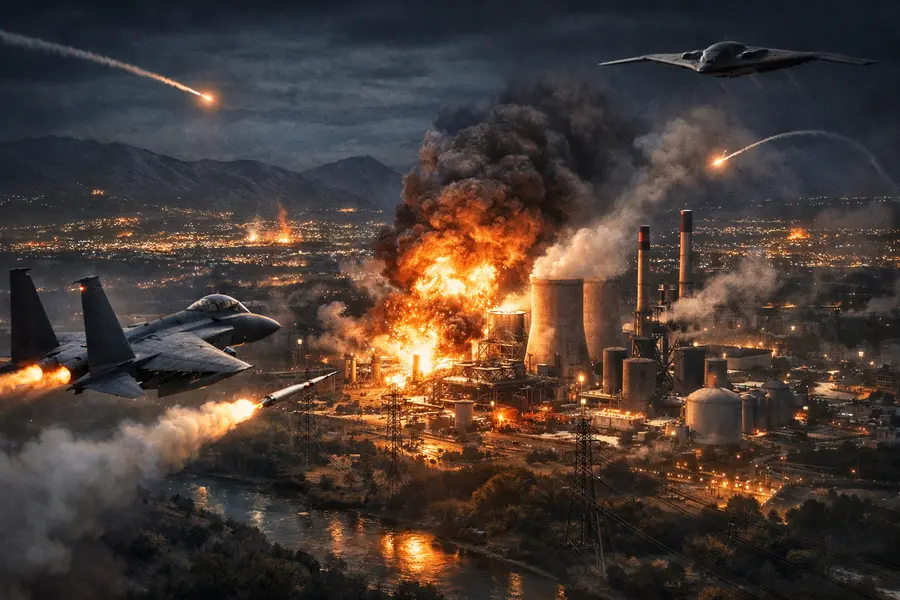
The United States conducted its fourth consecutive night of airstrikes against Iran on July 14–15, 2026, while reinstating a naval blockade and threatening to target the country's civilian power grid, sending Brent crude back above $87 per barrel.
- US airstrikes hit Iran military targets near Bandar Abbas and the Strait of Hormuz for a fourth straight night on July 14–15.
- Trump issued a direct threat to destroy Iran's power plants and bridges within one week unless Tehran returns to the negotiating table.
- The reinstated US naval blockade on Iran disrupts roughly 20% of global energy shipments through the Strait of Hormuz.
Lead
Washington resumed its military campaign against Iran early July 15, 2026, with a seventh-hour strike package that struck missile and drone installations, naval assets, and coastal defense systems concentrated around Bandar Abbas, the port city of Sirik, and Sistan and Baluchestan province. The operation represents the fourth successive night of US strikes since the June 2026 memorandum of understanding between President Donald Trump and Iranian President Masoud Pezeshkian collapsed on July 9. Combined with the reimposition of a maritime blockade announced July 13 and effective July 14 at 4 p.m. ET, the escalation marks the sharpest deterioration in the conflict since its outbreak on February 28, 2026.
What Happened
The latest air campaign targeted Iran's capacity to threaten commercial shipping through the Strait of Hormuz, striking military installations, drone and missile launch facilities, and naval platforms along the southeastern coast. Fighter aircraft, drones, and naval vessels delivered precision munitions across a seven-hour window beginning at 10 p.m. ET on July 14.
Simultaneously, the US military began enforcing a reinstated US naval blockade on Iran covering all vessels transiting to and from Iranian ports. The blockade exempts humanitarian cargo — food and medical supplies — subject to inspection, but applies broadly to commercial and energy shipments. The Strait of Hormuz accounts for roughly 20% of global energy supply in transit; tanker activity in the corridor has fallen to near-standstill.
The blockade was first imposed in April 2026 following the breakdown of talks in Islamabad, lifted on June 17 as part of the Trump-Pezeshkian agreement, and is now back in force. When first imposed in April, the Treasury Department estimated the measures cost Tehran approximately $500 million per day in foregone oil revenue.
Trump Iran Power Plant Threat
Speaking publicly on July 15, Trump issued his most explicit warning yet about broadening the campaign against civilian infrastructure. "Next week it gets really bad for them because next week comes the power plants," Trump stated. "We're going to knock out all their power plants. We're going to knock out all their bridges unless they get to the table and negotiate."
The Trump Iran power plant threat drew immediate condemnation from Tehran, whose foreign ministry described the ongoing US strikes as a "gross violation" of the June memorandum of understanding. Iran's chief negotiator Mohammad Bagher Ghalibaf said the country is prepared for "all-out defense" if Washington continues to breach agreed terms.
Targeting civilian power infrastructure would represent a significant legal and strategic escalation, raising questions under international humanitarian law and risking broader regional destabilization. Pakistan and Qatar are currently working to return both governments to a negotiating framework, though no new talks have been announced.
Middle East War Escalation: Background
The current Middle East war escalation traces to February 28, 2026, when US-Israeli airstrikes killed Iranian Supreme Leader Ali Khamenei and senior officials during what had been ongoing nuclear negotiations. The conflict has since seen multiple ceasefire attempts: a two-week pause brokered by Pakistan in April, a 60-day framework agreed June 12, and the Trump-Pezeshkian memorandum signed June 17.
That last agreement unraveled within weeks. On July 9, at a NATO summit in Turkey, Trump declared the ceasefire "over" and fresh US strikes resumed. Earlier strikes during the campaign struck the perimeter of the Bushehr Nuclear Power Plant and, by July 7, satellite imagery confirmed repair activity at several Iranian nuclear facilities targeted in the initial campaign — suggesting meaningful but incomplete degradation of Iran's nuclear infrastructure.
Market Reaction
Brent crude surged to $87 per barrel on July 15, its highest level since June, extending a rally of more than 10% from the prior Sunday as the ceasefire collapse became apparent. The reinstatement of the US naval blockade on Iran amplified energy supply concerns, with traders pricing in extended disruption to Persian Gulf export flows.Energy equities and defense contractors registered gains, while broader equity benchmarks reflected investor uncertainty over the trajectory of the conflict and its potential to widen. Global shipping rates for tanker routes around the Strait of Hormuz have risen sharply since the blockade's reimposition.
Strategic Context
The conflict has exposed the fragility of ceasefire architecture in a war neither side has been willing to end on the other's terms. Iran's insistence on continued maritime operations in the Gulf directly contradicts Washington's precondition — that Tehran halt disruption to commercial shipping — for any durable agreement. Trump's ultimatum on power plants introduces a new coercive lever, one designed to impose civilian costs on Iran's government without engaging in ground operations.
The threat is also a negotiating signal: by announcing the next escalation step explicitly and attaching a one-week deadline, the administration preserves diplomatic space while intensifying pressure. Whether Tehran treats it as credible will shape the next phase of the conflict.
Outlook
The US strikes on Iran on July 15 entered a fourth night with no diplomatic resolution in sight. The reimposed US naval blockade on Iran and Trump's explicit threat to target power plants and bridges signal that the administration is prepared to escalate further if negotiations do not resume. Brent crude at $87 per barrel reflects market assessment that the Strait of Hormuz disruption is structural, not transitory. Qatar and Pakistan's mediation efforts remain the primary near-term off-ramp, though the one-week timeline Trump attached to his power plant ultimatum compresses the window considerably. Markets, shipping operators, and regional governments are now calibrating for the possibility of a broader infrastructure campaign beginning as early as the week of July 20.
Mentioned tickers: BNO, USO, XLE, LMT, RTX, NOC, GD, HII, TAN