Pomegra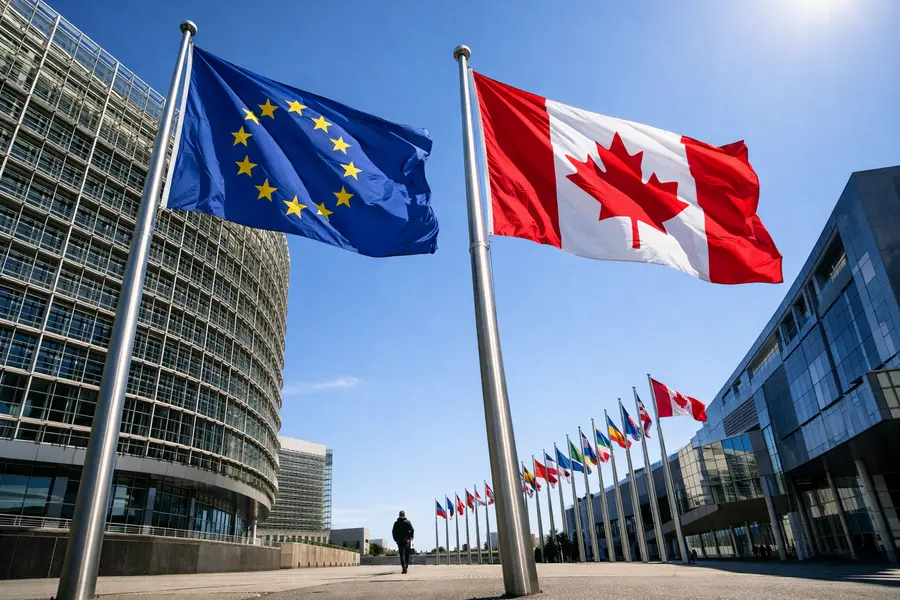
Von der Leyen named Canada as the EU's first-ever associate member in Strasbourg, marking a structural geopolitical break from the postwar Atlantic trade order.
- Von der Leyen proposed an unprecedented "associate member" designation for Canada on Sept. 16 -- a legal category that does not yet exist in EU treaty law.
- Bilateral EU-Canada trade in goods and services reached €130 billion in 2025, up 80% since 2016; the new alliance would expand into defense, AI, critical minerals, and Arctic governance.
- Trump's threatened 50% tariffs on Canadian vehicles from January 2027, combined with annexation rhetoric, drove Ottawa to accelerate its pivot toward European institutional frameworks.
Lead
European Commission President Ursula von der Leyen stood before the European Parliament in Strasbourg on Sept. 16, 2026, and extended an offer with no precedent in seven decades of European integration: Canada, she announced, should become the EU's first associate member. Canadian Prime Minister Mark Carney, seated to her left in the chamber, had flown to Strasbourg for the annual State of the Union address as US-Canada trade talks collapsed and President Donald Trump threatened 50% tariffs on Canadian vehicle exports starting January 2027. "I would like to work with you on opening the door for Canada to be the first associate member of the EU," von der Leyen told Carney directly, framing the invitation as a move beyond the existing Comprehensive Economic and Trade Agreement (CETA) toward what she called an "Alliance for the Future" -- a shared economic and security space spanning advanced manufacturing, defense production, energy, critical minerals, artificial intelligence, quantum technology, cybersecurity, and Arctic governance.
What Does 'Associate Member' Actually Mean?
The category does not exist. No article in EU treaty law defines associate membership for a non-European state, and no historical precedent offers a template. What von der Leyen proposed is the creation of an entirely new institutional tier -- one that could redefine the EU from a geographically bound bloc into an alliance organized around shared democratic values and strategic interest. The precise legal architecture will require treaty negotiation and unanimous ratification by all 27 member states, a process that historically spans years. The EU-Canada Summit, scheduled for October 29-30 in Montreal, is the earliest venue where the formal parameters of associate membership may begin to take shape.
What Would the Alliance for the Future Cover?
The proposed framework encompasses seven pillars: advanced manufacturing, defense production, energy security, critical raw materials, artificial intelligence, quantum technology, and Arctic governance. The trajectory of the partnership is already visible in concrete steps taken before Wednesday's address. In February 2026, Canada became the first and only non-European country granted access to the EU's €150 billion defense financing mechanism (SAFE), enabling participation in joint procurement of ammunition, drones, air and missile defense systems, and space technologies. Canada signed a strategic defence and security partnership with the EU in June 2025 and has been cleared to participate in the EU's $1.25-trillion ReArm Europe Plan/Readiness 2030 initiative. Separately, the two governments are in active negotiations on a digital trade agreement to complement CETA. Total bilateral trade in goods and services reached €130 billion in 2025 -- an 80% expansion since CETA entered into force in 2017, with goods trade at €81.5 billion and services at €49 billion.
Why Did Canada Pivot Toward Europe?
The United States absorbs approximately 72% of Canadian exports, a concentration that became a structural vulnerability once Trump began weaponizing market access. Ottawa launched retaliatory tariffs of 15% to 50% on roughly 700 US imports worth €17.2 billion, effective September 8. Trump's January 2027 vehicle tariff deadline and his repeated public framing of Canada as a prospective "51st state" -- rejected by Carney's government as categorically non-negotiable -- closed off diplomatic space for a near-term US-Canada resolution. Carney's office welcomed von der Leyen's Strasbourg proposal, stating that Canada is deepening EU ties "to strengthen our sovereignty." Canada's position as the fourth-largest global producer of aluminum, nickel, and platinum, and the leading western supplier of critical minerals essential to European aerospace and the green transition, gives Ottawa substantial leverage in structuring the terms of any new partnership.
Geopolitical Dimension
Wednesday's announcement crystallizes a structural realignment that took form after Trump returned to the White House. NATO allies that spent decades anchoring security and trade within a US-led architecture are recalibrating toward deeper intra-allied economic integration outside Washington's direct influence. Canada's associate membership bid -- if realized -- would mark the first time a major non-European democracy formally embedded itself in EU institutional frameworks. Several EU member states are reported to be cautious about provoking a White House reaction, and the ratification path through 27 national parliaments will be neither swift nor certain. The announcement nonetheless shifts the center of diplomatic gravity: Canada enters the Montreal summit not as a trading partner at arm's length but as a prospective institutional partner of the world's largest single market.
What Comes Next for EU-Canada Ties?
The October 29-30 Montreal summit is the next formal checkpoint. Negotiators there are expected to begin outlining the legal basis and scope of associate membership, alongside progress on the digital trade agreement and expanded defense procurement cooperation. Any treaty-level change requires unanimous member-state approval -- a multi-year undertaking. In the near term, the Strasbourg declaration itself carries diplomatic weight: it signals to markets, governments, and multilateral institutions that the postwar assumption of a stable, US-anchored Atlantic trade order is being actively renegotiated.
Outlook
Von der Leyen's Sept. 16 offer to Carney represents a structural break from the postwar pattern of Atlantic economic organization. Whether associate membership becomes a legal reality hinges on EU member-state consensus, treaty negotiations, and the trajectory of US-Canada relations. The October Montreal summit sets the first concrete deadline for translating the initiative into institutional architecture. With Trump's January 2027 vehicle tariff deadline closing in and Canadian exports still disproportionately exposed to US market access, the timeline pressure on both sides is acute.