Pomegra
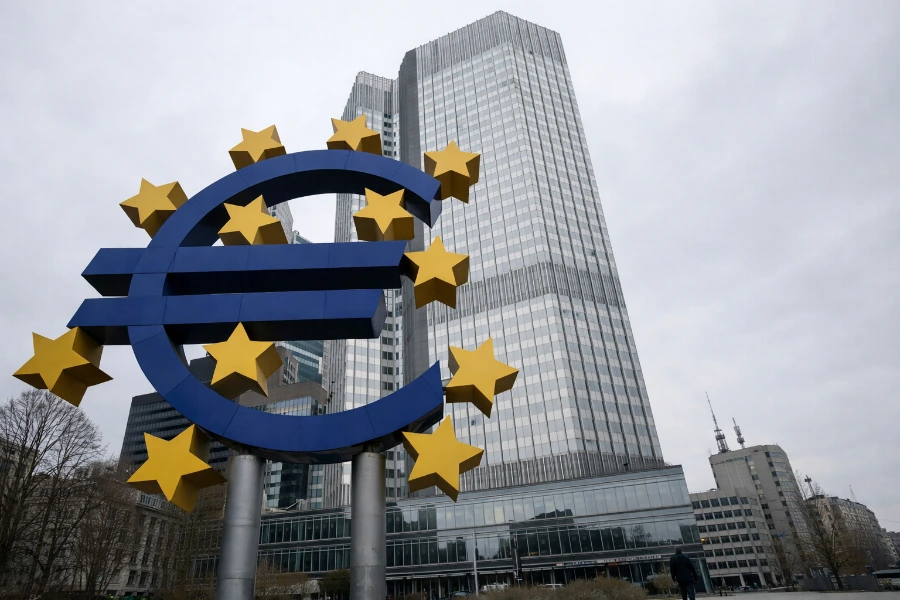
Euro-area leaders opened talks on the next ECB president on November 26, with Hernández de Cos and Klaas Knot the two candidates. A formal decision is targeted for the December 17-18 European Council summit.
- Euro-area leaders began talks on Lagarde's successor, with a formal appointment aimed at the December 17-18 summit.
- Spain's Pablo Hernández de Cos and the Netherlands' Klaas Knot are the two candidates.
- Lagarde leaves on February 7, 2027, with the ECB deposit rate at 2.5% and inflation at 3.8%.
Lead
Leaders of the euro area met on Thursday, November 26, to begin discussions on who will succeed Christine Lagarde as president of the European Central Bank. The field has narrowed to two names: Pablo Hernández de Cos, head of the Bank for International Settlements and a former governor of the Bank of Spain, and Klaas Knot, the former governor of De Nederlandsche Bank. Governments aim to reach a formal agreement at the European Council summit on December 17-18. The ECB's Governing Council meets on the same dates, so the ECB policy rate decision will be taken under Lagarde, who is still in office.
Why Is Lagarde Leaving Early?
Lagarde announced on October 29 that she will step down on February 7, 2027, about nine months before her eight-year term ends. The ECB gave no official reason. The timing lets leaders choose a successor before France's presidential election in April 2027. That vote could change the political make-up of the European Council and complicate a deal on the post.
Lagarde made the announcement at the meeting where the ECB held its deposit rate at 2.5%. It had raised rates twice in 2026, most recently in September. Inflation stood at 3.8%, nearly double the 2% target, driven by rising energy prices.
Who Are the Candidates?
Hernández de Cos has led the BIS since mid-2025. He chaired the Basel Committee on Banking Supervision and served on the ECB Governing Council while running the Bank of Spain. Spain is expected to put him forward formally. Knot governed the Dutch central bank for 12 years and is regarded as a policy hawk, a profile that fits an ECB fighting energy-driven inflation. The Netherlands has already said it will propose him.Other names, including France's Laurence Boone and economist Markus Brunnermeier, have been mentioned in the debate. The talks are now centred on the two nominated candidates.
How Will the Appointment Be Made?
The appointment follows a multi-step EU procedure. Leaders first reach a political agreement. The Council then issues a recommendation, and the European Parliament and the ECB's Governing Council are consulted. The European Council makes the final appointment by qualified majority.
The presidency is one of three Executive Board seats being decided. Chief economist Philip Lane of Ireland and Germany's Isabel Schnabel are also due to leave, so leaders are negotiating a package that balances nationality, gender and policy orientation. Board vacancies have often been settled through such trade-offs.
What Does the Succession Mean for the ECB Policy Rate?
The succession will not alter the near-term rate path. Money markets price a high probability of another 25 basis point increase on December 17, and several Governing Council members, including the heads of the German and Italian central banks, have signalled that a move may be warranted. Lagarde said policymakers are reviewing the indicators to judge whether a hike is needed.
The longer-term effect depends on the nominee's reputation. A hawkish choice such as Knot would signal continuity in the fight against inflation. A candidate with a financial-stability and supervisory background, such as Hernández de Cos, would stress the tightening in financing conditions that the ECB cited in October as a drag on growth.
Market and Political Context
The ECB governs monetary policy for 20 economies, so the choice of president affects borrowing costs for mortgages, business loans and savings across the euro area. Energy-driven inflation has kept the ECB's decisions under scrutiny, and the central bank has said energy prices pose upside risks to inflation and downside risks to growth.
The early announcement was meant to reduce uncertainty, and a December decision would leave about seven weeks between the appointment and Lagarde's exit for a handover.
Outlook
Euro-area leaders have started the process, and the formal decision is aimed at the December 17-18 summit, the same days the ECB decides on rates. Hernández de Cos and Knot remain the two candidates, and the outcome will depend on how the three open Executive Board seats are distributed. Lagarde stays in office through the December rate decision and leaves on February 7, 2027.
Mentioned tickers: none