Pomegra
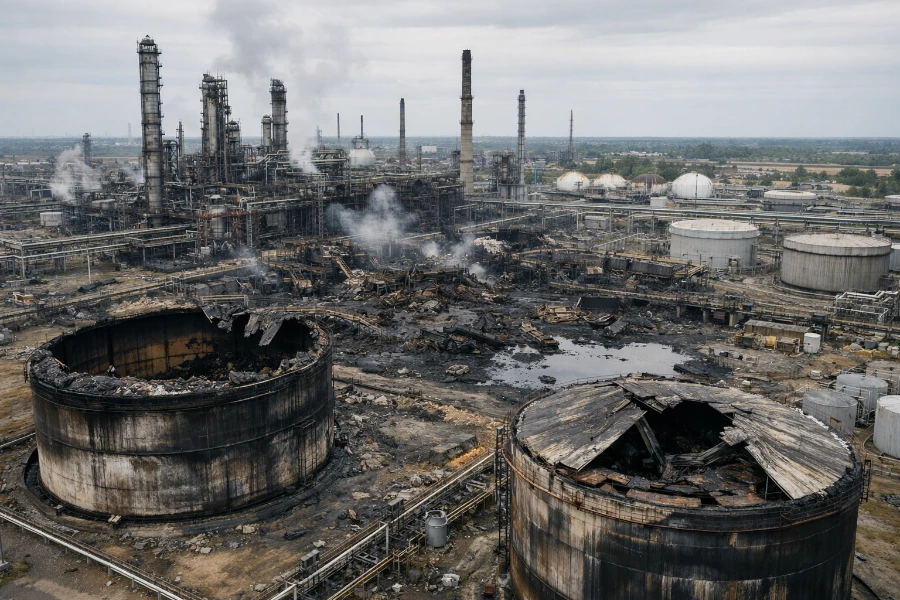
Ukrainian drones struck three more Russian refineries, including Novoshakhtinsk, which halted operations. Russian refining runs are down about 45% since late October.
- Ukraine hit the Kuibyshev, Syzran and Novoshakhtinsk refineries overnight, and Novoshakhtinsk suspended operations.
- Russian crude processing has fallen about 45% since late October under sustained drone attacks.
- Brent settled near $94.61 on Nov. 25, with Middle East disruption the main price driver.
Lead
Ukraine struck three Russian oil refineries in an overnight drone assault reported on Nov. 25. The Novoshakhtinsk refinery in the Rostov region suspended operations. Fires broke out at two Rosneft (MOEX: ROSN) plants in the Samara region, Kuibyshev and Syzran. Russian refining runs have fallen about 45% since late October. That is the steepest sustained loss of processing capacity since Kyiv began its long-range campaign against Russian energy infrastructure.
What Happened at the Three Refineries?
Three Russian refineries were hit in a single overnight wave: Kuibyshev and Syzran in the Samara region, and Novoshakhtinsk in the Rostov region. Kuibyshev has annual capacity of about 8.8 million tonnes and Syzran about 8.5 million tonnes. Both belong to Rosneft.
Novoshakhtinsk absorbed the heaviest attack. The regional governor said the plant came under more than 50 drones and missiles over roughly six hours and suspended operations. It is the only refinery in the Rostov region and one of the largest fuel suppliers in southern Russia, with capacity of about 7.5 million tonnes a year.
The plant had already been struck on Nov. 23. Ukraine's General Staff said that attack damaged a bitumen unit, the atmospheric-vacuum distillation column, a reboiler furnace and the tank farm. It also destroyed a Pantsir air defense system and an electronic warfare system protecting the site. On the same night Ukraine hit the Lukoil (MOEX: LKOH) refinery in Perm, damaging three processing units, and a pumping station feeding the Druzhba pipeline network.
How Much Russian Refining Capacity Has Been Lost?
Russian refining runs are down about 45% since late October. Repeated strikes have knocked out primary distillation units, the core of any refinery, and Russian operators have struggled to repair them quickly. Replacement parts and specialized equipment are scarce under Western sanctions.
The campaign has moved from isolated strikes to a systematic effort. Targets now span the Krasnodar, Rostov, Samara, Perm and Ryazan regions, which cover southern, Volga and central Russian supply chains. Rosneft and Lukoil, the two largest producers, are both affected.
Russia's government has previously restricted gasoline exports to protect its domestic market. The renewed attacks raise concerns about its ability to keep exporting diesel, its main refined product sold abroad.
Why Did Oil Prices Barely React?
Oil prices were driven mostly by Middle East events, not by Russian refinery outages. Brent crude settled up about 3.5% at $94.61 a barrel on Nov. 25 after Yemen's Houthis said they had attacked Saudi Arabia's largest oil refinery. Traders also weighed disruptions around the Strait of Hormuz against a projected global supply surplus.
The crude oil price remains well below its early November level. Brent closed at $98.29 on Nov. 5 after tanker attacks and traded near $92.46 on Nov. 19. Losing Russian refining capacity does not remove crude from the global market. Russian crude that cannot be processed at home is more likely to be exported, which adds to supply. The immediate pressure falls on refined products such as diesel and gasoline.
Economic Channels and Geopolitical Dimension
The strikes pressure Russia in three ways:
- Domestic fuel supply. Lower runs tighten gasoline and diesel availability, especially in the south, where Novoshakhtinsk is a key supplier.
- Export earnings. Reduced diesel exports cut hard-currency revenue that supports the federal budget.
- Military logistics. Fuel shortages complicate supply for Russian forces, although the military is typically prioritized over civilian buyers.
Ukrainian President Volodymyr Zelenskyy has described the deep strikes as "long-range sanctions." He frames them as retaliation for Russia's attacks on Ukrainian energy infrastructure. Russia launched 112 drones at Ukraine overnight, and Ukrainian air defenses downed 88. At least seven people were killed across six regions.
The pattern is a reciprocal energy war. Each side targets the other's power, fuel and refining systems as winter demand rises. Ukraine's strikes hit a Russian economy that depends heavily on energy revenue, while Russian strikes aim to degrade Ukraine's grid and heating systems.
What Comes Next for Russian Fuel Markets?
Russian fuel markets will likely tighten further over the next three to six months. Repairing a distillation unit typically takes weeks to months, and repeated strikes on the same sites such as Novoshakhtinsk delay restarts. Russia can offset part of the loss by cutting product exports and drawing on stocks. It cannot offset a 45% decline in runs without sharper domestic shortages or lower exports.
Three variables will shape the outcome:
1. Repair speed. How quickly damaged units return to service at Novoshakhtinsk and Perm. 2. Air defense. Whether Russia can protect refineries against sustained mass attacks. 3. Diplomacy. Whether any energy-infrastructure moratorium emerges. None is in place, and the strikes continue.
For global markets, the larger effect is on refined product spreads, particularly diesel. Crude prices will stay tied to Gulf supply risks and the outlook for a surplus in 2027.
Outlook
Ukraine's attacks on Kuibyshev, Syzran and Novoshakhtinsk extend a campaign that has cut Russian refining runs by about 45% since late October. Crude prices are being set by Middle East disruption, with Brent near $94.61, while the Russian impact shows up in diesel and gasoline supply. Further strikes are likely as long as the energy war continues.
Mentioned tickers: ROSN, LKOH