Pomegra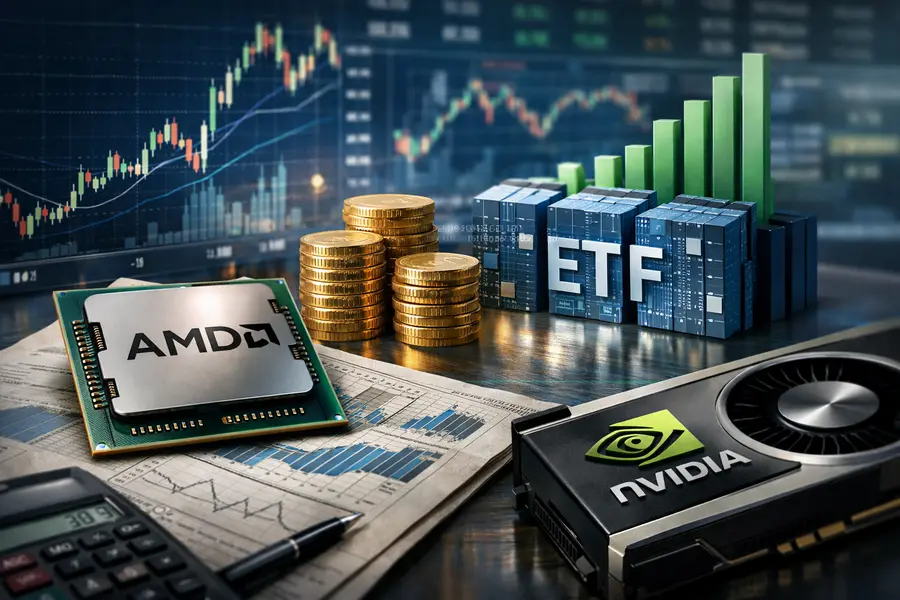
Advanced Micro Devices dethroned Nvidia as the largest holding in the iShares Semiconductor ETF after a 200%-plus twelve-month rally reshaped the AI chip trade.
- AMD stock holds an 8.51% weighting in SOXX, edging Nasdaq: NVDA at 8.35% after momentum-based rebalancing.
- AMD shares have surged more than 157% year-to-date in 2026, vastly outpacing Nvidia's roughly 5% gain.
- MU stock ranks third in SOXX at 7.73%, reflecting Micron's rise above a $1 trillion market cap in May 2026.
Lead
Advanced Micro Devices clinched the top position in the iShares Semiconductor ETF (SOXX), the world's largest chip-focused fund with roughly $45 billion in assets under management, displacing Nvidia (Nasdaq: NVDA) after a momentum-driven quarterly rebalance locked in AMD stock's dominant twelve-month price run. As of mid-July 2026, AMD commands an 8.51% share of SOXX against Nvidia's 8.35%, with Micron (MU stock) closing in at 7.73% and reinforcing a structural rotation that has spread the AI semiconductor trade well beyond its original single-name concentration.
What Happened
The shuffle at the top of SOXX traces directly to the fund's modified market-cap methodology, which ranks holdings by share-price momentum since the prior rebalance rather than raw market capitalization alone. That mechanism now works in AMD's favour.
AMD stock closed at $500.94 on July 16, 2026, pulling back roughly 17% from an all-time high of $580.91 reached on June 30. Even after that correction, AMD shares are up more than 157% year-to-date and have delivered more than 200% over the trailing twelve months. That pace of appreciation is what drove the weighting above Nvidia in the latest reshuffle. Nasdaq: NVDA, by contrast, has gained approximately 5% year-to-date despite reporting first-quarter fiscal 2027 revenue of $81.6 billion, an 85% year-over-year increase. Nvidia's share price reached an all-time intraday high of $235.47 in May before settling near $202 in mid-July trading. The divergence between Nvidia's fundamental momentum and its lagging stock-price performance in 2026 explains the positional swap: the business remains formidable, but the stock's appreciation rate has been slower than AMD's. MU stock tells a similarly striking story. Micron surged more than 240% during the second quarter of 2026 alone, briefly lifting the company above a $1 trillion market valuation for the first time in late May. Its SOXX weighting of 7.73% places it just behind the two leaders and reflects a broader recognition that AI infrastructure is as memory-intensive as it is compute-intensive.Market Context and ETF Mechanics
SOXX caps individual holdings at approximately 8% during quarterly rebalances to prevent excessive single-name concentration. That cap historically constrained Nvidia at a time when its market capitalization was expanding far faster than any peer. Now the same methodology is lifting AMD into first place based on recent relative performance.
The practical effect for institutional investors tracking the index is a marginal reduction in Nvidia exposure and a marginal increase in AMD exposure — shifts that can translate into meaningful dollar flows given the fund's $45 billion asset base. For active managers who benchmark against SOXX, the reweighting creates implicit pressure to realign portfolios accordingly.
Strategic Context: A Broadening AI Trade
The position swap reflects something larger than index arithmetic. For most of 2023 and 2024, the AI semiconductor trade was essentially a single-name story: Nvidia designed the graphics processing units that powered virtually all large-scale model training, and institutional capital followed. That concentration has unwound considerably.
AMD has established itself as a credible second-source supplier of AI accelerators. The company's MI300X series found traction among hyperscale cloud operators seeking supply-chain diversification, and the upcoming MI455X roadmap — alongside the Zen 6 Venice server CPU launch offering roughly 1.7 times the performance of its predecessor — extends AMD's competitive positioning into the next hardware cycle. A major industry event scheduled for late July 2026 is expected to formalize several of those product timelines. Micron (MU stock) benefits from a different but complementary dynamic. High-bandwidth memory, the dense DRAM stacked alongside AI accelerators in a single package, is in short supply relative to demand. Every additional AI server unit deployed — whether powered by Nvidia's H-series or AMD's MI-series GPUs — requires several HBM modules. Micron, alongside South Korean peers, is one of only three companies in the world capable of producing it. Nvidia's position remains structurally dominant. Its software ecosystem, including the CUDA programming environment and a library of optimised model-serving tools, has compounded over more than a decade and represents a switching cost that hardware comparisons alone do not capture. The company's revenue trajectory — 85% growth year-over-year at an $81.6 billion quarterly run rate — confirms that AI infrastructure capital expenditure is still accelerating. What has changed is not Nvidia's absolute importance but the market's willingness to pay a premium multiple for that importance relative to alternatives that are now shipping real silicon.What Comes Next
Near-term attention turns to AMD's product release cadence and whether the company can sustain the revenue growth necessary to justify a valuation that has expanded dramatically alongside its stock price. AMD shares remain approximately 14% below their June all-time high, a gap that suggests the market is pausing to assess execution rather than abandoning the thesis.
For SOXX and similar passive vehicles, the next quarterly rebalance will recalibrate weightings again based on relative price performance. If Nasdaq: NVDA shares outpace AMD stock over that interval — possible given Nvidia's earnings growth rate and any sustained rally in the broader market — the top position could flip back. MU stock's trajectory adds a third variable: if Micron's memory pricing cycle remains favourable, its weighting could challenge both leaders.